
Adobe Research's Agentic-DRS Beats Single AI Critics by 12 Points on Design Review
Adobe Research turns graphic design critique into a peer-review panel of specialist agents, hitting double-digit accuracy gains on a new 15-attribute benchmark.
 Pro
Takeaways
- Adobe Research proposes Agentic-DRS, a peer-review-inspired multi-agent framework for graphic design evaluation.
- A meta-agent orchestrates static reviewers (fixed attributes) and dynamic reviewers (context-specific concerns) built on GPT-4o or Gemini.
- GRAD retrieves in-context examples via graph matching using Wasserstein and Gromov-Wasserstein distances over design elements.
- Structured Design Description grounds MLLM reviewers with bounding-box-aware textual walkthroughs instead of raw XML metadata.
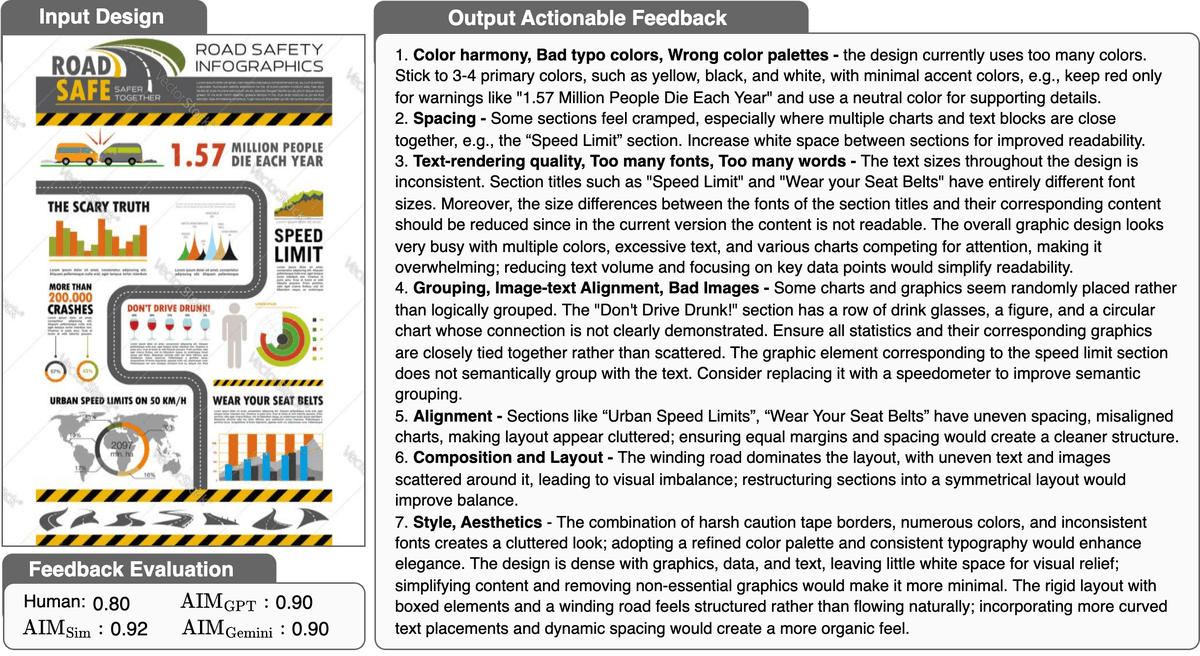
- New DRS-Bench covers 15 attributes across 4 datasets with actionable-feedback metrics validated by human raters.
- Agentic-DRS beats single-agent MLLM baselines by 10-15 accuracy points and correlates more strongly with human ratings.
Judging whether a poster or flyer actually works is stubbornly hard to automate. Alignment, typography, color harmony, whitespace, and vibe all matter, and a single model tends to fixate on one thing while missing the rest. A team from Adobe Research is proposing a fix that borrows a page from academic conferences: send the design to a panel of specialist reviewers, coordinated by a meta-reviewer, and aggregate their feedback. Their Agentic Design Review System (Agentic-DRS) does exactly that, and posts double-digit accuracy gains over strong single-model baselines.

Why single-shot design critique falls over
Judging whether a design is good or bad is hard and subjective as characteristics of designs are inherently tacit. Older methods split into two camps that both have obvious ceilings. Heuristic approaches try to mathematically quantify design characteristics like alignment, overlap and whitespace to give a score, but fail to see the overall global harmony of the designs. Learning-based scoring models, meanwhile, need large annotated datasets and typically collapse the answer into a single number that gives designers nothing to act on.
Multimodal LLMs like GPT-4o can already correlate with human ratings on some design principles, but one model wearing every hat tends to spread itself thin. The Adobe team's bet is that specialization plus orchestration beats a monolithic critic.
A meta-agent running a panel of specialists
The framework has three types of agents, all built on top of the same MLLM (they test both GPT-4o and Gemini-1.5-Pro):
- Static agents handle universally relevant attributes. These agents serve as the backbone of the evaluation system, ensuring that essential design attributes are consistently reviewed, covering things like typography, alignment, spacing, and color palette.
- Dynamic agents are spawned on the fly for design-specific concerns. These agents assess factors such as relative spacing, grouping, semantic effectiveness of communication, stylistic coherence, etc. which vary across different designs.
- Meta agent plans which agents to run, dispatches them, and consolidates their scores and comments into a final report. A consolidation mechanism, also managed by the Meta Agent, performs summarization, synthesizing feedback, resolving potential inconsistencies, and generating a unified evaluation report.
The whole pipeline runs in three phases: planning (meta agent picks reviewers), reviewing (each agent scores its slice), and summarization (meta agent merges everything into ratings plus actionable feedback).

Two tricks that make the agents design-aware
The novelty is not just the multi-agent structure, but how each agent is grounded before it starts critiquing. Two modules do the heavy lifting.
GRAD (Graph-based Design Exemplar Selection) retrieves similar reference designs from a library to use as in-context examples. Instead of matching designs by a single CLIP embedding, GRAD builds a graph where nodes are individual design elements (crops from bounding boxes, encoded with CLIP) and edges combine spatial distance (between bounding box centroids) and semantic distance (cosine between element embeddings). Similarity between two designs is then computed with a mix of Wasserstein distance (matching nodes across graphs, sometimes called optimal transport between element sets) and Gromov-Wasserstein distance (matching the relationships between pairs of nodes, which preserves graph topology). The best performance occurs at α=0.5, denoting the importance of combining semantic feature matching with structural similarities for improved in-context retrieval.
Structured Design Description (SDD) generates a textual walkthrough of the design that references bounding boxes explicitly, so the MLLM gets phrases like "a title 'ABC' at the top [coordinates], with an image of 'X' below it [coordinates]". Such textual descriptions are superior to merely feeding the raw metadata information (e.g., xml or json) and assists in anchoring the MLLM responses in a detailed visual description. An ablation confirms SDD beats dumping XML metadata directly, likely because LLMs read prose better than markup.
DRS-Bench: a 15-attribute benchmark
To evaluate all this, the authors built DRS-Bench, which spans four datasets and 15 attributes covering things like text rendering, too many fonts, color harmony, alignment, spacing, grouping, and aesthetics. The datasets are:
- GDE: 700 banner and poster designs with continuous 1-10 ratings on alignment, overlap, and whitespace.
- Afixa: 71 designs with yes/no labels across 5 attributes.
- Infographic: 55 samples with layout metadata and yes/no labels across all 15 attributes.
- Internal Design Dataset (IDD): 137 professionally curated flyers, invitations, and posters with layout metadata.
Feedback quality is scored with an Actionable Insights Metric (AIM), which comes in three flavors: semantic similarity between the generated feedback and ground-truth problems, and LLM-as-judge scores using GPT-4o and Gemini.
What the numbers look like
The gains over vanilla single-agent MLLMs are substantial. On the Afixa dataset, Agentic-DRS with GPT-4o hits 75.29% accuracy versus 62.91% for GPT-4o alone, a jump of over 12 points. Similar deltas show up across Infographic and IDD, and Pearson correlation with human ratings on GDE rises from 0.597 to 0.722 for alignment. The ablations tell a clean story: GRAD alone lifts scores a few points, SDD adds another few, and stacking both plus the full agent panel produces the biggest bump. The best α for mixing Wasserstein and Gromov-Wasserstein sits at 0.5, and GRAD hits its peak with just 4 in-context examples, fewer than random or CLIP-global baselines need.
Where it struggles, and what's missing
The paper is honest about the limits. In the failure-case appendix, the authors show that small perturbations in alignment slip past the reviewers even when humans catch them, suggesting the visual encoders still lack pixel-level sensitivity. The system also inherits whatever biases the underlying MLLM brings, and it depends on layout metadata (bounding boxes) to hit its best numbers, though GRAD's box-free graph variant using CLIP patch features still works.
A few practical caveats worth flagging:
- Every design goes through several MLLM calls (planning, per-agent reviews, summarization), so latency and cost scale with the number of agents.
- SDD adds an extra MLLM pass to generate the description before any review happens.
- There is no public code or model release mentioned; the paper points to a project webpage, and the framework itself is defined algorithmically in the paper.
The natural next step, which the authors flag explicitly, is closing the loop: feeding the generated critique back into a design-editing model so the system doesn't just grade the poster but rewrites it. If that lands, tools like Canva, Figma, or Adobe Express get a plausible path to an always-on design reviewer that also fixes what it flags.