
ADLA Beats Specialized AI Detectors on Two Line Detection Benchmarks at Once
A new algorithm unifies generic and wireframe line segment detection under one framework, beating specialized detectors on both benchmarks with minimal parameter tuning.
 Pro
Takeaways
- ADLA is a new line segment detector that handles both generic and wireframe tasks in one framework.
- It grows segments from edge strength maps using orientation coherence plus bounded orthogonal distance to a line.
- Line parameters are dynamically refined as pixels are aggregated, improving geometric accuracy.
- Beats prior state of the art on YorkUrban-LineSegment, ShanghaiTech, and YorkUrban benchmarks.
- Roughly 2 to 4 percent higher FH than DT-LSD and LINEA on wireframe detection.
- Source code will be released on acceptance; built on top of EdgeNAT edge detector.
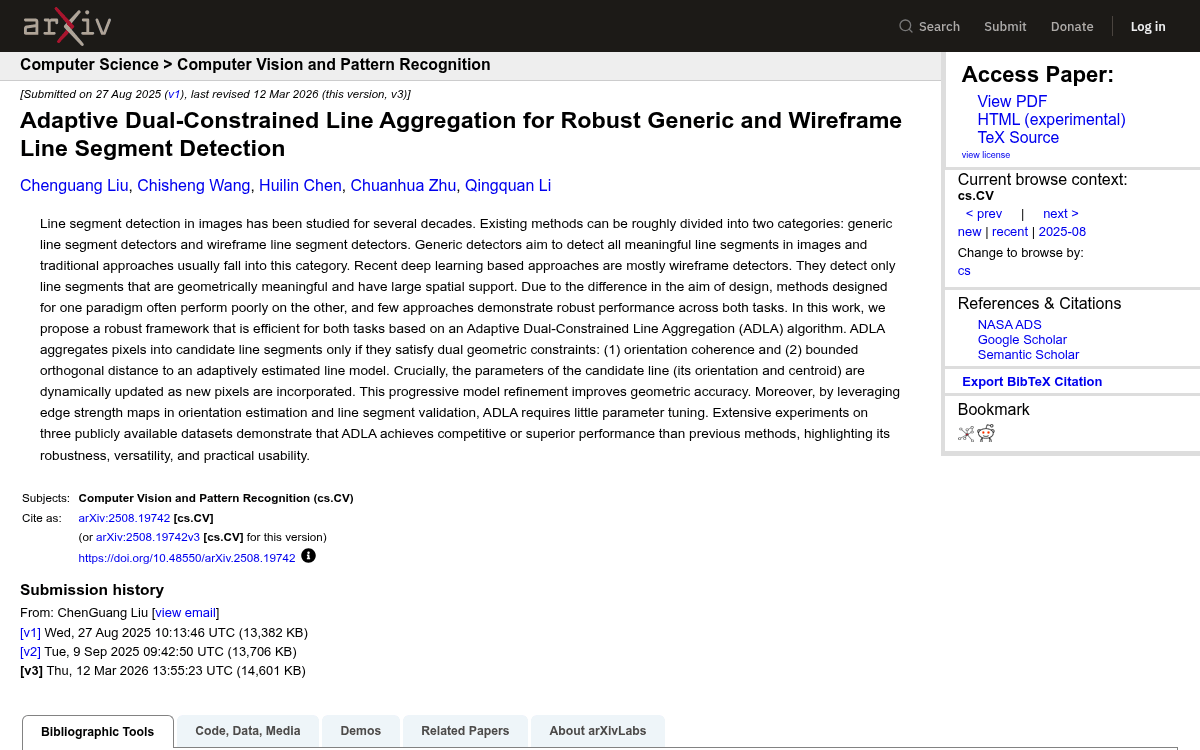
Line segment detection has quietly split into two camps that rarely talk to each other. Classical detectors like LSD try to find every meaningful straight edge in an image. Modern deep learning detectors focus almost exclusively on wireframes, meaning only the line segments that describe scene structure such as building outlines or room corners. A new paper proposes Adaptive Dual-Constrained Line Aggregation (ADLA), an algorithm that handles both tasks with the same underlying method and posts state of the art numbers on both.
Two tasks that look alike but aren't
Generic detectors aim to find all meaningful line segments in an image, while wireframe detectors detect only line segments that are geometrically meaningful and have large spatial support. The gap matters in practice. A generic detector produces many false positives when judged against wireframe annotations, and a wireframe detector misses many true segments when judged against generic annotations.
The problem is that once you pick a paradigm you are usually locked in. Deep learning wireframe models trained on the ShanghaiTech dataset learn to ignore shadows, furniture, and irregular objects, so they cannot be repurposed as generic detectors. Traditional generic detectors like LSD or Linelet flood wireframe benchmarks with distractor segments. Notably, most recent deep learning wireframe detectors do not evaluate on the standard generic benchmark, the YorkUrban-LineSegment dataset.
The core idea: aggregate pixels with two geometric rules
ADLA operates on an edge strength map rather than a binary edge map, and it does not try to learn line segments end to end. Instead it grows candidate segments pixel by pixel around a seed, enforcing two constraints simultaneously:
- Orientation coherence. A pixel can join only if its estimated orientation matches the seed's orientation within an angular tolerance.
- Bounded orthogonal distance. The pixel's perpendicular distance to the current line model must stay within a few pixels.
The twist that gives the method its name is that the line model is not fixed. Instead of using a fixed reference point and line angle, these two parameters are dynamically updated as more pixels are aggregated to increase their accuracy. The reference point becomes the probability-weighted centroid of the aggregated pixels, and the line angle is recomputed from the principal axis of the pixel set. Update timing is controlled by a distance threshold that scales with the worst-case angular error given the discretized orientation bins.
How the pipeline runs end to end
- Edge strength map. The authors use EdgeNAT, a transformer-based edge detector, trained on BIPEDv2 for generic edges and on ShanghaiTech (with line annotations rasterized into wireframe edge maps) for wireframe edges.
- Per-pixel orientation. For each nonzero edge pixel, the algorithm sums pixel values along 16 discrete directions inside a 15 by 15 window and picks the direction with the maximum response as that pixel's orientation.
- Bin-ordered seeding. Pixels are bucketed into ten bins by edge strength. ADLA visits bins in descending order so strong edge pixels seed segments first.
- Region growing under dual constraints. From each seed the algorithm searches an s by s neighborhood, aggregates qualifying pixels, and refines the line parameters as the set grows.
- A contrario validation. A candidate is kept only if its size exceeds the minimum meaningful length derived from the Helmholtz principle, a classical false-alarm control originally used by LSD.
Numbers that hold up on both benchmarks
The evaluation uses the heatmap-based F1 score FH, which the authors argue captures localization accuracy better than the more common Structural AP because under Structural AP an endpoint can drift by roughly the square root of the tolerance and still be counted as correct, which can heavily distort a segment's angle.
| Dataset | Task | ADLA FH | Best prior |
|---|---|---|---|
| YorkUrban-LineSegment | Generic | 0.8665 | Linelet 0.8511 |
| ShanghaiTech | Wireframe | 0.8720 | DT-LSD 0.8515 |
| YorkUrban | Manhattan | 0.7297 | LINEA 0.6900 |
On ShanghaiTech, ADLA's FH is around 2 percent higher than DT-LSD and around 4 percent higher than LINEA, both recent transformer-based wireframe detectors. On the generic YorkUrban-LineSegment benchmark, deep wireframe detectors like HAWPv2, HAWPv3, ScaleLSD, DT-LSD and LINEA post high APH but very low ARH, meaning they detect far fewer true line segments because they were trained only on wireframes. ADLA keeps both scores high.
What is actually new
The headline is dual detection in one framework, but the deeper contributions are worth flagging:
- Progressive line refinement. Classical region-growing detectors like LSD estimate a line from the seed and lock it in. ADLA recomputes orientation and centroid from the growing pixel set, which reduces drift on long segments.
- Edge strength, not binary edges. Both orientation estimation and validation use continuous edge probabilities. This lets weaker but still meaningful pixels contribute if they align with a strong candidate line.
- Detector-agnostic. Because ADLA consumes an edge strength map, swapping EdgeNAT for a different edge model changes what the pipeline detects. Train the edge model on wireframe edges and you get a wireframe detector. Train it on all edges and you get a generic detector.
- Low parameter sensitivity. The performance of ADLA is not very sensitive to the choice of the seed threshold.
Where it falls short
The authors are upfront about the main weakness: compared with deep learning based wireframe line segment detectors, the line segments detected by ADLA are less structurally complete. In wireframe images a single ground truth segment may span across occlusions, and neural detectors that predict endpoints and junction connectivity can bridge those gaps. ADLA, being a grower over an edge map, tends to fragment there. It also depends heavily on the quality of the underlying edge detector.
Availability
Code is not out yet. The authors state that the source code will be released upon acceptance of the paper. Until then the arXiv HTML version is the primary reference, and the underlying edge model, EdgeNAT, is already public. For anyone building SLAM front-ends, vanishing point estimators, or geometric layout parsers, ADLA is worth watching because it suggests a single component can replace two specialized ones in the pipeline.