
Adelaide Researchers Replace Deep NeRF MLPs With a 125x Faster Linear Layer
New ECCV theory shows positional encoding hinges on stable rank and distance preservation, letting a single linear layer replace a deep MLP.
 Pro
Takeaways
- Adelaide team shows positional encoding is governed by stable rank plus distance preservation, not Fourier structure specifically.
- A Kronecker-product complex encoding lets a single linear layer replace a 4-5 layer MLP.
- On 2D image fitting, closed-form Gaussian encoding hits 26.69 PSNR in 0.18s vs 22.6s for RFF+MLP.
- 3D video reconstruction stays within 1 PSNR of deep MLPs while being roughly 10-100x faster.
- Random Fourier Features fall out as one specific point on the rank versus distance trade-off curve.
- Frequency-based complex encodings are rank-deficient under Kronecker; shifted Gaussian and triangle encoders work best.
Anyone who has trained a NeRF, an implicit image representation, or any other coordinate-based network knows the ritual: feed raw (x, y, z) into an MLP and it collapses into a blurry mess. The standard fix, popularized by Tancik et al., is to lift those coordinates into a bank of sines and cosines before the network ever sees them. A group from the Australian Institute for Machine Learning at the University of Adelaide has now published a paper arguing that the Fourier part of that recipe is not actually the point, and that swapping in a richer non-Fourier encoding lets you throw away most of the MLP behind it.
Why coordinate networks need help
Coordinate-MLPs are small fully connected networks that learn a signal, like a 2D image or a 3D scene, as a continuous function of position. Coordinate-based MLPs benefit, in terms of preserving high-frequency information, through the encoding of coordinate positions as an array of Fourier features. Without that lift, they suffer from a well-known spectral bias and simply refuse to fit fine detail.
The dominant explanation for why Fourier features work is the neural tangent kernel: the sinusoidal projection reshapes the NTK spectrum so the network can express high frequencies. Hitherto, the rationale for the effectiveness of these positional encodings has been mainly studied through a Fourier lens. In this paper, we strive to broaden this understanding by showing that alternative non-Fourier embedding functions can indeed be used for positional encoding. The catch with the Fourier view is practical: performance is sensitive to the sampled frequencies, and picking them is largely a stochastic art.
The real knobs: stable rank and distance preservation
The authors reframe positional encoding as sampling from a shifted basis function, where the shift is the coordinate. Under that lens, only two properties matter:
- Stable rank of the embedding matrix, defined as the squared Frobenius norm over the squared spectral norm. Higher rank means better memorization of training coordinates.
- Distance preservation, meaning the inner product between two embedded coordinates should track their Euclidean distance. This is what gives you smooth generalization to unseen positions.
Their performance is entirely determined by a trade-off between the stable rank of the embedded matrix and the distance preservation between embedded coordinates. Random Fourier Features turn out to be one specific point on that trade-off curve. The paper shows that a Gaussian embedder with standard deviation sigma has stable rank min(N, 1 / (2 sqrt(pi) sigma)), and that Gaussian and RFF are equivalent whenever their sigmas satisfy sigma_g * sigma_f = 1 / (2 sqrt(2 pi)).

Trading depth for a bigger embedding
The more surprising contribution is a scheme called complex encoding. In the usual setup you concatenate 1D encodings across axes, then rely on a deep MLP to mix them, because concatenation caps the effective rank of a 2D image reconstruction at 2. Instead, the authors build the multi-dimensional embedding as a Kronecker product of the 1D encodings. That gives:
Rank(Psi(x) ⊗ Psi(y)) = Rank(Psi(x)) * Rank(Psi(y))The embedding is huge on paper, but on a regular grid you never materialize it. Using vec-Kronecker identities, a naive O(N²K²) cost drops to O(NK(N+K)) compute and O(2NK + K²) memory. Once the encoding has full rank, a single linear layer suffices, and the weight matrix has a closed-form least-squares solution instead of requiring SGD.
What the numbers look like
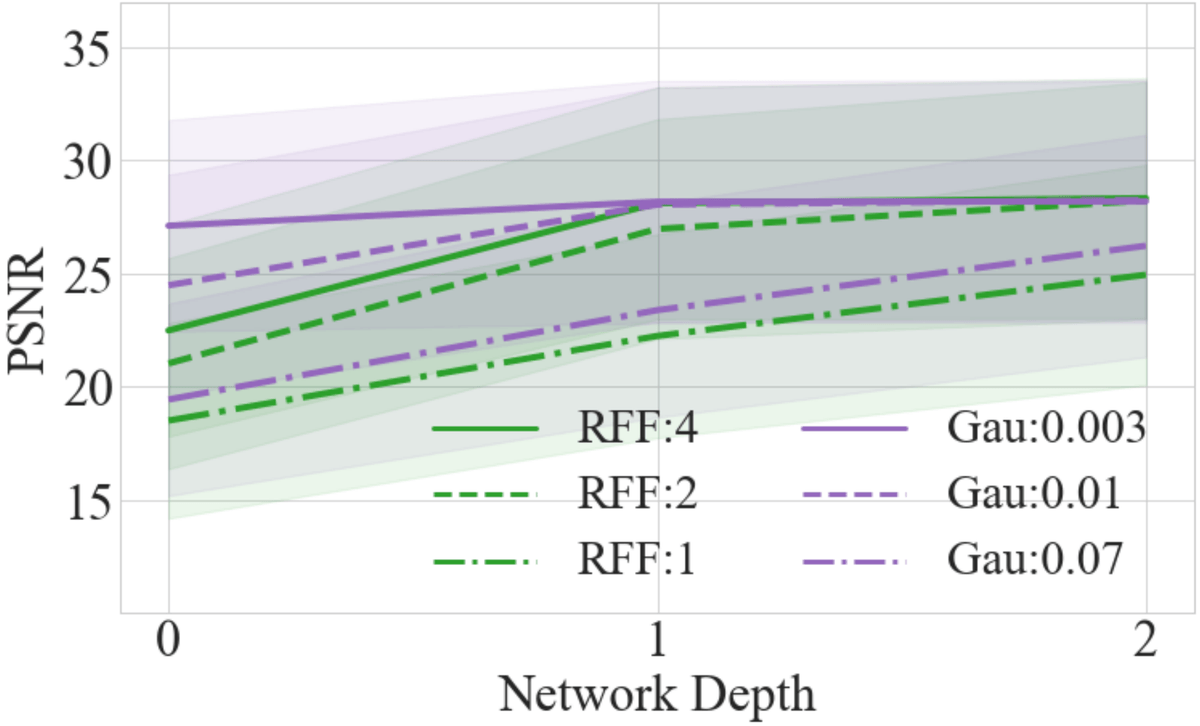
On the 32-image dataset from Tancik et al., using 512x512 natural images and 2000 epochs of training, the trade-off pays off dramatically. A single linear layer on top of complex Gaussian encoding matches or beats a 4-layer MLP with simple Fourier encoding, at a fraction of the runtime:
| Setup | PSNR | Time (s) |
|---|---|---|
| Simple RFF + 4-layer MLP | 26.58 | 22.62 |
| Simple Gaussian + 4-layer MLP | 26.17 | 23.12 |
| Complex Gaussian + linear (SGD) | 26.69 | 2.01 |
| Complex Gaussian + linear (closed form) | 26.69 | 0.18 |
That is roughly a 125x speedup for the closed-form variant at equal or better reconstruction quality. On 3D video reconstruction, complex encoding with a single linear layer stays within ~1 PSNR of a 5-layer MLP while being about 10x faster on non-separable coordinates and ~100x faster with closed-form solves.
Where it shines and where it does not
The method is clearly useful when you are fitting a signal to network weights, that is, instance-based optimization: image compression, video overfitting, volumetric fitting, and NeRF-style setups where every scene gets its own model. On separable grids you get a closed-form solution, which is essentially free. On non-separable coordinates, a sparse blending matrix interpolates from a virtual grid, still much cheaper than a deep MLP.
Two caveats stand out. Frequency-based complex encodings (LinF, LogF, RFF) turn out to be rank-deficient under the Kronecker construction and underperform the shifted Gaussian and triangle variants; the paper reports the LogF complex encoding as ill-conditioned. And the exponential blow-up in embedding dimension only stays tractable if coordinates are separable or nearly so, so genuinely irregular high-dimensional point clouds remain awkward.
Code and reproducibility
The authors released a reference implementation and a Colab demo on GitHub, along with a project page containing qualitative reconstructions for images and videos under separable and non-separable sampling. Complex encodings with only one single linear layer (without hidden non-linear layers) have comparable performance to simple encodings with deep non-linear MLPs (5 layer MLPs). Complex shifted encodings outperformed complex Fourier feature-based encodings.
The bigger takeaway beyond the speedup is conceptual. Positional encoding is not really about frequencies; it is a knob that controls a rank-versus-distance trade-off. That framing makes it easier to design new encodings with predictable behavior, and it explains, in one line, why RFF sigmas that are too low give blurry outputs and sigmas that are too high give noisy ones: you are sliding along the same trade-off curve.