
Adelaide Proves Robot AI Action Heads Are 50x Bigger Than Needed
A new study finds robot action generation backbones can be shrunk 51x with no performance loss, and the frozen weights never need to see a task.
 Pro
Takeaways
- Paper shows task knowledge in diffusion policies lives in the conditioning pathway, not the action backbone (arxiv)
- A frozen 5M-parameter MLP matches or beats a 244M U-Net on MimicGen and LIBERO, a 51x parameter reduction
- Two-stage recipe: pretrain backbone on observation-free forward-kinematics data, freeze it, then train only conditioning on task demos
- Modulation-based conditioning (FiLM, AdaLN, adaRMSNorm) enables decoupling; attention-based conditioning collapses to near zero
- Backbone pretrained on external DROID trajectories (no images) transfers directly and slightly beats in-distribution pretraining
- Suggests current VLA action experts (100M to 1B+ params) are one to two orders of magnitude oversized
Modern robotic manipulation policies have been getting bigger and bigger. Systems like π0, CogACT, GR00T-N1, and DexVLA all bolt a diffusion or flow-matching action head onto a vision-language model, and those action heads have ballooned from around 100M parameters into the billion-parameter range. A new paper from the University of Adelaide argues that almost all of that capacity is wasted, and provides a strikingly simple experiment to prove it.
The Decoupled Action Expert paper shows that the giant denoising network at the heart of these policies encodes essentially no task-specific knowledge. You can pretrain it once on generic joint-motion data, freeze it forever, and get performance comparable to training the whole stack end-to-end. Pushed further, a 5M-parameter MLP matches a 244M-parameter U-Net on standard manipulation benchmarks.
Why 300M parameters to output 160 numbers?
The starting point is a size mismatch that has quietly been ignored. Image diffusion models like Stable Diffusion denoise 16,384 structured latent values, while a manipulation policy generates only 160 physically correlated values. Yet action experts have inherited image-diffusion architectures (U-Nets, DiTs, flow-matching transformers) along with their scale.

The output of a manipulation policy is not just small, it is also physically constrained: adjacent time steps must be smooth, joint values are correlated, and only a handful of predicted steps are actually executed before the next replan. A manipulation policy generates only 16×10=160 action values in Diffusion Policy, of which only a fraction are executed before replanning (8 steps in DP, 5 in π0). The authors argue this raises an obvious question that nobody had systematically tested: is the giant backbone actually storing task knowledge, or is it just modeling generic trajectory shape?
The two-stage decoupling trick
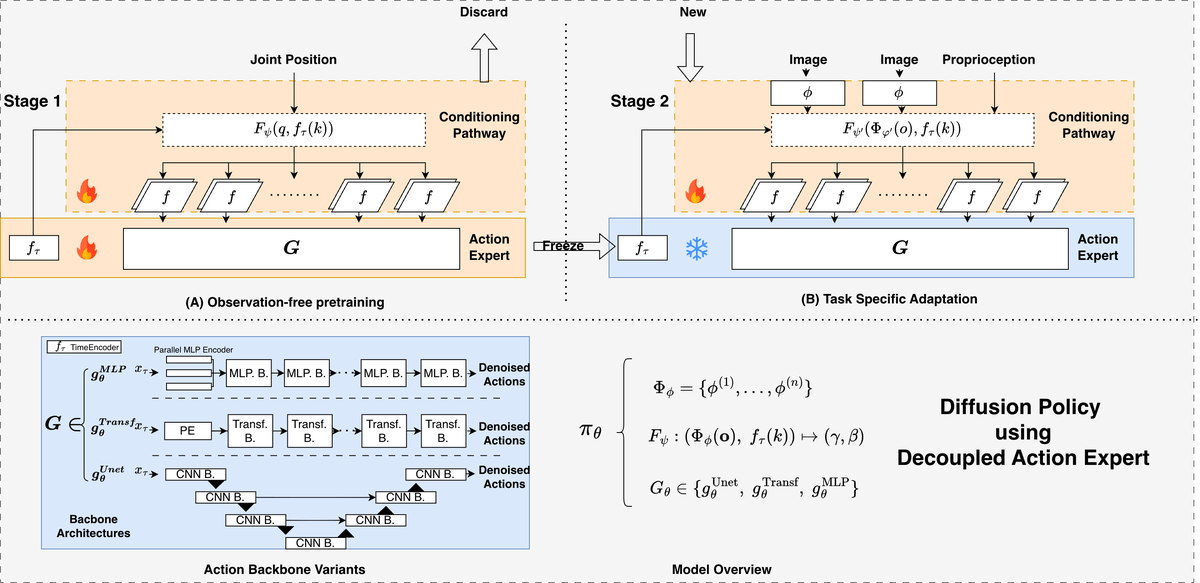
To answer that, the authors split a FiLM-conditioned Diffusion Policy into three parts: an observation encoder, a conditioning network that produces per-layer scale-and-shift parameters, and the denoising backbone itself. Then they train it in two stages:
- Observation-free pretraining. The backbone learns to denoise end-effector pose trajectories conditioned only on joint positions, derived via forward kinematics. No images, no task labels, no environment interaction.
- Task-specific adaptation. The backbone is frozen. A brand-new observation encoder and conditioning network are initialized from scratch and trained on the actual task demonstrations.
The logic is direct: if freezing the backbone still lets the policy learn new tasks, then the backbone wasn't holding the task knowledge in the first place. All the task-specific learning has to happen inside the conditioning pathway.
A frozen, task-blind backbone matches end-to-end training
The experiments run on two standard benchmarks. LIBERO consists of four suites (Spatial, Object, Goal, Long) testing spatial generalization, object transfer, semantic goals, and long-horizon reasoning, each with 10 tasks and 50 expert demonstrations per task. MimicGen contributes eight harder single-task settings with 1,000 demonstrations each.
On the CNN U-Net variant of Diffusion Policy (DP-C), the frozen decoupled backbone hits 62.2% average success on MimicGen versus 63.6% for normal end-to-end training, a 1.4-point gap. On LIBERO the gap is 2.5 points (76.8% vs 79.3%), concentrated in the harder Goal and Long suites. In other words, a network that has literally never seen a task image performs within noise of one trained the standard way.
The transformer variant (DP-T), which uses cross-attention conditioning, tells the opposite story. Under decoupling, its LIBERO score collapses from 76.4% to 5.9%. This is not a wash, it is a signal: the conditioning mechanism, not the backbone architecture, determines whether decoupling works.
The real breakthrough: where task knowledge actually lives
An ablation across seven conditioning mechanisms on the same transformer backbone isolates the cause. Under normal training, everything works roughly equally (56 to 64% success). Under decoupling, a clean split emerges:
- Modulation-based conditioning survives. AdaLN, AdaLN-Zero, adaRMSNorm, and FiLM keep their performance because scale-and-shift parameters flow through an external pathway. The backbone weights themselves are condition-independent.
- Attention-based conditioning collapses. Cross-attention and prefix tuning route conditions through the backbone's own Wq, Wk, Wv projections, so freezing the backbone locks in the Stage 1 input distribution.
This lines up with recent VLA design choices: π0.5 uses adaRMSNorm, GR00T-N1 uses AdaLN, DexVLA uses FiLM. The paper explains structurally why those choices matter beyond stability, they are what makes the backbone reusable.
A 5M MLP beats a 244M U-Net
If the backbone only models generic trajectory smoothness, then it should not need hundreds of millions of parameters. The authors test this with DP-MLP, a stack of residual FiLM-conditioned MLP blocks totaling about 5M parameters, a 51x reduction. Under normal training it scores 65.9% on MimicGen and 84.7% on LIBERO, actually beating the 244M U-Net's 63.6% and 79.3%. Under the decoupled recipe it retains 61.2% and 84.2%.
Two other ablations sharpen the picture:
- The conditioning signal in Stage 1 doesn't matter. Whether the backbone is pretrained conditioned on joint positions, on end-effector poses (a trivial identity mapping), or with no conditioning at all, downstream performance is statistically identical (62.2%, 63.8%, 62.2%). A randomly initialized frozen backbone, on the other hand, scores 0%. Pretraining is essential, but it just needs to expose the network to smooth trajectories.
- External trajectory data helps. Pretraining on DROID's roughly 76k real-world Franka trajectories, using only joint states and end-effector poses (no images, no task labels), matches or slightly beats in-distribution pretraining. Standard Diffusion Policy training cannot use this data at all because it needs paired observation-action tuples.
What this means for VLA design
The practical implications are concrete. Diffusion and flow-matching backbones are called repeatedly at inference (one forward pass per denoising step), so shrinking them directly cuts action-generation latency. If the finding transfers to full VLA systems, teams could keep a modest, general-purpose action head frozen across projects and only retrain the conditioning pathway per task, which is a much smaller optimization problem with far less data. It also suggests a fix for the observation from Physical Intelligence's team that large uninitialized action experts can destabilize VLA training through harmful gradient flows to the reasoning backbone: a pretrained, frozen action head sidesteps that pathology entirely.
The caveats are worth noting. All experiments run in simulation on MimicGen and LIBERO with Diffusion Policy as the testbed rather than a full billion-parameter VLA, and the paper does not report code availability at this time. Real-world validation and direct testing on systems like π0 or GR00T-N1 remain future work. But as a controlled study, it delivers a rare thing: a claim that current action experts are one to two orders of magnitude larger than they need to be, backed by an ablation clean enough to actually believe.