
AdaSwitch Beats Rival AI Training Methods by 11.8% With One Smart Handoff
A new knowledge distillation method lets small models explore freely, then hands control to the teacher exactly when the student hits its limit.
 Pro
Takeaways
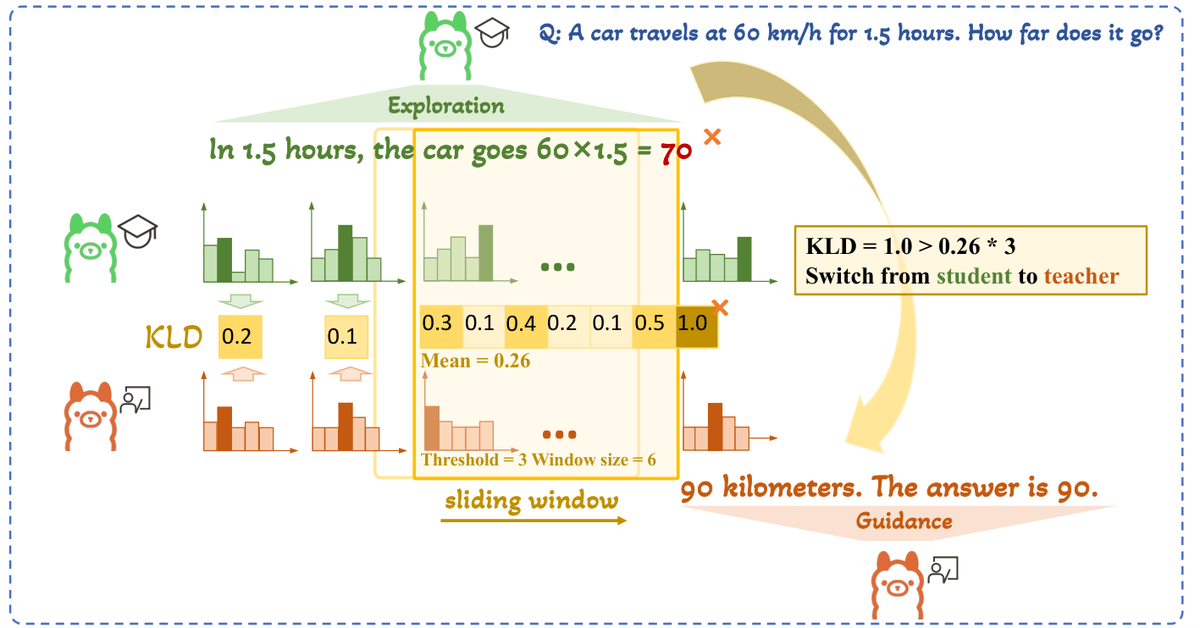
- AdaSwitch is a knowledge distillation method that switches once per sequence from student to teacher generation.
- Switch triggers when KL divergence exceeds K times a sliding-window average of recent divergences.
- Beats SKD and SWITCH on GSM by 7.2% (Llama) and 11.8% (Qwen) over second-best baselines.
- Tested with Qwen 2.5, Llama 3.1, and Gemma teacher-student pairs on GSM8K, GSM-Plus, DialogSum.
- Runtime is 1.2-1.4x pure on-policy training, roughly 10% faster than SKD and SWITCH.
- Full details in the arXiv paper; no public code released yet.
Training a small language model to punch above its weight usually means learning from a bigger teacher. Picking the right training signal has long been an awkward tradeoff: either you feed the student polished sequences it will never actually produce at inference, or you let it train on its own messy outputs and hope the teacher's corrections stick. A new paper called AdaSwitch proposes a cleaner way out with a single, well-timed handoff between student and teacher during generation.
The distillation dilemma in one paragraph
Knowledge distillation for language models splits into two camps. Off-policy methods use teacher-generated sequences or ground-truth data, giving rich supervision but suffering from a training-inference mismatch because the student never learns to recover from its own errors. On-policy methods train on student-generated sequences, aligning training with inference but often collapsing due to the low quality of the student's initial outputs, especially early in distillation.
Recent hybrids like SWITCH and SKD try to blend the two by flipping between student and teacher tokens inside a single sequence. The authors argue this creates a different problem: frequent, bidirectional switching disrupts the semantic coherence of generation, producing disjointed "chimera" sequences that satisfy neither model's distribution.

One switch, chosen adaptively
AdaSwitch replaces frequent alternation with a single, context-aware handoff. The student generates tokens on its own during an exploration stage. At each step, the framework measures how far the student's next-token distribution has drifted from the teacher's using KL divergence. Once that divergence blows past a moving threshold, the teacher takes over and generates every remaining token in the sequence.