
AdaFuse Cuts Dynamic LoRA Routing Overhead by 2.4x With One Kernel
Researchers pinpoint that GPU kernel launch overhead, not compute, is the real cost of dynamic LoRA routing, and fix it with a fused kernel.
 Pro
Takeaways
- AdaFuse cuts dynamic LoRA adapter decoding latency by 2.4x versus prior state-of-the-art routers. Paper
- Root cause identified: fragmented CUDA kernel launches from per-layer routing, not extra computation.
- Token-level pre-gating makes one global routing decision per token, staticizing the execution path.
- Custom SGMM kernel fuses LoRA merge and unmerge into batched GEMM tiles for full GPU utilization.
- Overhead drops from 250 to 950 percent down to just 29 percent over the backbone model.
- Accuracy holds at 60.12% general and 83.58% domain-specific across evaluated benchmarks.
Mixing Mixture-of-Experts routing with LoRA adapters looks great on paper: you get the flexibility of many task-specific experts without the training bill of full fine-tuning. In practice, the moment you turn it on, decoding grinds. A new AAAI 2026 paper called AdaFuse, from a team at Shanghai Jiao Tong University and Baidu, argues the slowdown is not really a computation problem at all, and proposes a kernel-level fix that cuts the overhead by more than half.
When adding almost no FLOPs still tanks your throughput
The integration of dynamic, sparse structures like Mixture-of-Experts with parameter-efficient adapters such as LoRA is a powerful technique for enhancing LLMs, but the architectural enhancement comes at a steep cost: despite minimal increases in computational load, inference latency often skyrockets. The authors measure decoding slowdowns of over 2.5x for conventional dynamic adapter setups, which is wildly out of proportion to the extra math being done.
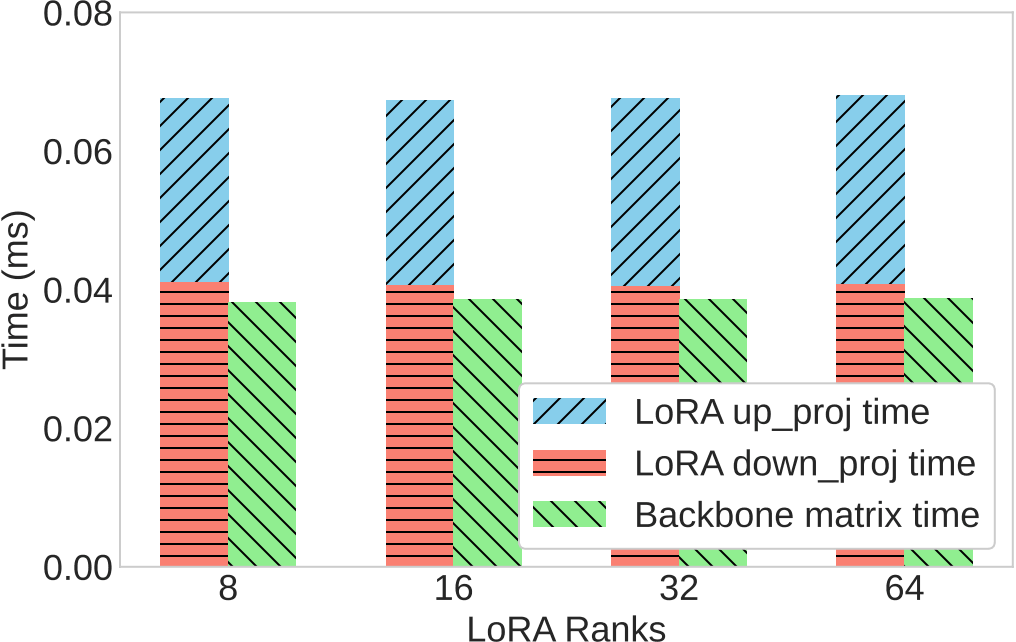
Their profiling traces the culprit to the GPU side of the stack. The primary bottleneck is not in the computation itself, but in the severe overhead from fragmented, sequential CUDA kernel launches required for conventional dynamic routing. Every transformer layer independently picks its experts, so each token drags a long tail of tiny kernel launches through the driver, and those small matmuls also underutilize the GPU's thread blocks.

Decide once, apply everywhere
AdaFuse's algorithmic move is to stop routing per layer. It employs a token-level pre-gating strategy, which makes a single, global routing decision for all adapter layers before a token is processed. This "decide-once, apply-everywhere" approach effectively staticizes the execution path for each token, creating an opportunity for holistic optimization.
Concretely, the Top-2 router consists of a lightweight linear transformation followed by a softmax activation and top-k selection mechanism, taking the hidden representation from the first layer as input and producing routing weights that determine expert activation. That single decision fixes which two LoRA experts will be active for every subsequent layer. Each expert is a standard LoRA module, with rank typically set to 64 or 128, depending on the model size and task complexity.

Fusing the switch into a single kernel
Once the route is known ahead of time, AdaFuse pre-merges the selected LoRA weights straight into the backbone before decoding the token, so inference looks almost identical to a plain LLM forward pass. The workhorse behind this is a new CUDA kernel called Segmented Gather Matrix Multiplication, or SGMM. The team observes that layer-by-layer merging operations can be handled concurrently, and adapts the SGMV kernel from Punica into a batched GEMM variant for merging and unmerging LoRA weights in one pass.
A few implementation details worth flagging:
- The addition operation within the SGMM kernel is performed in place, significantly reducing memory overhead.
- Inputs are arrays of pointers to the LoRA matrices and backbone matrices, storing the entries and the shape of each matrix segment.
- At launch, SGMM uses as many thread blocks as possible and divides the large matrix multiplication into GEMM tiles of the same shape, with a hardware-aware tiling scheme chosen for full thread-block utilization.
- The CUDA kernel is invoked k times instead of N (the total number of experts), and all LoRA adapters are concatenated before merging to further reduce kernel calls.
What the numbers say
AdaFuse achieves competitive accuracy of 60.12% general and 83.58% domain-specific while delivering a 2.4x decoding speedup over the fastest dynamic adapters, reducing the latency overhead from a typical 250 to 950 percent down to just 29 percent over the backbone model. In other words, dynamic routing goes from being a factor-of-several tax on decoding to a rounding error, without sacrificing the accuracy that made dynamic adapters interesting in the first place.
Where this fits, and where it doesn't
The real breakthrough here is less about a new algorithm and more about a systems-and-algorithm co-design that recognizes what modern GPUs actually punish. Layer-wise routing is theoretically appealing, but it's incompatible with the kind of large, contiguous matmuls that keep tensor cores fed. By trading a bit of routing flexibility for a static execution path, AdaFuse unlocks kernel fusion that was previously impossible.
Useful scenarios include:
- Serving a base LLM specialized across many domains with a bank of LoRA experts, where per-token routing latency dominates.
- Multi-tenant inference where you want dynamic expert selection without paying a decoding penalty.
- On-device or latency-sensitive deployments where the 250 to 950 percent overhead of conventional dynamic adapters is a non-starter.
Some limits are worth naming. The paper does not publicly release code or checkpoints alongside the preprint, so reproducing the SGMM kernel means re-implementing on top of prior work like LoRA-Switch and Punica's SGMV. Token-level pre-gating also assumes a single early decision is good enough; tasks where the ideal expert genuinely changes deep in the stack could lose a little accuracy relative to per-layer routers. And the gains are inherently decoding-side, so prefill-heavy workloads will see less benefit.
For anyone shipping MoE-plus-LoRA systems, the takeaway is blunt: before you blame your router or your adapter rank, profile your kernel launches. That's where the milliseconds are hiding.