
AdaAnchor Cuts AI Reasoning Tokens by 92% Without Losing Accuracy
A new latent reasoning method called AdaAnchor stops thinking when it converges, cutting reasoning tokens by 92% while gaining accuracy.
 Pro
Takeaways
- New paper AdaAnchor replaces token-level CoT with iterative refinement of latent anchor vectors.
- Adaptive halting monitors anchor stability and stops silent reasoning once dynamics converge.
- Cuts generated tokens by 92 to 93% versus standard reasoning baselines.
- Gains up to 5% accuracy over fixed-step latent refinement while using 48 to 60% fewer steps.
- Evaluated on GSM8K, SVAMP, MultiArith using Qwen2.5-1.5B and Llama-3.2-1B backbones.
- Accepted at ICLR 2026 LIT Workshop; targets efficient small-model reasoning deployments.
Chain-of-Thought prompting works, but it's expensive. Every intermediate reasoning token is another forward pass, another decoding step, another chunk of latency, and for simple problems the model often knows the answer before it finishes explaining itself. A new paper from Disha Sheshanarayana, Rajat Subhra Pal, Manjira Sinha, and Tirthankar Dasgupta, Thinking in Latents: Adaptive Anchor Refinement for Implicit Reasoning in LLMs, accepted at the ICLR 2026 LIT Workshop, proposes a way to move that reasoning entirely into the model's hidden states and to stop early once the hidden state stops changing.
The method, called AdaAnchor, does two things at once: it replaces verbose reasoning tokens with a small set of refined latent vectors, and it adds a convergence check that decides per example how much silent thinking is enough.
The token tax on reasoning
Latent reasoning is already an active research direction because token-level CoT has a cost problem. LLMs generate long human-like step-by-step rationales before arriving at final answers, and the length of these reasoning trajectories often far exceeds that of the final answers, which incurs substantial inference costs even for relatively simple tasks. Advanced methods typically attempt to compress reasoning trajectory length through post-training, but they remain decoding-intensive and fail to inherently mitigate the efficiency challenge.
The workaround has been to push computation into hidden representations and only emit a final answer. But most latent-reasoning approaches have a nagging hyperparameter: many latent reasoning methods depend on a fixed number of latent refinement steps at inference, adding another hyperparameter that must be tuned across models and datasets to balance accuracy and efficiency. A fixed step count wastes compute on trivial problems and underserves hard ones.

Anchors that quietly update themselves
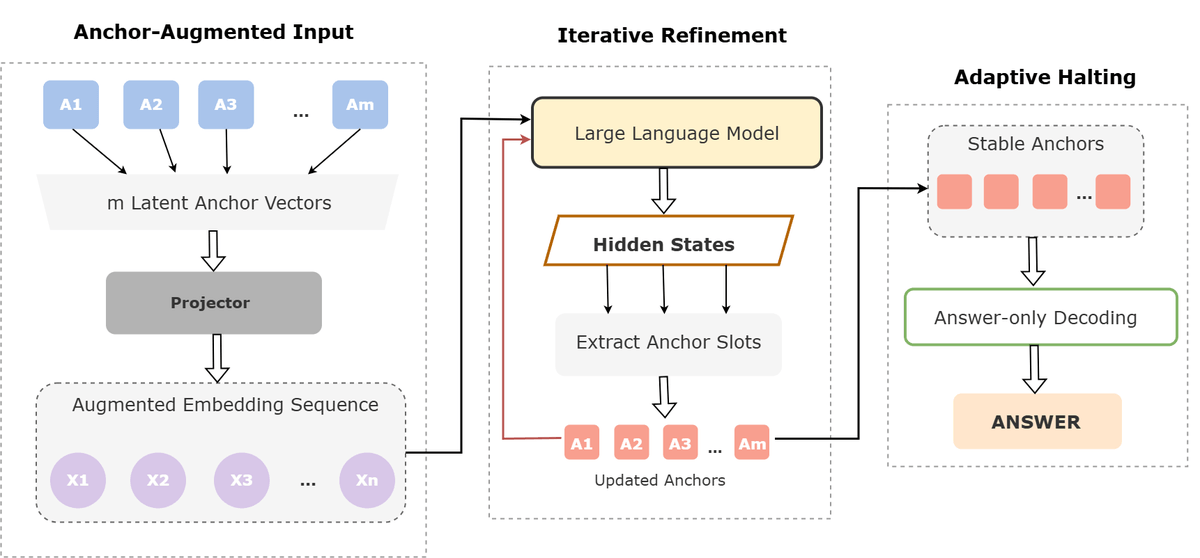
AdaAnchor attaches a compact set of learnable vectors, the anchors, to the input sequence. Instead of generating intermediate reasoning tokens, AdaAnchor updates these anchors using the model's hidden activations while keeping the output in an answer-only format. Each iteration is a silent refinement step: the anchors absorb information from the model's internal representations, then the refined anchors feed back into the next pass.
The clever part is when to stop. AdaAnchor tracks anchor stability across iterations and stops updating when the dynamics converge, thereby allocating computation on a per-instance basis. This enables instance-wise compute allocation under a shared maximum-step budget, so easier problems terminate quickly while harder problems receive additional refinement. Think of it as an adaptive computation time mechanism scoped to latent reasoning: if the anchor vectors have stopped moving between iterations, further refinement is unlikely to change the answer.
Training uses a standard answer-only cross-entropy loss plus a helper objective. In addition to the answer-only loss, the authors include an auxiliary anchor-alignment objective derived from coarse chunks of the rationale text, with dataset-dependent weighting. That auxiliary signal gives the anchors something to align against during training so they learn to encode reasoning structure, even though at inference the rationale text is discarded.
What the numbers say
The evaluation is small-model, math-word-problem focused. The team trains and evaluates on two backbone language models, Qwen2.5-1.5B and Llama-3.2-1B, across all experiments, focusing on small LMs where efficiency differences from latent refinement are easier to observe and measure reliably. Training uses approximately 7.47K examples from GSM8K and 700 from SVAMP, with test sets of 1.32K (GSM8K), 300 (SVAMP), and 600 (MultiArith) examples.
Baselines cover the natural comparison points:
- No CoT: direct answer generation without reasoning.
- CoT: full chain-of-thought rationales before the answer.
- iCoT: implicit chain-of-thought, which removes explicit reasoning traces while keeping an answer-only output format.
- Fixed-step latent refinement at a preset number of iterations.
The headline results: AdaAnchor with adaptive halting yields accuracy gains of up to 5% over fixed-step latent refinement while reducing average latent refinement steps by 48 to 60% under the same maximum-step budget. Compared to standard reasoning baselines, AdaAnchor achieves large reductions in generated tokens (92 to 93%) by moving computation into silent latent refinement, offering a different accuracy-efficiency trade-off with substantially lower output-token usage.

What it's actually useful for
The realistic use case is inference-cost-sensitive deployment of small models on constrained reasoning tasks. Cutting output tokens by roughly 92% translates directly into lower generation latency and lower serving cost, which matters most when small models are being used at scale for narrow reasoning tasks like arithmetic pipelines, structured extraction with light math, or agent tool-selection loops that don't need to expose a rationale to the user.
The limitations are visible from the setup. The evaluation is confined to mathematical word problems on sub-2B backbones, so there's no evidence yet about behavior on code, long-context reasoning, or frontier-scale models. Interpretability also takes a hit: silent latent refinement gives you an answer but not a human-readable trace, which is a problem if you need auditability or debugging. And the adaptive halting mechanism, while cheaper than a fixed budget, still requires training an auxiliary alignment loss against rationale text, so it isn't a drop-in inference-time trick.
The real contribution
The bigger idea underneath the numbers is that latent reasoning methods have inherited a hyperparameter problem from their token-based cousins: how many steps to take. AdaAnchor's answer is to let the model's own hidden dynamics decide. Convergence-driven adaptive halting improves the efficiency-accuracy trade-off relative to fixed-step refinement by avoiding unnecessary latent iterations, and stability-aware termination is a practical mechanism for controlling implicit computation and improving the deployability of latent reasoning methods.
That framing, stability of internal representations as a stopping signal, is more interesting than the specific numbers. It suggests a general recipe for any latent reasoning system: measure how much your hidden state is still moving, and stop when it settles.