
Ada3Drift Teaches Robots 12x Faster Without Losing Precision
A new one-step robotic policy moves iterative refinement into training, matching diffusion accuracy at 234 Hz on 3D point cloud inputs.
 Pro
Takeaways
- Ada3Drift is a one-step 3D visuomotor policy that matches or beats 10-step diffusion baselines on Adroit, Meta-World, and RoboTwin.
- Trick: move iterative refinement from inference to training via a drifting field that attracts predictions to expert modes and repels them from each other.
- Two adaptive pieces make it work in few-shot robotics: multi-temperature aggregation and a sigmoid schedule that starts with MSE and transitions to drift loss at 70% of training.
- Runs at 233.9 Hz on RTX 4090D (4.3 ms per action chunk), a 12.5x speedup over DP3, with 1 function evaluation instead of 10.
- On a physical Cobot Magic arm, achieves 79% average success across 5 tasks vs 68% for DP3 and 69% for MP1.
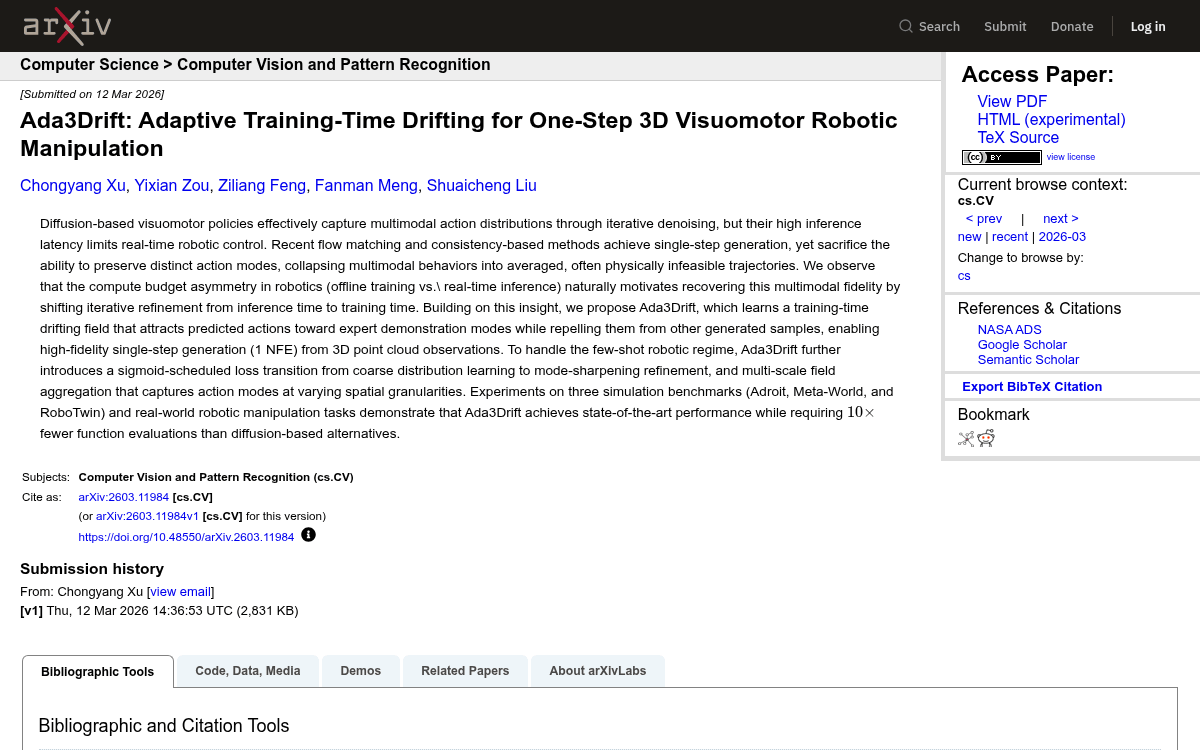
- Paper: arxiv.org/abs/2603.11984. Builds on the DP3 pipeline and the training-time drifting idea from Deng et al.
Diffusion policies have quietly become the default way to teach robots multimodal skills from demonstrations, but they carry an ugly secret: every action chunk costs 10 to 100 forward passes through a neural network. That is fine on a lab GPU and awful on a robot arm that needs to react at 30 Hz. A new paper introduces Ada3Drift, a single-step 3D visuomotor policy that reaches state-of-the-art performance on Adroit, Meta-World, RoboTwin, and a real Cobot Magic arm, while running at roughly 234 Hz on a single RTX 4090D.
The mode-averaging trap
Behavior cloning has a fundamental data problem: for the same observation, human demonstrators often pick different valid strategies. Reach around the mug from the left, or from the right. Both are correct, but the average of the two drives the gripper straight through the mug. Diffusion Policy and its 3D extension DP3 handle this by iteratively denoising noisy predictions, which naturally preserves distinct action modes. That iterative refinement is exactly what makes them slow.
The obvious fix is to distill diffusion into a single forward pass using flow matching or consistency models. The catch is subtle but serious. Without iterative refinement, regression-based objectives converge to the conditional expectation of target fields, averaging over distinct action modes rather than preserving them. In image generation such averaging produces blurry but recognizable outputs, but in robotic manipulation the averaged trajectory of two valid strategies can drive the gripper straight into an obstacle. Mode averaging stops being an aesthetic issue and becomes a safety issue.
Refinement in the right place
The core insight is a piece of systems thinking rather than a new architecture. Robotics has a compute budget asymmetry: training is offline with no latency constraints, while inference must satisfy strict real-time requirements. Existing one-step methods throw iterative refinement away entirely. Ada3Drift keeps it, but relocates it: all the mode-preserving work happens during training, and inference is a single U-Net pass.

The mechanism is a drifting field applied during training. For each batch of noisy predictions, the network computes a displacement vector for every sample. The attraction term pulls each prediction toward its assigned demonstration mode, while the repulsion term pushes predictions apart to ensure coverage of all modes. The assignment between predictions and expert samples is done with a bidirectional softmax over pairwise distances, which prevents one popular demonstration from monopolizing every prediction.
Two ideas that make it work in the few-shot regime
Directly borrowing training-time drifting from image generation would fail on robotics, because robotic tasks typically have only 10 to 50 demonstrations and action geometries that differ wildly across tasks. Ada3Drift adds two adaptive pieces to bridge the gap.
- Multi-temperature field aggregation. A single softmax temperature only captures modes at one spatial scale. Grasping tasks may exhibit tightly clustered modes where approach angles differ by millimeters, while bi-manual coordination tasks have widely separated modes corresponding to fundamentally different arm configurations. Ada3Drift computes drifting fields at three temperatures (0.02, 0.05, 0.2) and normalizes each to unit variance before summing, so the same recipe works across tasks with very different action magnitudes.
- Sigmoid-scheduled loss transition. Early in training, predictions are so far from any data mode that the soft assignment produces garbage drift vectors. The loss starts as pure MSE and transitions to drift-based supervision. The crossover point sits at 70% of training with sharpness 0.05, reflecting a finding that with only few demonstrations, the model requires the majority of training to establish a coarse distribution before drift-based refinement becomes effective.
Because there is no iterative denoising at inference, the network also drops the timestep embedding used in diffusion and flow-matching policies. What is left is a 1D convolutional U-Net with three resolution levels, FiLM conditioning on a PointNet-encoded point cloud plus proprioceptive state, and a 16-step prediction horizon.
What the numbers look like
Across three simulation benchmarks and a physical robot, Ada3Drift consistently beats other single-step methods and matches or exceeds multi-step diffusion baselines while using one function evaluation instead of ten.
| Benchmark | DP3 (10 NFE) | FlowPolicy (1 NFE) | MP1 (1 NFE) | Ada3Drift (1 NFE) |
|---|---|---|---|---|
| Adroit + Meta-World avg | 78.0 | 77.0 | 78.6 | 79.2 |
| RoboTwin (8 tasks) | 62.5 | 58.4 | 68.3 | 71.2 |
| Real-world (5 tasks) | 68 | 57 | 69 | 79 |
The RoboTwin result is the most interesting. Ada3Drift surpasses the multi-step DP3 by 8.7% on average despite using only a single forward pass, highlighting the advantage of explicit mode separation over iterative refinement in tasks with complex 3D contact geometry. On the physical Cobot Magic, the gap widens further on precise-placement tasks like Stack Blocks (60% vs 45% for MP1) and Cup on Coaster (85% vs 75%).
On latency, DP3 runs at 18.7 Hz, FlowPolicy at 274.4 Hz, MP1 at 249.5 Hz, and Ada3Drift at 233.9 Hz (4.3 ms per step), representing a 12.5x speedup over DP3. Ada3Drift is slightly slower than the other one-step baselines because of its larger U-Net with temporal attention, but everything above 10 Hz is comfortably real-time for closed-loop manipulation.
Where it fits and where it does not
The paper is honest about the failure modes. On Meta-World Hard, Ada3Drift lands at 58.7% versus 62.3% for MP1. The authors attribute this to the high action-space variance of hard tasks, where the sigmoid schedule may benefit from task-specific tuning of the crossover point. The fixed 70% crossover, three fixed temperatures, and few-shot assumption make Ada3Drift a natural fit for the classic imitation-learning setup: a handful of demonstrations per task, 3D point cloud input, closed-loop control at tens of Hz. It is not obviously the right choice for large-scale multi-task foundation models like Octo and RDT-1B, which scale diffusion policies to hundreds of thousands of trajectories, where the few-shot assumption breaks down.
The broader takeaway is architectural rather than task-specific. Training-time drifting was recently proposed for image generation by Deng et al., and this work shows the idea maps cleanly onto robotics with a few adaptations. If you are building on top of DP3 or flow-matching policies and hitting the mode-averaging wall, the recipe here (attract-and-repel loss, MSE warmup, multi-temperature aggregation, no timestep embedding) is small enough to graft onto an existing training pipeline. Code has not yet been released alongside the preprint.