
ActiveFreq Cuts Medical Image Annotation Clicks by 27% Using Frequency AI
A new interactive segmentation framework cuts clinician clicks by up to 23.5 percent by combining active learning with Fourier-domain features.
 Pro
Takeaways
- ActiveFreq combines active learning with Fourier features to cut clicks in interactive medical segmentation.
- AcSelect module scores mislabeled regions using three entropy metrics: MPE, APE, and Regional Group Uncertainty.
- FreqFormer replaces SegFormer's decoder with Freq blocks that apply 2D DFT across three dimension pairs.
- Achieves 3.74 NoC@90 on ISIC-2017 and 9.27 on OAI-ZIB, beating previous best by 23.5% and 12.8%.
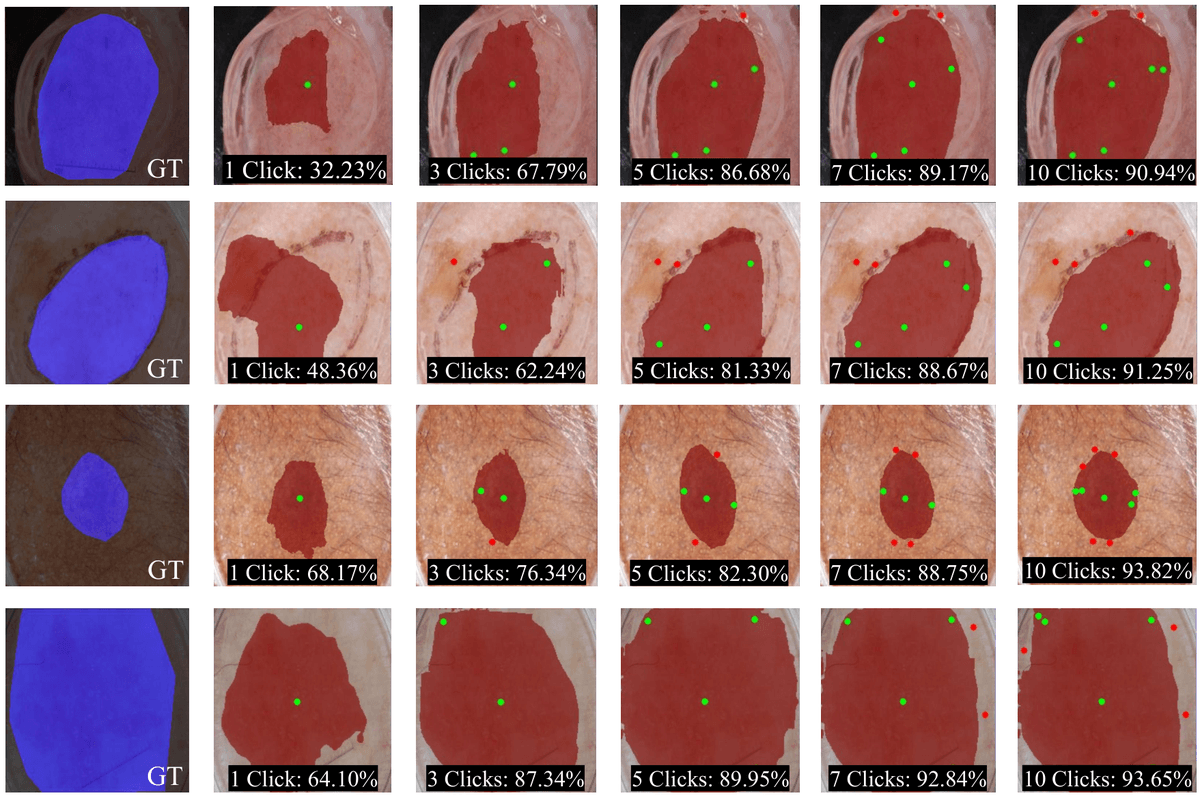
- Reaches 85.29% mIoU on skin lesions with only two clicks; model uses just 9.20M parameters.
- AcSelect is plug-and-play; validated on HRNet-18 and SegFormerB0 backbones with consistent gains.
Medical image annotation is one of those tasks where humans and models have to cooperate. A radiologist clicks on a lesion, the network refines its mask, and the cycle repeats until the segmentation is clean enough for a diagnosis or a training set. The catch is that most interactive segmentation systems waste those clicks. A new framework called ActiveFreq, published in Knowledge-Based Systems, tries to fix that by teaching the model to tell the human where to click next, and by pulling extra signal out of the frequency domain.
Why every click should count
Interactive segmentation requires minimal user input to refine predictions and produce precise results, even in complex scenarios, which is why it has become the default for pixel-level labeling in clinical workflows. But there is a hidden inefficiency in how existing methods handle correction. After generating a coarse mask and identifying multiple mislabeled regions, most existing approaches treat all regions as equally important and randomly select one for annotation. However, different mislabeled regions vary greatly in their potential to improve the final segmentation.
The second gap is architectural. Nearly every popular click-based segmenter, from FocalClick to SimpleClick, operates purely on spatial features. That leaves useful information on the table, because frequency domain features are particularly beneficial in medical imaging, as they effectively filter high-frequency noise generated by imaging equipment while preserving critical low-frequency structural information. Small vessels and thin cartilage boundaries are exactly the kinds of structures that get lost when you ignore that signal.
Two modules, one pipeline
ActiveFreq is built around two components that work together. AcSelect leverages entropy-based metrics to assess the uncertainty within each mislabeled region, assigning scores to prioritize regions with the highest uncertainty for refinement. The second is FreqFormer, a SegFormer-based backbone that adds a Fourier transform module into the decoder to fuse spatial and frequency features.

The workflow is worth walking through, because it explains where the click savings come from:
- FreqFormer produces a coarse mask from the input image and any existing click map.
- The system identifies mislabeled pixels by comparing prediction with the working ground truth, then groups contiguous errors into connected components.
- For every mislabeled region, AcSelect computes three uncertainty scores and combines them into a single region score.
- The region with the highest score is surfaced to the user, who places the next click there.
- A refinement layer updates only the affected area, using ROI Align to keep already-correct regions intact.
Scoring uncertainty at three levels
Most active learning strategies for segmentation stop at pixel entropy. AcSelect goes further by evaluating uncertainty at three complementary granularities:
- Maximum Pixel Entropy (MPE): the single most uncertain pixel in a region, flagging localized failure points.
- Average Pixel Entropy (APE): mean entropy across the region, capturing how uniformly confused the model is.
- Regional Group Uncertainty (RGU): the gap between the worst pixel and the region average, measuring internal error consistency.
The three metrics are combined with fixed weights (0.35, 0.35, 0.30) into a Region Score, and the region with the highest score becomes the next click target. Ablations show each metric matters: adding MPE, then APE, then RGU on ISIC-2017 progressively drops NoC@90 from 5.11 down to 3.74. Compared to random, entropy, and least-confidence sampling baselines, AcSelect reduces NoC@85 by 27.06% on ISIC-2017 and 16.83% on OAI-ZIB.
Fourier features in the decoder
FreqFormer keeps SegFormer's transformer encoder but replaces the decoder with a FreqNet made of four Freq layers. Inside each Freq block, the feature map is split into four sub-maps along the channel dimension. One is processed with a depth-wise convolution to preserve spatial information. The other three go through 2D Discrete Fourier Transforms along different dimension pairs, height-width, height-channel, and width-channel, then get scaled by learned weights and inverse-transformed back.

The design choice of Fourier over wavelet transforms is deliberate. The authors argue that although wavelets provide multi-scale decomposition, Fourier captures global context better, and the ablation confirms it, with FT beating WT on both benchmarks. Notably, the whole network stays lean at 9.20M parameters and 2.67G FLOPs, smaller than nearly every baseline they compare against including HRNet-18, ViT-B, and Swin-B.
The numbers
Evaluation uses two datasets that are common yardsticks for medical interactive segmentation: ISIC-2017, a large-scale dataset of dermoscopy images from the International Skin Imaging Collaboration, and OAI-ZIB, which consists of 3D MRI images with annotations for the femur, tibia, patella, and tibial cartilage. The metric is NoC@X, the average number of clicks needed to reach X percent IoU, capped at 20.
| Metric | ISIC-2017 | OAI-ZIB |
|---|---|---|
| ActiveFreq NoC@90 | 3.74 | 9.27 |
| Previous best NoC@90 | 4.16 (GraCo-ViT-B) | 9.39 (FocalClick-HRNet-32) |
| Improvement | 10.1% fewer clicks | 0.12 clicks fewer |
| mIoU at 2 clicks | 85.29% | 75.76% |
The two-click result is arguably the most practically interesting number. Reaching 85 percent IoU on skin lesions after just two interactions means the annotator can plausibly clear most cases with a positive click and a correction, rather than a dozen back-and-forth clicks. On ISIC-2017, ActiveFreq passes 90 percent mIoU with only four clicks, while SimpleClick and FocalClick need eight or more.
Where it fits and where it doesn't
The strongest use case is medical annotation pipelines where expert time is the bottleneck. Dermoscopy triage, cartilage segmentation for osteoarthritis studies, and any workflow that produces training masks for downstream automatic models would benefit directly. Because AcSelect is designed as a plug-and-play module that can be seamlessly integrated into any CNN-based or Transformer-based backbone, teams already running FocalClick or a SegFormer-based tool can bolt on the selector without replacing their stack. The paper's Variant-1 and Variant-2 experiments confirm this by dropping AcSelect onto HRNet-18 and SegFormerB0 respectively and getting substantial gains.
The limitations are worth flagging. AcSelect analyzes mislabeled regions individually, potentially missing interactions between regions. The grouping and collectively analyzing regions could improve efficiency by focusing on areas that contribute most to global segmentation accuracy. Second, the FreqModule applies 2D Discrete Fourier Transform operations across height-width, height-channel, and width-channel dimensions, capturing pairwise frequency information but missing interactions across all dimensions. The work has also been validated only on 2D slices, so 3D volumetric performance and generalization to other modalities like CT or ultrasound remain open. The authors don't announce a public code release in the paper, though the datasets themselves are openly available through the ISIC challenge portal.
The bigger takeaway
The real contribution here is not the individual modules, both entropy-based active learning and Fourier features have been explored separately. It's the reframing of interactive segmentation as a two-way conversation where the model also has a say in what gets annotated next. That inverts the usual assumption that the human is always the smarter half of the loop, and the numbers suggest that inversion pays off. If you're building tools where each expert click has a real dollar cost, the direction ActiveFreq points to, letting the model triage its own errors, is likely to matter more than another point of mIoU on a fully-labeled test set.