
ActionPlan Makes AI Human Motion 5x Faster Without Sacrificing Quality
A hierarchical diffusion model predicts frame-by-frame text descriptors before generating motion, giving streaming synthesis future-awareness without sacrificing speed or quality.
 Pro
Takeaways
- ActionPlan unifies streaming and offline text-to-motion generation in one diffusion model via per-frame action plans.
- Streaming inference runs 5.25x faster than MotionStreamer while cutting FID by 51%.
- Offline mode improves FID by 22% over MARDM and hits 0.892 R-Precision Top-3 on HumanML3D-272.
- Latent-specific diffusion timesteps enable zero-shot motion editing and in-betweening without fine-tuning.
- Streaming output transfers to a Unitree G1 humanoid using SONIC as the low-level controller.
- Code released at github.com/Coral79/ActionPlan-Code; pretrained weights coming.
Text-to-motion research has been stuck in a frustrating tradeoff. Offline diffusion models generate high-quality 3D human motion but need the entire sequence at once, so they cannot power anything interactive. Streaming models generate frame by frame with low latency, but their strict causality creates a form of temporal myopia that garbles complex prompts. A new paper from the University of Tübingen and the Max Planck Institute for Informatics proposes a single model that handles both, and beats specialized systems in both regimes.
ActionPlan is a unified motion diffusion framework built around a simple structural idea: before generating any motion, first predict a per-frame textual action plan, then use those frame-level text latents as dense semantic anchors while denoising the motion itself. Experiments demonstrate that real-time streaming is 5.25x faster while achieving 18% motion quality improvement over the best previous method in terms of FID.
Why streaming motion models keep missing the point
Existing text-to-motion systems split into two camps. Offline frameworks use global bidirectional attention over the full sequence, which lets them see the future during denoising and produces coherent multi-action motions. Streaming systems like MotionStreamer use causal latent spaces and generate autoregressively, so they never get to look ahead. When a prompt says walks forward and picks something up then walks back, a causal model tends to drift or skip actions entirely because it cannot anticipate what is coming.
The authors argue that by decoupling high-level semantic planning from low-level kinematic synthesis, the approach enables state-of-the-art generation quality and future-aware streaming without sacrificing accuracy. In other words, if the model commits to a semantic timeline before generating any pose, streaming inference can stay causal on the motion side while still being globally coherent.
How the action plan works
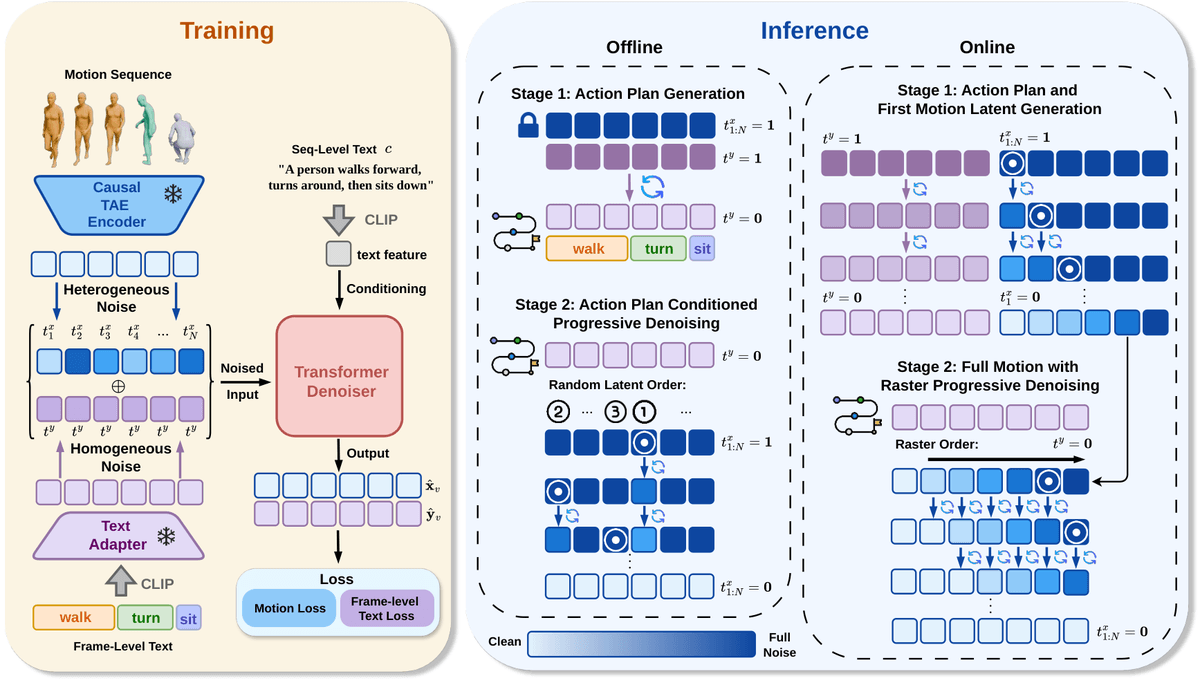
ActionPlan trains a Transformer denoiser to jointly reconstruct two aligned streams: motion latents encoded by a frozen Causal Temporal AutoEncoder, and frame-level text latents produced by a small MLP autoencoder that compresses CLIP embeddings of per-frame action descriptions down to 16 dimensions. At each temporal position, the motion latent and the text latent are concatenated into a single vector fed to the denoiser.
The critical trick is what they call latent-specific diffusion timesteps. During training, motion latents are noised with per-frame heterogeneous timesteps while frame-level text latents share a single global timestep. A Transformer Denoiser is trained to jointly reconstruct both. Because every motion frame carries its own noise level, the model learns to handle arbitrary mixtures of clean and noisy latents, which unlocks flexible sampling orders at inference.
At test time inference runs in two stages:
- Stage 1: Action plan generation. All motion latents are kept at pure noise while the frame-level text latents are denoised over T flow-matching steps, producing a full timeline of what should happen at each frame.
- Stage 2: Progressive motion denoising. Motion latents are denoised using overlapping pyramid schedules. In offline mode they are activated in random order; in streaming mode they are activated in raster (temporal) order, with the action plan denoised alongside the first motion frame.
The streaming schedule is what delivers the speedup. Rather than fully denoising every motion token before starting the next, the model keeps multiple tokens in flight at different denoising progress and only pushes one new token into the pipeline every K steps. The streaming mode completes generation in only N+T-1 total steps, enabling efficient low-latency generation without sacrificing motion quality.

The numbers
ActionPlan is trained on HumanML3D-272, the 272-dimensional SMPL-based rerepresentation of HumanML3D introduced by MotionStreamer, with additional frame-level annotations pulled from BABEL where available. To handle sequences that lack per-frame labels, the authors mask out the text-reconstruction loss on those samples so they can still train on the full dataset.
On the standard text-to-motion benchmark, a single checkpoint beats every prior method in both modes:
| Method | FID | R-Precision Top-3 | Latency/token |
|---|---|---|---|
| MotionStreamer | 11.79 | 0.859 | 360 ms |
| MARDM | 7.04 | 0.860 | 210 ms |
| ActionPlan (streaming) | 5.74 | 0.877 | 40 ms (subsequent) |
| ActionPlan (offline) | 5.52 | 0.892 | - |
That works out to a significantly better FID and R-Precision compared to schedules without ActionPlan, and streaming becomes 5.25x to 9x faster than the two strongest baselines while actually producing better motion. In a 30-participant user study on 20 prompts, ActionPlan was preferred 67.5% of the time against a combined field of MARDM and MotionStreamer.
Editing, in-betweening, and a humanoid robot
Because each latent has its own timestep, the same model handles two tasks that normally require separate systems. Motion editing fixes a subset of motion latents at timestep 0 (fully clean) and regenerates the rest under a new text prompt. In-betweening treats start and end poses as fully denoised anchors and fills in the intermediate frames. Both work zero-shot without fine-tuning.

The project page also shows the streaming output driving a Unitree G1 humanoid using SONIC as the low-level controller, which is a decent stress test since real robots do not tolerate the temporal drift that plagues causal motion models.
What it does not do
The authors are upfront about the boundaries. ActionPlan does not model finger articulation or facial expressions, both of which would require paired text-hand or text-face datasets that do not currently exist at scale. It also generates motion without any awareness of scenes or objects, so it cannot yet drive agents that need to physically interact with an environment. And it inherits the general vocabulary of BABEL for its frame-level text retrieval, which caps how fine-grained the per-frame action labels can get.
Availability
Code is on GitHub with generation and rendering scripts, and the authors state pretrained weights will be released. The arXiv paper includes full pseudocode for both offline and streaming samplers, along with the heterogeneous timestep sampling algorithm borrowed from SRM that keeps training coverage balanced across denoising stages.