
ACFS Beats Bayesian Optimization by 21.8% on Skewed Risk Problems
A four-phase simulation-optimization framework cuts run-to-run variance by up to 2.5x when uncertainty shifts with the decision itself.
 Pro
Takeaways
- ACFS is a four-phase framework for spectral risk optimization when uncertainty depends on the decision itself.
- Uses Generalised Random Forests to model the conditional distribution non-parametrically at each query point.
- Beat GP-BO by 8.6 to 21.8 percent median on a log-normal supply-chain benchmark across three penalty weights.
- Cut cross-replication standard deviation by 1.7x to 2.5x, materially improving run-to-run reliability under a fixed oracle budget.
- Two-stage reranking, from surrogate screening to direct-simulator rescoring, drives most of the outlier-suppression benefit.
- Tested only on synthetic six-dimensional benchmarks; scaling to higher dimensions and real simulators is unresolved.
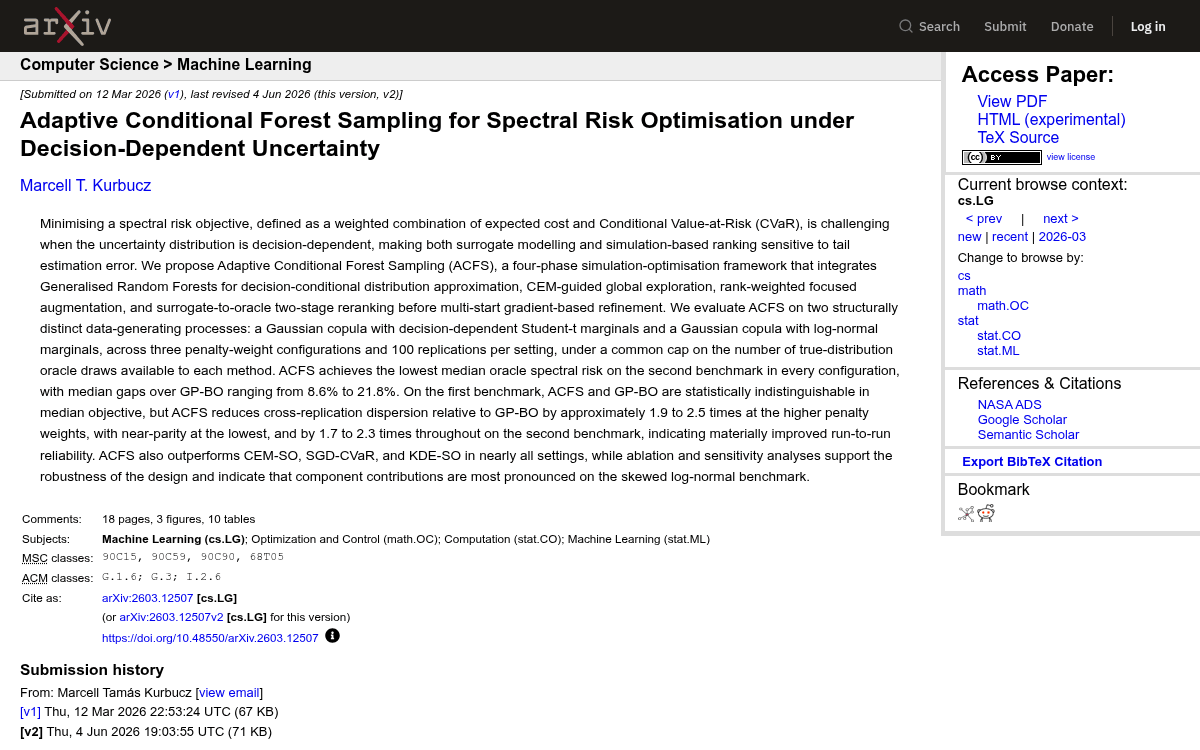
A new simulation-optimization framework tackles a stubborn corner of stochastic programming: what happens when the probability distribution of the uncertain variables actually moves in response to the decision you make. The method, called Adaptive Conditional Forest Sampling (ACFS), targets spectral risk objectives that blend expected cost with tail risk, and it does so with markedly more reliable convergence than the usual Bayesian optimization baselines.
When Your Decision Bends the Distribution
Most stochastic optimization tools assume the uncertainty is fixed: you draw samples once, then search for the best decision. A particularly challenging class of problems arises when the distribution of uncertain parameters depends on the decision variable itself. Think of demand-stimulated resource allocation, climate-sensitive infrastructure investment, or supply chain reliability that shifts with order volumes.
The complication is that a fixed Monte Carlo sample drawn independently of the decision is accurate only locally and can misrepresent the true distribution elsewhere. Worse, the objective here is not just expected cost. It is a spectral risk measure that adds Conditional Value-at-Risk (CVaR), which is the average loss in the worst alpha-percent of scenarios. Small errors in tail estimation can flip the ranking of near-optimal candidates, and standard surrogate models tend to be systematically optimistic in exactly the directions where the distribution concentrates tail mass.
Four Phases, One Oracle Budget
ACFS splits the work into a pipeline where cheap surrogate evaluations locate promising regions and the scarce true-simulator budget is reserved for ranking and refining candidates. The core estimator is a Generalised Random Forest that treats the decision itself as the splitting input, producing weights over historical observations that approximate the conditional distribution at any new query point.
- Global exploration. A maximin Latin Hypercube of 1,200 points seeds the initial training set, followed by a Cross-Entropy warm-start of seven iterations with 35 candidates and 300 Monte Carlo draws each. Differential Evolution then runs on a fast kernel-density surrogate.
- Focused augmentation. Around the top four elite candidates, 700 additional points are drawn with geometrically decaying rank weights of roughly 46, 28, 17, and 10 percent, raising local training density where the optimum most likely lives.
- Two-stage reranking. The GRF surrogate first screens 151 candidates at 800 draws each, retaining the top 60; the true simulator then rescores those 60 with 450 samples each to select 30 seeds. This is the step the authors identify as most responsible for suppressing high-cost outlier runs.
- Local refinement. Multi-start L-BFGS-B polishes the seeds using antithetic sampling paired with common random numbers, which reuses the same cached scenario matrix for both function and gradient evaluations to cut finite-difference noise.
What the Numbers Show
The evaluation spans two benchmarks: a Gaussian copula with decision-dependent Student-t marginals (symmetric heavy tails) and one with log-normal marginals (right-skewed, supply-chain flavored). Every method operates under the same hard cap of 260,000 true-simulator draws per replication, so any advantage cannot be attributed to extra sampling.
On the log-normal benchmark, ACFS beat Gaussian Process Bayesian Optimization in every configuration, with median gaps of 8.6, 8.6, and 21.8 percent as the CVaR penalty weight changed. On the heavy-tailed benchmark the two methods were statistically indistinguishable in median performance, but ACFS reduced cross-replication standard deviation by roughly 1.86x at penalty weight 0.70 and 2.53x at 0.90. In plain terms: even when medians tie, ACFS produces far fewer disaster runs.
The other baselines fared worse across the board. The gap to KDE-SO exceeds 38 percent in every setting and reaches 70.1 percent on the skewed benchmark, and SGD-CVaR's cross-replication SD is 2.6 to 9.2 times larger than ACFS's on the heavy-tailed benchmark and 3.2 to 11.2 times larger on the log-normal one.
Where the Advantage Actually Comes From
An ablation study pulled the algorithm apart to see which pieces mattered. On the skewed benchmark, every component contributed positively when removed, with focused augmentation and the CEM warm-start doing the heaviest lifting. Removing the CEM warm-start inflates the standard deviation the most on the log-normal benchmark, from 38,580 to 47,649, indicating that elite seeding stabilises convergence under right-skewed marginals by steering Differential Evolution away from high-cost basins.
An interesting nuance surfaced in the cost decomposition. On the log-normal benchmark, ACFS and GP-BO converge to structurally different solutions: ACFS's allocation attains a lower average cost at the expense of somewhat elevated tail risk, while GP-BO's allocation has lower tail risk but incurs substantially higher expected cost. Which one wins depends on how heavily CVaR is weighted, hinting that the advantage could narrow at very high penalty weights.
Practical Takeaways
- Good fit: operations research problems where allocation decisions shift demand, capacity, or failure distributions, particularly with right-skewed outcomes like demand spikes or shortage costs.
- Less useful: settings where GP-BO is already known to work well, since ACFS consumes a larger share of the oracle budget on symmetric heavy-tailed problems for no median gain.
- Reliability play: if run-to-run consistency matters more than shaving evaluations, the variance reduction across replications is the headline number.
- Scaling caveat: the benchmarks are six-dimensional and synthetic. Validation on real simulation models and higher dimensions remains open, and future work targets scalability to 20 or more dimensions via sparse forest variants or dimensionality reduction.
No code repository is referenced in the paper. The implementation is described as R-based and single-threaded on an Apple M4 Pro, with each ACFS run completing in seconds thanks to the small number of local L-BFGS-B iterations per seed. The full manuscript includes the closed-form cost specifications for both benchmarks in the appendix, which would be the starting point for anyone rebuilding it.