
A*STAR's ELC Ranks Vision AI Models With 0.9 Accuracy and No Labels
A parallel reasoning channel using LLMs, vision foundation models, and probabilistic logic lets you validate and boost MLLMs without ground truth labels.
 Pro
Takeaways
- New Explicit Logic Channel runs an LLM plus vision foundation model in parallel with any MLLM for zero-shot validation. Paper
- Consistency Rate between the two channels correlates above 0.9 with true accuracy, enabling model selection without labels.
- Tested on 11 open-source MLLMs from Gemma, LLaVA, InternVL, and Qwen-VL families across three benchmarks.
- Aligned fusion of both channels sets new SOTA on NegBench, HC-RefCOCOg, and HC-RefLoCo without fine-tuning.
- Ablations show LLM noun extraction and VFM grounding each cost roughly 10 accuracy points.
- Pipeline uses off-the-shelf Qwen3-4B, GroundingDINO, EvaCLIP; latency reaches ~7s on long-context queries.
Picking the right multimodal LLM for a new task is mostly guesswork. You throw a benchmark at eleven models, watch the scores land in wildly different places, and hope your production data looks enough like the benchmark that the ranking still holds. A new paper from Singapore's A*STAR proposes a way out: run a second, transparent reasoning pipeline alongside the black-box MLLM and use the agreement between the two as a stand-in for accuracy.
The technique is called an Explicit Logic Channel (ELC), and the headline result is that a simple Consistency Rate between the ELC and the MLLM correlates with real accuracy at above 0.9 across three benchmarks and eleven frontier open-source models, with no labels required.
The black-box problem in zero-shot deployment
Frontier MLLMs are typically dropped into new visual-language tasks as zero-shot solvers. They produce an answer, sometimes a confidence score, and nothing else. Recent research has increasingly highlighted the limitations of MLLMs in reliability, factuality, explainability, and logical reasoning, and existing grounded-VQA fixes mostly require new annotations or fine-tuning. That's fine for research, useless for a team trying to figure out which 8B model to ship next week.
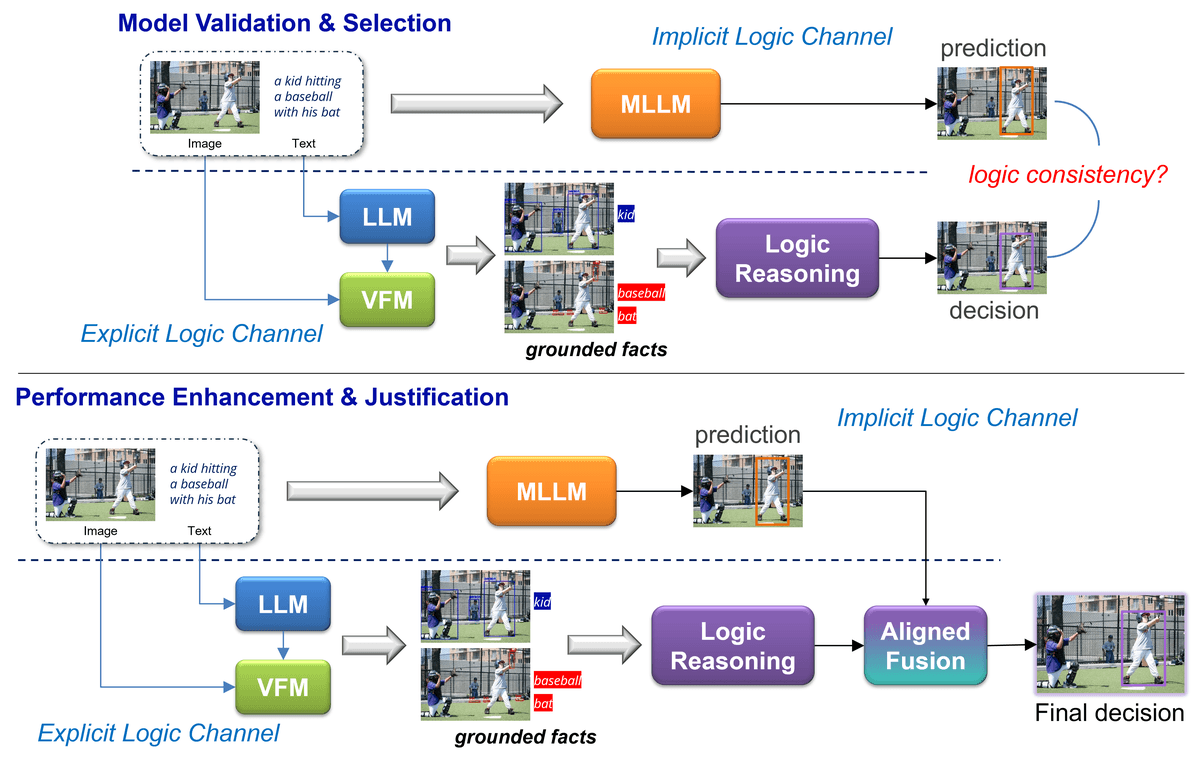
The authors treat the MLLM itself as an Implicit Logic Channel (ILC), a statistical next-token predictor whose reasoning is baked into weights. To audit it, they build a parallel channel that mimics how a human would justify a decision: extract the facts, look for them in the image, then apply logic rules.
How the second channel works
The ELC is a three-step pipeline that runs alongside the MLLM on the same input:
- Language parsing. An LLM (they use Qwen3-4B-Instruct) reads the text query and extracts task-relevant nouns, attributes, and logical relations, tagging them as positive or negative facts.
- Visual grounding. A vision foundation model such as GroundingDINO locates each extracted concept in the image and returns detection probabilities.
- Logical inference. Task-specific probabilistic rules combine the grounded evidence into a final prediction, with the confidence score derived from the detection probabilities.

For multiple-choice VQA on the NegBench benchmark, which mixes positive and negative phrases, the ELC computes P(pos) = min of detection scores for present objects and P(neg) = max for absent objects, then combines them using a geometric mean. For human-centric referring expression comprehension, the ELC crops each detected person, scores each crop against the query with a VLM, and accumulates evidence from associated objects using an intersection-over-area weighting.
Consistency Rate as a label-free metric
The Consistency Rate is just the fraction of test samples where ILC and ELC agree. The claim is that this cheap-to-compute number tracks true accuracy closely enough to use for model selection.
The correlation numbers are strong. The correlation between CR and Accuracy is consistently strong across all benchmarks, with Pearson's r, Spearman's rho and Kendall's tau exceeding 0.89 on most benchmarks and averaging above 0.9. The rankings the CR produces also match the ground-truth rankings surprisingly well across the four model families tested: Gemma, LLaVA, InternVL, and Qwen-VL.
The evaluation also surfaces some awkward truths about the current MLLM landscape. Newer version models are not guaranteed to outperform earlier ones, even from the same family, for example InternVL-3.0 beats InternVL-3.5 on NegBench. A model that excels on one task may perform poorly on another; Gemma-3 achieves strong results on MC-VQA but fails on HC-REC.
Fusion actually improves accuracy
Beyond validation, the two channels can be fused. When ILC and ELC agree on a subset of samples, the mean confidence of each channel on that subset is used to rescale ELC predictions to the ILC scale, and the aligned scores are summed. The result is a new SOTA on all three benchmarks without any fine-tuning. On NegBench COCO, InternVL2.5's accuracy jumps from 0.912 to 0.965. On HC-RefLoCo, Qwen3.0-VL improves its Acc50 from 0.942 to 0.939 , roughly flat there, but the mAcc bumps from 0.80 to 0.81, and weaker models gain far more.

Where it breaks
The ELC inherits errors from every foundation model in its pipeline. An ablation on HC-RefCOCOg found that swapping in ground-truth nouns lifted ELC accuracy from 82% to 93%, and swapping in ground-truth object boxes lifted it further to 98%. In other words, the LLM parser costs roughly 10 percentage points and the object detector another 10.
The ELC is also more fragile than the MLLM under adversarial edits: masking a critical object drops Qwen3.0-VL's ILC accuracy from 91% to 60%, but ELC's from 82% to 41%. And there's latency. On the long-context HC-RefLoCo task, the VLM matching step alone takes almost 7 seconds per sample. This is not a real-time system.
Practical takeaways
- Model selection without labels. Run both channels on your unlabeled data, compute CR, and use it to rank candidate MLLMs before you commit to any of them.
- Trust calibration. Flag disagreements between channels for manual review; the paper reports these surfaces genuine hallucinations, gt annotation errors, and model biases.
- Free accuracy boost. Aligned fusion consistently improves accuracy without any training, and works on top of whatever MLLM you already picked.
The benchmarks used are all publicly available, including NegBench, RefCOCOg, and HC-RefLoCo. The paper does not release a dedicated code repo, but every component (Qwen3-4B, GroundingDINO, EvaCLIP, InternVL2.0) is off-the-shelf, and the logic rules for both tasks are spelled out with explicit equations. Reimplementing the pipeline for a new VLC task is a weekend of engineering, not a research project.