
A*STAR's AdaMCoT Lets AI Think in English and Answer in Any Language
A new framework routes reasoning through auxiliary 'thinking languages' to close the gap between high- and low-resource performance in multilingual LLMs.
Takeaways
- AdaMCoT lets LLMs reason internally in an auxiliary thinking language before answering in the user's language.
- Uses GPT-4o as a reward model to score four criteria and fine-tunes only on top-ranked reasoning paths.
- Boosts LLaMA 3.1-8B accuracy on multilingual TruthfulQA in 31 of 32 languages, with 10+ point gains on low-resource languages.
- Adaptive routing beats fixed-English reasoning by 5.2% to 9.3% on CrossAlpaca-Eval 2.0.
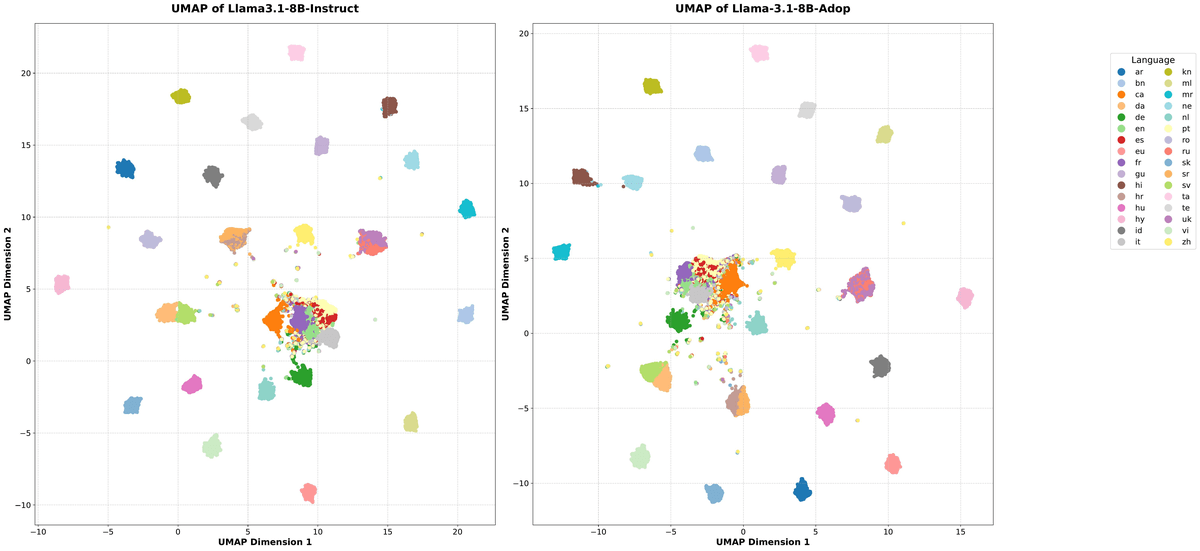
- Logit Lens and UMAP show tighter cross-lingual semantic alignment and fewer hallucinations after fine-tuning.
- Code released at Social-AI-Studio/AdaMCoT; requires more inference tokens than direct answering.
Large language models can reason surprisingly well across dozens of languages, but the quality of that reasoning drops sharply the moment you leave the English-dominated corner of their training data. A team from A*STAR and Singapore University of Technology and Design has proposed AdaMCoT, a framework that lets a model quietly do its chain-of-thought in whichever language it happens to be strongest at, then respond in the language the user actually asked in.
The approach lifts factual accuracy on multilingual TruthfulQA by more than 10 percentage points in several low-resource languages, without any additional multilingual pretraining. It also opens up a more interesting research thread: the idea that different languages inside a single model encode different cognitive priors, and that a router can learn which one to trust for a given task.
Why multilingual reasoning still breaks
The core problem is well known but stubborn. LLMs exhibit strong reasoning capabilities alongside significant performance disparities across languages, favoring dominant ones like English, and translation-based fixes tend to introduce artifacts and lose logical nuance. Fine-tuning on massive multilingual corpora helps a little, but it is expensive and inconsistent.
Recent interpretability work has converged on a useful observation: LLMs possess a language-agnostic reasoning core that enables cross-lingual inference, while factual knowledge itself remains stubbornly language-dependent because of how training data is distributed. An 8B model may genuinely be able to reason about Singapore's road network, but only if it accesses the knowledge through the English-shaped part of its weights.
Prior prompting-based attempts to exploit this, like XLT, Cross-lingual Prompting, and AutoCAP, either use fixed reasoning templates or vote across multiple language paths. AutoCAP's multi-language voting mechanism can introduce noise, especially when incorrect reasoning paths dominate, and needing multiple generations per query makes inference expensive. Mixed-language methods like xCoT go further by splicing translated inputs together, but risk semantic drift.