
A Simple Linear Classifier Beats Transformers Detecting Bangla Financial Scams
A Linear SVM beat a transformer at spotting Bangla-English scam messages, exposing where deep learning still struggles in low-resource, code-mixed text.
 Pro
Takeaways
- Linear SVM hit 91.59% accuracy on Bangla-English fraud detection, beating a transformer by 2 points (paper).
- Transformer had higher fraud recall (94.19%) but nearly double the false positive rate versus Linear SVM.
- Scam messages contain URLs 32% of the time and phone numbers 97% of the time; legitimate ones almost never do.
- Dataset skews 80% English, 15-17% Bangla, plus code-mixed content from Mendeley Data.
- Top scam signals are urgency words: "now," "urgent," "claim your," "verify," "renew now."
- Classical ML with TF-IDF stays competitive for low-resource, code-mixed fraud detection tasks.
A new study tackling financial fraud in a language most NLP pipelines ignore has come back with a result that developers keep rediscovering: a well-tuned linear classifier can still out-punch a transformer when the data is small, messy, and multilingual. Researchers evaluated classical machine learning and transformer models on Bangla-English scam messages and found that a Linear SVM with TF-IDF features edged out the neural model on nearly every metric that matters.
The blind spot in fraud detection
Bangla (Bengali), spoken by over 250 million people worldwide, is commonly used alongside English in digital financial platforms, informal transaction messages, and online advertisements. Yet the vast majority of fraud detection research assumes monolingual English input. The paper argues this gap is dangerous in South Asia, where mobile money and SMS-based scams frequently mix Bangla script, romanized Bangla, and English within a single message.
The scarcity of labeled datasets, complex morphology, and frequent code-mixing with English pose additional challenges that are not addressed by English-centric models. Code-mixing here means switching languages mid-sentence, which breaks tokenizers trained on clean monolingual corpora and leaves multilingual transformers with sparse coverage of domain vocabulary like Bangla financial terms.
What the setup looks like
The authors pulled from a publicly released Financial Scams Detection Dataset on Mendeley and ran a head-to-head comparison using 5-fold stratified cross-validation. On one side: Logistic Regression, Linear SVM, and an Ensemble classifier, all fed TF-IDF vectors built from unigrams and bigrams across both languages. On the other side: a transformer-based classifier meant to capture context and cross-lingual structure through subword tokenization and self-attention.
The dataset itself is heavily English-leaning. English dominates both classes (around 80%), with Bangla comprising 15-17% and code-mixed messages forming a small but notable portion. That skew turns out to matter for the results.
The scoreboard
Across 523 test samples aggregated over folds, the classical models came out ahead:
| Model | Accuracy | F1 Macro | PR-AUC |
|---|---|---|---|
| Linear SVM | 91.59% | 91.30% | 97.17% |
| Ensemble | 91.21% | 90.91% | 97.19% |
| Logistic Regression | 91.02% | 90.73% | 96.82% |
| Transformer | 89.49% | 88.88% | 95.78% |
The nuance is in the error profile. The transformer model achieves the highest recall for detecting fraudulent messages (94.19%, with only 18 false negatives), indicating strong sensitivity to fraud patterns. But it pays for that sensitivity by flagging legitimate messages twice as often as the SVM does, misclassifying 37 real messages as scams versus 22 for Linear SVM.

What the scam messages actually look like
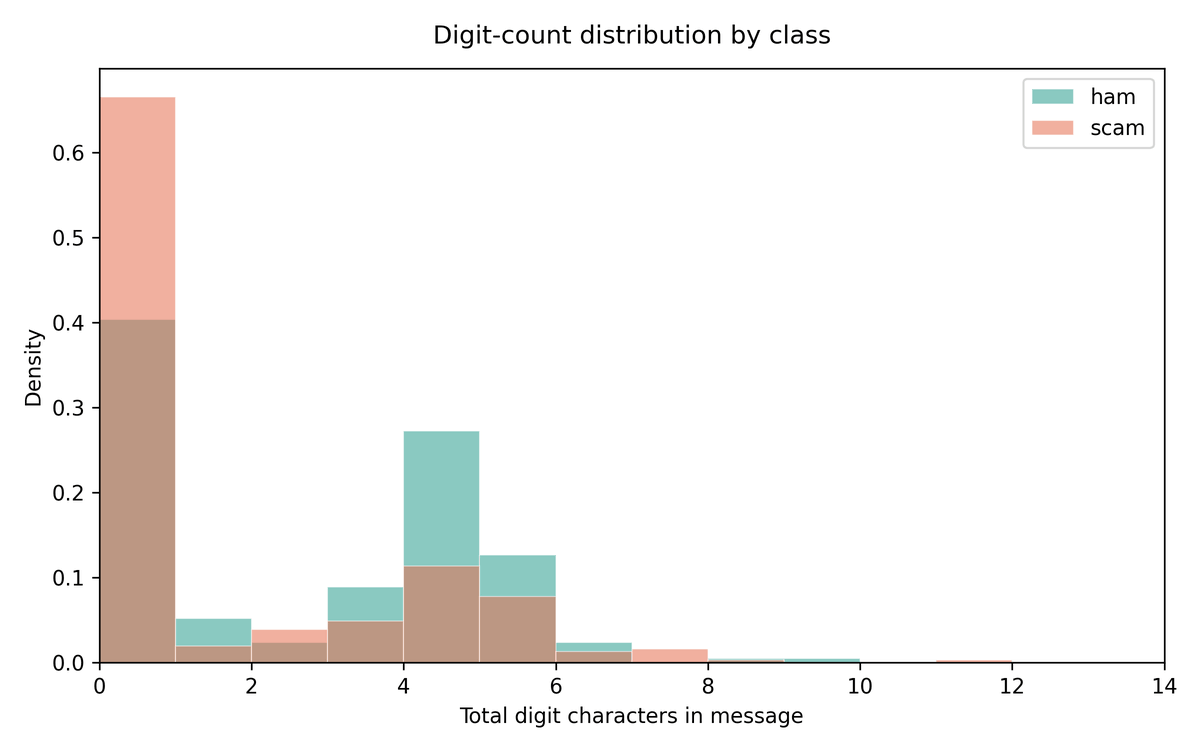
The exploratory analysis is arguably more useful than the model comparison, because it hands developers concrete features they can drop into any pipeline. Fraudulent messages share a fingerprint:
- Scam messages tend to be longer than legitimate messages, peaking around 70-75 characters compared to 50-60 for ham, with some exceeding 150 characters.
- Urgency-inducing tokens like "now," "urgent," "claim your," "verify," and "renew now" carry the highest SVM weights for the scam class.
- Approximately 32% of scam messages include URLs and 97% contain phone numbers, strong indicators of fraudulent intent.
- Legitimate messages instead show transactional confirmations like "successfully" and "activity detected," plus specific currency references such as "taka."

Why the small model wins
The real breakthrough here is not the accuracy number. It is the diagnosis of why the transformer underperformed. In a dataset dominated by short SMS-style messages with heavy reliance on lexical giveaways (URLs, phone numbers, urgency words), TF-IDF captures the discriminative signal almost perfectly. A linear decision boundary over sparse token features is hard to beat when the class separation is essentially a bag-of-red-flags.
Multilingual transformers, meanwhile, spread their pretraining budget across dozens of languages and rarely see Bangla financial vocabulary. The presence of Bangla text, English text, and code-mixed content may limit the effectiveness of both TF-IDF representations (which treat languages independently) and multilingual transformers (which may have limited exposure to Bangla financial vocabulary during pretraining). With only a few hundred training samples per fold, the transformer cannot recover that gap through fine-tuning.
When to actually use each
The trade-off maps cleanly to deployment choices:
- Linear SVM: pick this when you want stable, low-variance performance on short, feature-rich text, and when explainability matters. The top scam weights are literally interpretable words.
- Transformer: pick this when missing a scam is far more expensive than annoying a legitimate user, since it maximizes recall at 94.19% at the cost of more false alarms.
- Ensemble: pick this for the best PR-AUC (97.19%), which matters if you plan to tune the decision threshold based on business cost.
What the paper does not offer is a public code release or a pretrained model weight drop. The work is reproducible in principle since the dataset is on Mendeley and the classifiers are stock scikit-learn, but there is no GitHub repository attached. For teams building fraud filters for Bangladeshi or Indian fintech products, the practical takeaway is to start with TF-IDF plus a linear model, layer in the structural features (URL presence, phone number presence, digit distribution, message length), and only reach for a fine-tuned multilingual transformer once the labeled corpus is an order of magnitude larger than what this study used.