
A New Proof Gives Neural Operator Learning Its Strongest Universal Guarantees Yet
A new theoretical framework proves that neural operators can universally approximate nonlinear maps between arbitrary Banach spaces using projection methods.
 Pro
Takeaways
- New universal approximation theorem for nonlinear operators between arbitrary Banach spaces via Leray-Schauder mappings.
- Introduces neural projection operators, a learnable polynomial-basis architecture for L^p function spaces.
- Proves projected fixed-point solutions converge to true solutions as projection dimension grows.
- Extends DeepONet-style guarantees beyond spaces equipped with the uniform norm.
- Companion implementation paper benchmarks the approach on Burgers' equation and integral equations.
- Best suited for smooth, nonlocal problems; weaker on discontinuous phenomena where wavelets dominate.
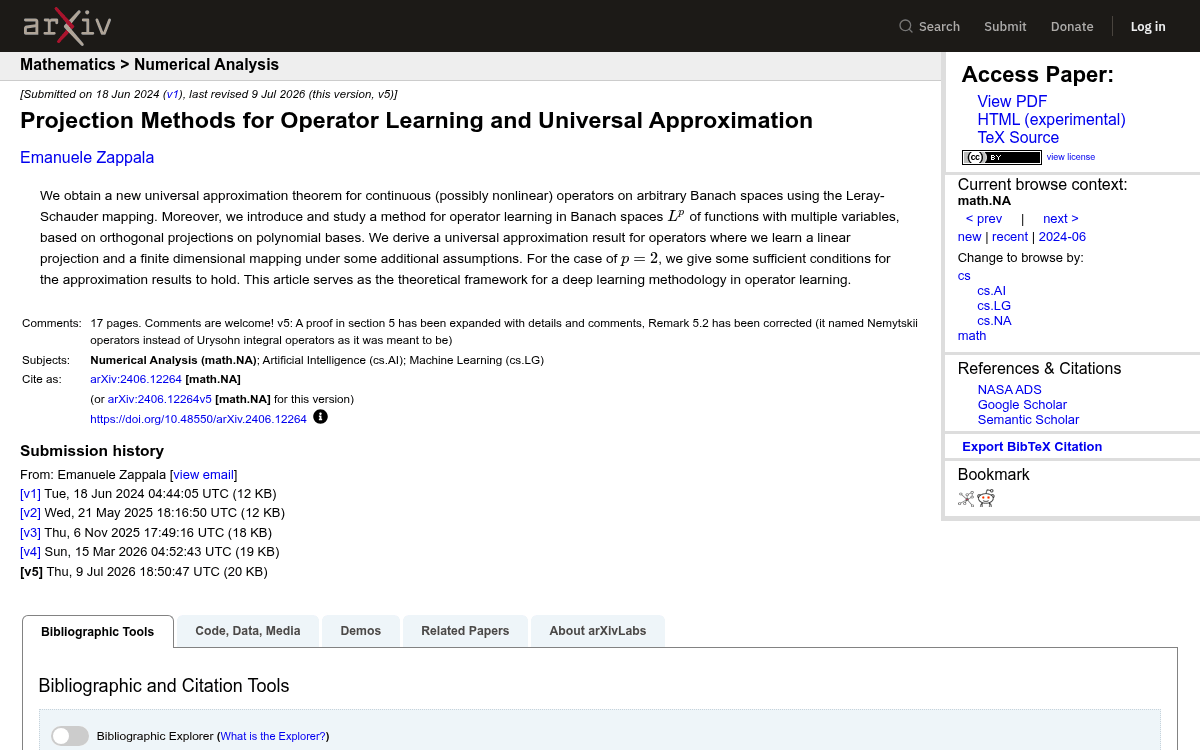
Operator learning, the branch of deep learning that tries to approximate mappings between infinite dimensional function spaces, just got a substantial theoretical upgrade. A paper titled Projection Methods for Operator Learning and Universal Approximation proves that a broad family of neural operators can approximate any continuous, possibly nonlinear operator between arbitrary Banach spaces, and it does so by learning both a projection onto a finite dimensional subspace and a small neural network that maps between those subspaces.
This matters because most practical operator learning models today work under fairly narrow assumptions about the target space, and this result pushes the guarantees to a much more general setting.
Why operator learning needs better foundations
Operator learning is a branch of deep learning involved with approximating (potentially highly nonlinear) continuous operators between Banach spaces. The appeal is that it allows to model complex phenomena, e.g. dynamical systems, whose underlying governing equations are not known. Think surrogate models for PDEs, integral equations in plasma physics, or dynamics in computational neuroscience.
The problem is that the spaces involved are infinite dimensional, but neural networks operate on finite tensors. Every practical model has to reduce the problem to something finite. Since most of the algorithms in practice discretize the domains of the functions, and therefore create a finite space upon which the neural networks are used, one might ask whether the mapping is really between function spaces, or it can just be reduced to some map between high dimensional spaces. For instance, one might ask whether it is possible to upsample the discretized domains after training, e.g. to interpolate and output arbitrarily dense predictions. Existing theory such as the DeepONet universal approximation theorem covers only the case where the output space is a space of functions equipped with the uniform norm, which is restrictive.
Two new theorems, two ways to build a neural operator
The paper builds the theory in two stages, giving two different constructions:
- General Banach spaces via Leray-Schauder projections. Given any compact subset of a Banach space, the classical Leray-Schauder construction covers it with epsilon-balls and builds a continuous (nonlinear) projection onto the finite span of those centers. The paper stitches this together with a small neural network mapping between finite dimensional coordinate spaces.
- L^p spaces via orthogonal polynomial projections. For the more concrete case of L^p function spaces, the projection is a learnable linear map defined by orthogonal polynomials against a learnable weight function, which the author calls a neural projection operator.
The main result for the general case is Theorem 2.2: for any continuous operator T between Banach spaces X and Y, any compact subset K, and any epsilon, there exist finite dimensional subspaces, a continuous projection, and a neural network such that the composition approximates T uniformly on K to within epsilon. A corollary strengthens this further, noting that the neural network can be chosen to have a single hidden layer.
The neural projection operator, in plain terms
For the L^p case, the model is a quadruple: two learnable weight functions (themselves neural networks), two sets of orthogonal polynomials with respect to those weights, and a neural network mapping between projection coefficients. Concretely, an input function f is projected onto the polynomial basis using inner products weighted by the learned weight function, the resulting coefficient vector is passed through the neural net, and the output coefficients are used to reconstruct a function in the target polynomial space.
The paper shows this construction is a universal approximator for continuous operators between L^p spaces, and gives explicit bounds. If the polynomials satisfy a summability condition on their norms, the projections are uniformly bounded, and the paper suggests this is therefore an explicit bound that can be imposed in the training algorithm, if the polynomials p_k are learned as well. That is a concrete training-time regularizer you can actually implement.
Fixed points and convergence guarantees
Beyond approximation, the paper tackles operator equations of the form T(x) + f = x, which is how integral and integro-differential problems are often framed. Under four assumptions on T (complete continuity, Fréchet differentiability, 1 not an eigenvalue of the derivative at zero, and nonzero topological index), Theorem 5.3 shows the projected finite-dimensional equation has a unique solution for every n, and those solutions converge to a true solution of the original equation as n grows. In other words, as the projection dimension increases, you recover the actual fixed point, not just a good-looking approximation.
How it compares to what exists
The paper includes a comparison table of neural operator architectures. A subset of the relevant properties:
| Model | Spaces | Hypothesis | Learned projection |
|---|---|---|---|
| Leray-Schauder (this work) | Arbitrary Banach | Continuous operator | Optional |
| L^p projection (this work) | L^p | Continuous operator | Yes |
| DeepONet | Banach to uniform | Continuous operator | No |
| PCA-Net | Hilbert | Measure-based | Yes |
| Spectral NIE | Hölder | Fréchet integral op | No |
The distinguishing property is generality: the Leray-Schauder result holds for general Banach spaces X and Y, whereas the universal approximation of DeepONet holds for spaces of functions Y with the uniform norm over compacts.
Is there code?
The paper itself is pure theory, but the author released a companion implementation as Leray-Schauder Mappings for Operator Learning. That paper presents an algorithm for learning operators between Banach spaces, based on the use of Leray-Schauder mappings to learn a finite-dimensional approximation of compact subspaces. It shows that the resulting method is a universal approximator of (possibly nonlinear) operators. It demonstrates the efficiency of the approach on two benchmark datasets showing it achieves results comparable to state of the art models. The benchmarks include Burgers' equation and integral equations, both standard testbeds in the neural operator literature.
When to reach for it, and when not to
The framework is designed for problems where nonlocal operators are central, and where you need an explicit, analytical description of the projection basis. The author calls out particular fit for:
- Galerkin-type and kernel methods for PDEs and integral equations
- Smooth, nonlocal problems where polynomial bases are natural
- Problems in plasma physics and computational neuroscience where nonlocal integral operators dominate
Where it will be less useful: Polynomial bases, by contrast, are advantageous in smooth, nonlocal settings,such as integral equation formulations,and remain applicable even in the absence of periodicity, though they are less effective for discontinuous phenomena. If your data has shocks, sharp fronts, or strong discontinuities, wavelet-based operators are a better fit. For periodic systems with clean frequency structure, Fourier-based approaches like FNO remain the pragmatic choice.
The real breakthrough here is not a new state-of-the-art number, it is a cleaner theoretical foundation that unifies projection-based operator learning under one roof, adds convergence guarantees for the projected fixed-point problem, and gives an explicit norm-based constraint that can be baked into training loops.