
4D Synchronized Fields Couples Motion and Meaning to Double Temporal Scene Understanding
A new 4D Gaussian representation ties object motion and language together during training, enabling text queries that pinpoint both objects and moments.
 Pro
Takeaways
- 4D Synchronized Fields couples reconstruction, object motion, and language in a single Gaussian representation. Paper
- Per-Gaussian trajectories split into shared SE(3) object motion plus implicit residual, learned in-loop during training.
- Achieves 28.52 dB PSNR on HyperNeRF, best among language-grounded methods and within 1.5 dB of recon-only.
- Temporal-state retrieval hits 0.733 mean tIoU vs 0.439 for 4D LangSplat and 0.262 for LangSplat.
- Kinematic conditioning alone drives +0.45 tIoU over a static-embedding-only baseline.
- Optimization takes about 41 minutes per scene on an A100; code release promised.
Dynamic scene reconstruction has come a long way, but the pieces still don't quite fit together. You can rebuild a moving scene with 4D Gaussian Splatting, attach open-vocabulary language labels to it, or track motion as per-point deformation, but each approach hands you back only one piece of the puzzle. A new paper called 4D Synchronized Fields argues that geometry, motion, and semantics need to be learned as a coupled system, and it demonstrates why with some sizeable numbers on temporal query benchmarks.
The decoupling problem
The authors frame the issue bluntly. Current 4D representations decouple geometry, motion, and semantics: reconstruction methods discard interpretable motion structure; language-grounded methods attach semantics after motion is learned, blind to how objects move; and motion-aware methods encode dynamics as opaque per-point residuals without object-level organization.
That last point matters. In methods like 4D LangSplat, language features are distilled onto a frozen deformation backbone that has no notion of object-level motion. So if you ask "find the cup while it's being filled," the system knows what a cup is but not when the pouring is happening. The paper's premise is that an object's kinematics are actually a strong predictor of its semantic state: how it moves reveals what it is doing.
How the synchronization works
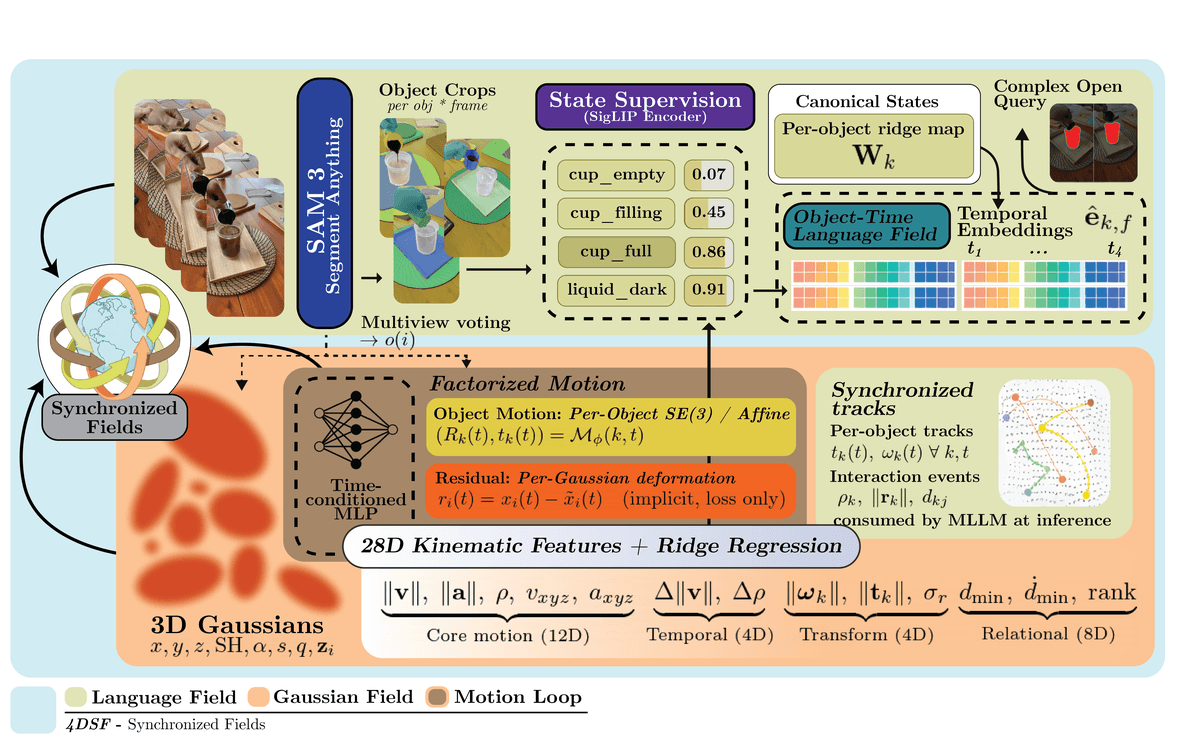
Each Gaussian trajectory is decomposed into shared object motion plus an implicit residual, and a kinematic-conditioned ridge map predicts temporal semantic variation, yielding a single representation in which reconstruction, motion, and semantics are structurally coupled. The training happens in three phases:
- Deformable 4D Gaussian reconstruction using a small MLP that predicts per-Gaussian position, rotation, and scale deltas at each timestep.
- In-loop motion decomposition, where a per-object SE(3) transform captures the shared rigid component and residuals absorb whatever doesn't fit. Object assignments come from projecting Gaussians into per-frame SAM 3 masks and using multiview majority voting.
- Kinematic-conditioned language field, where a closed-form ridge regression per object maps a 28-dimensional kinematic feature vector (speed, acceleration, rigid-share ratio, relational distances, and more) to semantic residuals on top of a static SigLIP appearance anchor.

Crucially, the forward renderer is untouched. The motion decomposition injects training signal only through five regularizers: a residual energy term, a residual-adaptive modulation that eases pressure on genuinely non-rigid Gaussians, a one-sided hinge that enforces a minimum rigid-share ratio, a velocity coherence term, and temporal smoothness on the SE(3) parameters. Removing the object motion model entirely recovers baseline rendering exactly.
The numbers
On HyperNeRF, the method posts 28.52 dB mean PSNR, the highest among all language-grounded and motion-aware baselines, within 1.5 dB of reconstruction-only methods. That 1.5 dB gap versus unconstrained methods like Deformable-3DGS is notably narrower than the 4.5 dB gap that 4D LangSplat gives up.
The temporal-state retrieval results are where things get interesting. The kinematic-conditioned field attains 0.884 mean accuracy, 0.815 mean vIoU, and 0.733 mean tIoU, surpassing LangSplat (0.415, 0.304, and 0.262) and 4D LangSplat (0.620, 0.433, and 0.439 respectively). The gains are largest on scenes where state changes are tightly coupled to motion: pouring liquid into an americano, filling an espresso cup. An ablation that strips out kinematic conditioning and uses only the static SigLIP embedding halves temporal localization quality, confirming that motion features are doing the heavy lifting.
When it works and when it doesn't
This is useful if you need to answer questions about when things happen in a reconstructed scene, not just what's there. Robotics, embodied agents, and video understanding pipelines that need to reason about object state transitions are the natural fit. The structured export includes per-frame object tracks, motion primitives, interaction graphs, and language slots that a multimodal LLM can consume directly.
The limitations are worth flagging:
- Appearance-driven states where surface color or texture change without much motion get little help from kinematic conditioning. The chickchicken scene shows the narrowest margin over baselines.
- Articulated bodies are only approximately captured. The shared SE(3) grabs the dominant rigid component and the rest lands in residuals.
- Optimization time is about 41 minutes per scene on a single A100, so this isn't a feed-forward inference system.
- External masks required. Object assignment depends on SAM 3, and systematic segmentation failures propagate into the factorization.
The paper states that code will be released, though a repository was not yet linked at the time of the preprint. For teams working on world models, temporal grounding, or any pipeline where an LLM needs to reason about a dynamic scene in terms of objects and their moments, this is a compact recipe worth watching.