
3D Camouflage Texture Makes Cars Invisible to Self-Driving Stereo Vision
A new 3D camouflage texture fools stereo depth networks used in autonomous driving, causing simulated Apollo cars to collide with adversarial vehicles up to 76% of the time.
 Pro
Takeaways
- First physical adversarial attack against stereo matching depth estimation using a full 3D vehicle camouflage texture.
- Stereo-aligned rendering module preserves left-right disparity, the physical constraint that defeated prior 2D patch attacks.
- New merging attack blends the target into background depth instead of pushing depth to infinity, removing the tell-tale silhouette.
- Achieves E_blend of 0.056 to 0.082 across five stereo networks, versus 0.4 to 0.8 for prior methods.
- Integrated with Baidu Apollo, the attack triggers rear-end collisions in up to 76% of test episodes.
- Validated with 3D-printed 1:30 vehicle and iPhone 14 Pro Max stereo capture across angles, distances, and lighting.
Most work on tricking self-driving car vision has focused on flat, printed patches stuck onto stop signs or car doors, and almost all of it targets single-camera depth estimation. A new paper flips that script by going after stereo matching models, the two-camera depth systems that many autonomous driving stacks rely on, using a full 3D camouflage texture wrapped around an entire vehicle.
The result is the first physical adversarial attack that survives the strict geometric constraints of binocular vision and can make a car essentially disappear from the depth map. When plugged into Baidu's Apollo self-driving stack, the attack causes the ego vehicle to plow into the adversarial car instead of changing lanes to avoid it.
Why stereo cameras were the safer bet, until now
Monocular depth estimation infers depth from a single image, and adversarial rendering in such settings can be flexibly adjusted, as long as the generated image appears visually plausible. In contrast, stereo matching models depend fundamentally on binocular disparity between two images captured from rigid, spatially coupled viewpoints, which imposes strict physical constraints on how adversarial examples must be rendered.
That physical constraint is exactly why stereo systems were considered a decent defense against the current generation of adversarial patches. A 2D sticker optimized for a single camera view will not produce the geometrically consistent left-right pair that a stereo network needs to be fooled from every angle. Prior attacks on stereo matching mainly relied on 2D patches overlaid in image space, which not only limits their effectiveness to narrow viewpoints, but also breaks the physical disparity consistency required by real-world systems, rendering them ineffective under physical deployment.
The authors argue that a texture covering the whole surface of the target is the only way to sustain a full-scale adversarial effect across viewpoints, distances, and lighting.

The trick: rendering the attack the way stereo cameras actually see
The core technical contribution is what the authors call a stereo-aligned 3D rendering module. Instead of applying perturbations in image space, they build a full physical simulation of the attack scene:
- A 3D object detection model extracts the target vehicle's pose and size as a bounding box with position, dimensions, heading angle, and category.
- The left and right camera viewpoints are parameterized in spherical coordinates (distance, elevation, azimuth) computed from real stereo calibration.
- A differentiable renderer places a textured 3D mesh into both views independently, so the disparity between the two rendered images matches the physics of the real stereo rig.
- Gradients from the stereo matching model flow back through the renderer to optimize the texture
θ.
Without this alignment, the texture just produces two mismatched views that the network can still parse correctly. With it, the adversarial mesh maintains disparity-consistent projections across both cameras, the property that actually breaks depth perception.

A smarter hiding attack that actually hides things
Existing hiding attacks against depth estimation push the predicted depth to infinity. That sounds effective, but the object's silhouette still shows up as a suspicious hole in the depth map, which a downstream planner can flag. The paper introduces what it calls a merging attack, which optimizes the texture so the vehicle's depth blends smoothly into the surrounding background instead of vanishing into a void.
The insight driving this is that the lower regions of the vehicle, which are closer to the ground, tend to align well with the nearby background, while the upper parts show larger depth gaps . So the method splits the object into upper and lower regions using a horizontal contour anchored at the mean background depth, then optimizes each region toward its own local depth prior with a region-aware MSE loss. Two regularizers keep the texture printable: a total variation loss that suppresses high-frequency noise and a non-printability score that penalizes colors printers cannot reproduce.
A complementary appearing attack variant does the opposite. It minimizes the perceived depth so that a distant object looks close, potentially forcing a following car into emergency braking.
How badly it breaks the models
The authors trained textures on the KITTI2015 dataset, a widely adopted benchmark for autonomous driving that provides stereo image pairs , using Expectation over Transformation with randomized lighting and Gaussian noise to simulate rain and fog. They evaluated against five representative stereo networks: PSMNet, GA-Net, RAFT-Stereo, CREStereo, and AnyStereo.
Three metrics matter here: E_blend measures how much of the object still stands out from the background (lower is better for the attacker), E_cover measures how much of the object's depth was altered (higher is better), and E_sys is the actual collision rate in the Apollo simulator.
| Method | PSMNet E_blend / E_cover / E_sys | RAFT-Stereo E_blend / E_cover / E_sys | AnyStereo E_blend / E_cover / E_sys |
|---|---|---|---|
| Benign texture | 0.631 / 0.013 / 0 | 0.786 / 0.012 / 0 | 0.572 / 0.093 / 0 |
| PASM (prior 2D) | 0.475 / 0.154 / 0.13 | 0.502 / 0.148 / 0.07 | 0.471 / 0.124 / 0.15 |
| Adv-DM (prior 2D) | 0.510 / 0.176 / 0.04 | 0.614 / 0.143 / 0.05 | 0.480 / 0.119 / 0.09 |
| This work | 0.058 / 0.553 / 0.74 | 0.082 / 0.571 / 0.62 | 0.056 / 0.576 / 0.76 |
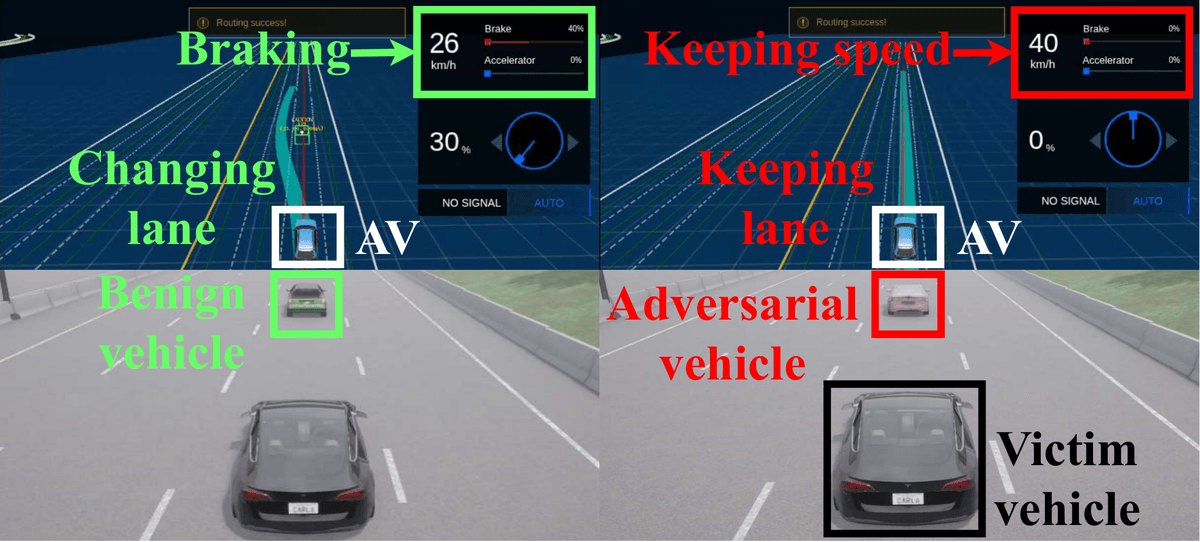
The collision rate is the number that should get attention. In the Apollo simulation, in the benign case, the AV detects the vehicle ahead, slows down, and initiates a lane change to avoid collision. In contrast, under attack, the adversarial texture disrupts scene understanding, causing the AV to maintain its speed and lane, ultimately resulting in a rear-end collision.
Physical world validation
To prove the attack is not a simulator artifact, the team went physical.
They 3D-printed a 1:30 scale sedan and physically applied the optimized texture to its surface. A total of 300 stereo image pairs were collected across diverse conditions using two iPhone 14 Pro Max cameras, emulating the KITTI stereo setup.
The adversarial car maintained E_blend values between 0.067 and 0.095 across midday, sunset, side and front angles, and distances of 12 and 24 meters, compared to 0.4 to 0.5 for the benign texture.
Robustness holds across a full 360 degree sweep of heading angles too. Unlike patch-based attacks that depend on frontal visibility, the full-surface adversarial texture maintains effectiveness from oblique viewpoints due to its geometry-aware design. Even under simulated rain and fog, the worst-case hiding error stays at 0.091.
Transferability and limits
Cross-model transferability is uneven. Textures optimized on PSMNet transfer well to GA-Net, but transfer more weakly to RAFT-Stereo, likely because RAFT-Stereo uses an iterative recurrent refinement paradigm that differs structurally from the cost-volume approaches. Interestingly, cross-category transfer works: an adversarial texture trained on a human mesh still blends into the background when applied to a person model in simulation.
The paper does not release code or model weights at this stage, which limits reproduction. And while the attack is convincing in the KITTI-style two-camera setup, modern production self-driving stacks typically fuse stereo with LiDAR and radar. The Apollo experiments here use decision-level fusion, but multi-sensor fusion under adversarial pressure remains an open question.
Why this matters for perception stacks
The practical takeaway is that stereo depth is not the security backstop some assumed. Any perception pipeline that treats binocular disparity as a robust ground-truth signal for obstacle avoidance now has a documented physically realizable attack surface. Defenders working on autonomous driving safety should probably add adversarial camouflage to their threat models, alongside the more familiar 2D patch attacks against detectors and classifiers.