
17 Researchers Explain Why Most GenAI Pilots Fail in the Real World
A review of 28 studies maps how organizations actually deploy generative AI, and why so many pilots stall before reaching production.
 Pro
Takeaways
- Systematic review of 28 papers synthesizes GenAI benefits, challenges, and research gaps in Information Systems.
- Three dominant failure modes: technical unreliability, societal-ethical risks, and a systemic governance vacuum.
- Introduces the Sociotechnical GenAI Outcomes Matrix mapping benefits, failures, controls, and KPIs across six perspectives.
- Argues the unit of analysis should shift from tool adoption to hybrid human-AI ensemble design.
- Full replication package with screening logs and codebooks on GitHub.
- Healthcare, education, and software engineering emerge as the most heavily studied application sectors.
A group of seventeen researchers spent seven weeks screening 210 papers to answer a question that has quietly become one of the most expensive in enterprise computing: why do so many generative AI pilots look brilliant in a demo and fall apart in the wild? Their systematic review pulls together 18 secondary studies and 10 research agendas published since 2023, and the picture it paints is less about model quality than about the mismatch between what the models can do and what the surrounding organizations are ready to absorb.
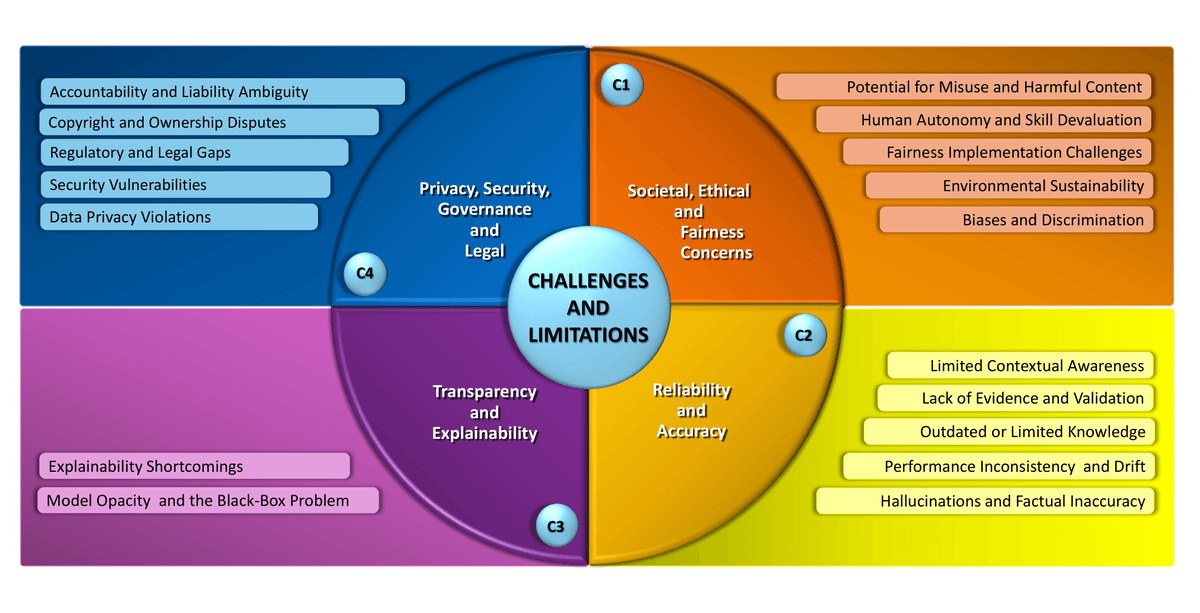
The review analyzes 28 papers and finds that while GenAI offers transformative potential for productivity and innovation, its adoption is constrained by multiple interrelated challenges, including technical unreliability, societal-ethical risks, and a systemic governance vacuum. The authors frame the gap as a socio-technical one: the code moves faster than the humans, policies, and processes around it.
The three failure modes that keep showing up
Across every application sector, from healthcare to software engineering, the same challenges surfaced. The team clusters them into four categories, but three drive most of the pain:
- Technical unreliability. Hallucinations, outdated knowledge from fixed training cutoffs, limited contextual awareness, performance drift, and a lack of domain-specific validation frameworks all undermine confidence in GenAI's readiness for critical applications. Performance drift is especially awkward because initial testing does not reveal it.
- Societal and ethical risks. Bias inherited from training data, misuse for disinformation and deepfakes, and skill erosion from over-reliance on AI assistants.
- Governance vacuum. Current laws and regulations are inadequate for GenAI, adoption is running faster than governance, and there is no globally agreed set of standards for ethical and safe deployment. Suppliers refuse to give performance warranties, leaving adopters holding the operational and legal risk.
What the review actually did
The authors ran their search across Scopus, Web of Science, and the AIS eLibrary using a three-part query combining study type, phenomenon (LLM, GenAI, ChatGPT), and domain (information systems and related fields). They limited results to publications from 2023 onward to capture the post-ChatGPT surge, executing the search on April 12, 2025. The initial search yielded 242 documents before duplicate removal.
Screening happened in two phases, with three reviewers doing title-and-abstract passes and six reviewers doing full-text extraction into a shared Google Sheet. The final set consisted of 28 studies: 18 secondary studies and 10 research agenda papers. Quality was scored with DARE criteria for the reviews and a custom five-point rubric for the agendas. Full replication material, including screening logs and coding sheets, lives in the GenAI4IS GitHub repository.
The Sociotechnical GenAI Outcomes Matrix
The most useful artifact for practitioners is a framework the authors call SGOM. It is a six-row matrix that maps user, organizational, societal, ethical, engineering, and quality perspectives against four columns: what works, why it fails, high-value design moves, and evidence or KPIs to track. The intent is to force teams to align a benefit on any row with a control on the same row and a metric that proves the control is working.
For example, in the engineering row the benefit is defense-in-depth pipelines, the failure mode is prompt injection and performance drift, the design moves include OWASP LLM Top 10 checks, red teaming, retrieval-augmented generation hardening, and canary tests, and the KPIs are attack block rate, jailbreak detection, and a semantic robustness score. It reads like a checklist for anyone shipping an LLM feature into production.
Where the value actually shows up
The synthesis is careful to separate hype from evidence. The team argues that GenAI value materializes primarily through complementarity rather than the wholesale substitution of human labor. The concrete wins named in the literature include:
- Ambient documentation systems in healthcare that cut administrative burden when paired with human review.
- AI-augmented programming that accelerates routine tasks and helps less experienced developers ramp up.
- Automated summarization, translation, and multimodal content generation in knowledge work.
- Synthetic data generation for training and validation without exposing sensitive records.
The catch is that the same complementarity creates a paradox. The more successfully GenAI lowers cognitive load and entry barriers, the greater the risk of human automation bias and long-term erosion of the critical judgment required to supervise the system itself.
The real headline
Beyond the taxonomy, the review pushes a specific argument: the unit of analysis in AI deployment should shift from the tool to the hybrid human-AI ensemble. That means role allocation patterns like assistant-reviewer-attestor, provenance tracking for AI-generated artifacts, contestability by design so users can override and audit outputs, and risk-based governance modeled on the NIST AI Risk Management Framework rather than a compliance checklist.
For teams still running AI as a straight software rollout, the review is a decent diagnostic tool. The pattern it documents across 28 independent studies is consistent enough that if your pilot is stalling, the odds are the problem is not the model.