

Zyphra's ZUNA 1.1 Rebuilds Messy Brain Signals With 90% Electrode Dropout
Zyphra's ZUNA 1.1 upgrades its open EEG foundation model with variable-length inputs, realistic dropout training, and a no-code browser playground for brain signal reconstruction.
 PRO
- ZUNA 1.1 released: Zyphra updates its open EEG foundation model with variable-length inputs (0.5s–30s), four realistic dropout training schemes, and quality-aware preprocessing.
- Bigger training corpus: ZUNA 1.1 trained on ~3.5M channel-hours of public EEG data, up from ~2M in ZUNA 1, across 208 datasets.
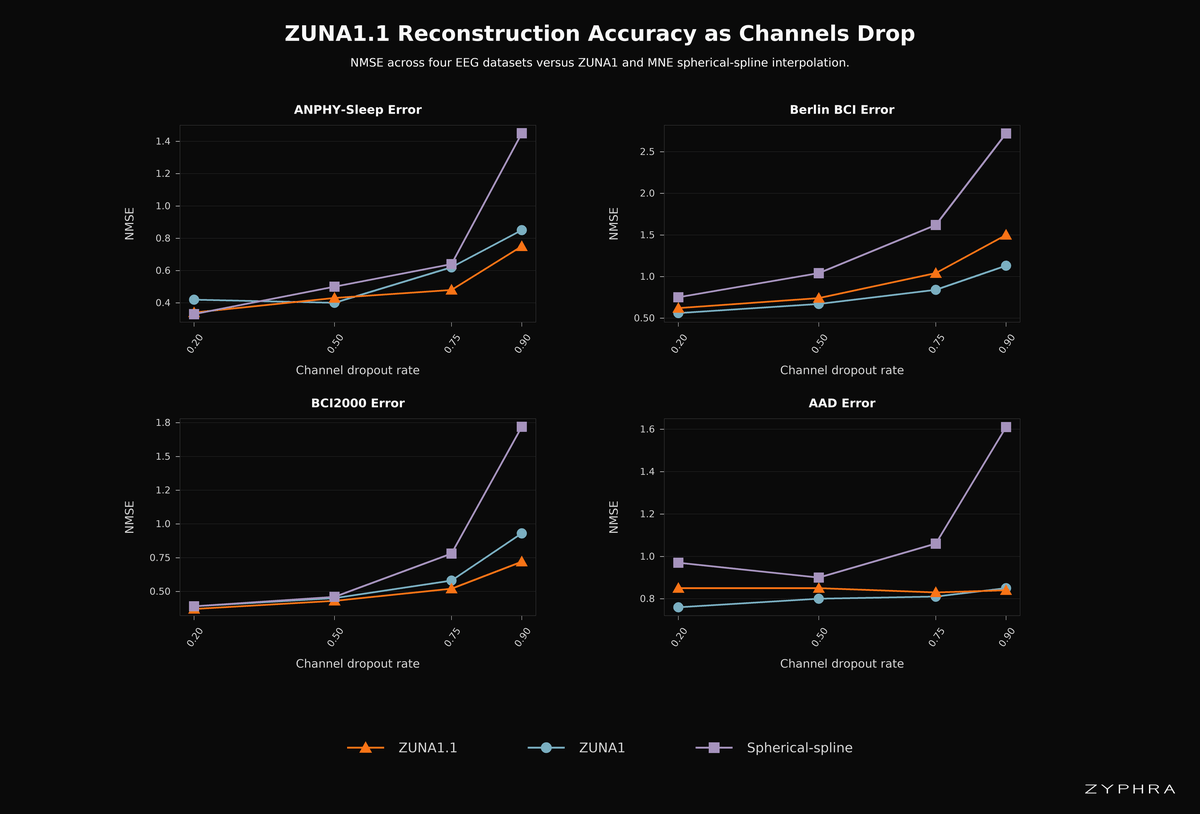
- Beats spherical-spline interpolation: ZUNA 1.1 outperforms the MNE default across all brain regions, with the gap widening at high dropout rates (90% channel loss).
- No-code playground: Available free in the Zyphra Cloud EEG Playground — upload your EEG and run reconstruction in the browser.
- Free and open: Apache 2.0 license; install via
pip install zuna, weights auto-download from Hugging Face. - Research use only: Not validated for clinical or diagnostic use; aimed at neuroscience researchers, BCI developers, and EEG practitioners.
ZUNA 1.1 is the latest version of Zyphra's open EEG foundation model, and it is a meaningful step up from its predecessor. The update brings four concrete upgrades that make the model far more practical for real-world EEG data: variable-length input windows, four new realistic dropout training schemes, quality-aware preprocessing, and a browser-based playground on Zyphra Cloud that requires no GPU or coding knowledge. The weights are Apache 2.0 licensed and free to use.
The problem no one talks about
While scalp EEG data is widely available and noninvasive, it is often messy and incomplete. EEG datasets frequently include partially corrupted sessions, and a few bad channels can render an otherwise valuable recording unusable. The traditional fix has been spherical-spline interpolation, a geometric method built into MNE that smooths signals across the scalp. Spherical splines perform reasonably well when only a few electrodes fail, but as dropout increases, whether from motion artifacts, hardware faults, or low-density headsets, signal quality deteriorates.
Unlike text, images, or audio, the EEG domain still lacks general and powerful foundation models. Data fragmentation is a major reason: EEG datasets are typically small, collected under different protocols, and distributed across many institutions. Different datasets use varying numbers of channels and inconsistent electrode positions, and most deep learning models are trained on fixed channel montages, making them fail when applied to new datasets or recording conditions.
What ZUNA actually is
ZUNA is a 380M-parameter masked diffusion autoencoder trained to perform masked channel infilling and superresolution for arbitrary electrode numbers and positions in EEG signals. A diffusion autoencoder is a model that compresses data into a compact internal representation (the encoder) and then reconstructs it by iteratively denoising random noise into a clean signal (the decoder). ZUNA leverages a diffusion autoencoder architecture based on a transformer backbone. An encoder maps EEG signals to a shared latent space, and a decoder reconstructs EEG signals from latents. It was trained with a masked reconstruction loss and a heavy dropout scheme, enabling ZUNA to denoise existing channels and predict new ones during inference.
This story is for Pro members
You've reached the end of the free preview. Upgrade to AlphaSignal Pro to read the full article - and everything else behind the paywall.
Comments
