

Zed Launches Delta to Replace Git Where AI Agents Write Code
Zed's new standalone app turns agent coding sessions into shared, reviewable, real-time multiplayer threads backed by a CRDT-based version control layer
- Delta launched in private beta: Zed's new standalone multiplayer app lets teams code with agents and review the results in shared, persistent threads.
- Powered by DeltaDB: A CRDT-based version control layer that captures every edit operation between commits, not just snapshots, keeping code and conversation permanently linked.
- Real-time multiplayer: Share a thread link and teammates join as first-class participants who can comment, co-edit prompts, or pick up work without needing a commit or push.
- Claude Code integration: Terminal Claude Code sessions sync live into Delta threads via the open Agent Client Protocol (ACP), with full conversation and code history visible to collaborators.
- Browser version via WASM/WebGL: Delta.dev runs the same Rust app compiled to WebAssembly, so teammates can open threads in a browser with no install required.
- Sign up for early access: Invites rolling out over coming weeks at zed.dev/deltadb; pricing not yet announced.
Delta is a brand-new, standalone application from the team behind the Zed editor. It is designed to be a multiplayer environment where developers and AI agents write code together, and where reviewing that code happens in the same place the work was done. The first private beta invites went out today, with more rolling out over the coming weeks.
This is not a Zed plugin or a new panel inside the editor. Delta is its own app, built from scratch around a new idea: the conversation between you and an agent is the actual source of your software, and your tooling should treat it that way.
The gap Git was never designed to fill
Increasingly, the conversation that generates code is becoming the true source of software. That conversation unfolds continuously and must be cross-referenced to the code as it changes. Git, organized around discrete commits, was never designed to support this. Every prompt, every agent decision, every mid-session course correction disappears the moment you commit.
The announcement is directed at the growing fraction of developers whose workflows involve AI coding agents: tools that generate code through multi-turn conversations that Git's snapshot model permanently discards. Pull requests and review threads exist precisely because the discussion and the code lived in separate places. Delta's bet is that putting them in the same place makes the ceremony disappear.
DeltaDB: the engine underneath
Delta is built on DeltaDB, a new kind of version control the Zed team has been building for over a year. DeltaDB breaks your work into a stream of fine-grained deltas. Where Git captures a snapshot at each commit, DeltaDB captures every operation in between and gives each one a stable identity. Because every delta can be addressed on its own, you can point to the code at any moment in its evolution, even as it keeps changing.
DeltaDB is built on operation-based conflict-free replicated data types, or CRDTs, a class of distributed data structures originally designed for collaborative text editing and since deployed in distributed databases including Redis, Riak, and Azure Cosmos DB. CRDTs are the same technology that makes Google Docs feel seamless: multiple people editing the same document simultaneously, with changes that always converge without conflicts.
In practical terms, multiple people and AI agents can edit the same files simultaneously across different machines, and DeltaDB guarantees the results will converge without producing a merge conflict that demands human resolution.
The key architectural insight is bidirectional traceability. Because every reference is anchored to a delta instead of a line number, it survives as the code moves underneath it. From any line in a past conversation, you can jump to that code as it stands now or as it stood the moment the agent wrote it. From any line of code, you can find the conversation that produced it and every conversation that has touched it since.
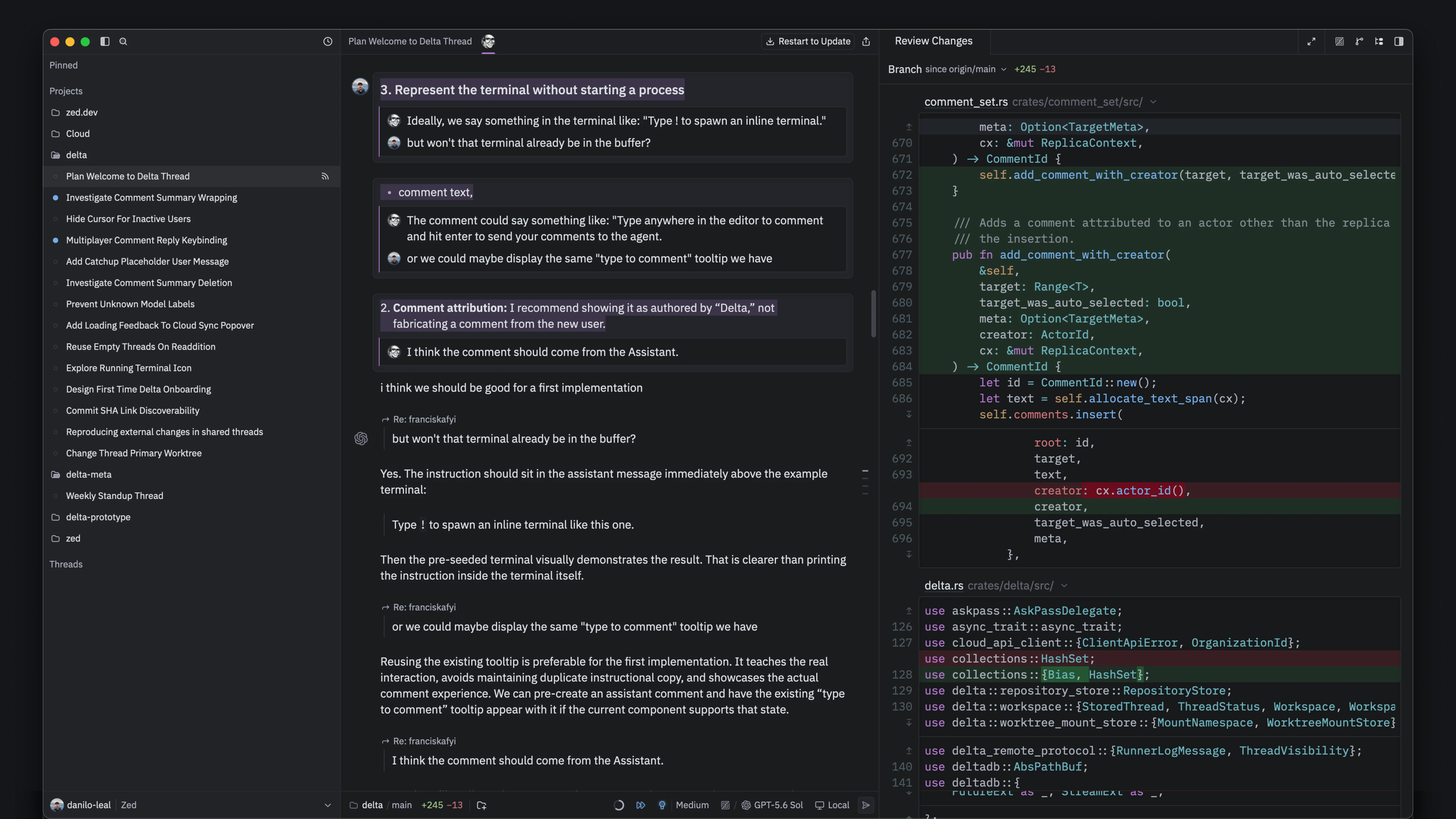
What Delta actually looks like to use
The core interaction model is the thread. You start a coding session with an agent, and that session becomes a shareable, persistent artifact. Here is what that unlocks:
- Multiplayer review: Share a thread with a teammate via a link. They join as a first-class participant, can explore the full history, co-edit prompts, or pick up the work later without wondering whether the latest code was committed or pushed.
- In-place commenting: Comments attach to the exact text they are about, whether that is a line of the diff, a step in the agent's plan, or a thinking block. The agent is still in the thread, so when something looks wrong, you ask it directly instead of reconstructing intent from a diff.
- Cursor-everywhere editing: The conversation is treated as a document. You navigate it with the same keyboard motions you use on code, and you can put your cursor anywhere in the thread to respond to something specific.
- Cloud continuity: Move your work to a cloud runner, close your laptop, and the agent keeps going. The conversation and code stay synchronized with the thread.
- Git compatibility: DeltaDB works with the git repo you already have. Every edit and conversation is captured between your commits. Teammates who never open Delta see a normal git repo.
A browser version that is not a downgrade
One of the more technically ambitious claims in the announcement is about the web version. The vision is to turn your IDE into a collaborative workspace where humans and AI agents work together across a range of time scales, with every insight preserved and linked to the code forever. DeltaDB is a new kind of version control that tracks every operation, not just commits. It uses CRDTs to incrementally record and synchronize changes as they happen, and it is designed to interoperate with Git.
Delta.dev is not a stripped-down JavaScript rebuild. The team compiled the same Rust application to WebAssembly and renders it through WebGL, meaning a teammate can open a shared thread in a browser and get the same experience as the native app, with no install required.
Claude Code plugs right in
Delta also connects to third-party agent harnesses out of the box. As of 2026, Claude Code can run directly inside Zed through ACP , and Delta extends this: keep working in your Claude Code terminal session, and it syncs live into a Delta thread. Teammates can watch the conversation and code evolve, comment in place, and pick up the work with full context. This is the same Agent Client Protocol (ACP) that Zed open-sourced and that JetBrains has also adopted across its IDE suite.
Why a separate app, not a Zed feature?
The Zed team is explicit about this choice. Rebuilding Zed's foundations underneath hundreds of thousands of daily users would have disrupted the workflows they rely on. DeltaDB is version control designed to store the process of coding alongside the agent, not just the code itself , and that required an application built around its replicated abstractions from day one, with the conversation at the center rather than the editor. DeltaDB will eventually come to Zed, but Delta is where it begins.
There are still open questions. CRDTs are harder to implement correctly than snapshot-based systems, and storage requirements can be larger because every operation must be retained rather than just the final state. Zed has not yet published details on how it handles CRDT metadata growth, garbage collection of obsolete operations, or performance characteristics of the synchronization layer under heavy concurrent load. These are real engineering challenges that will surface as the beta scales.
Who it is for and how to get in
Delta is in private beta right now. Zed is open-source with an optional paid offering, and the plan is to do the same with DeltaDB: build it, open-source it, and offer an optional paid service. No pricing for Delta specifically has been announced yet. You can sign up for early access at zed.dev/deltadb, with invites rolling out over the coming weeks.
The practical use-cases are clearest for teams already doing heavy agentic development: reviewing long agent sessions without losing context, handing off work mid-session to a teammate, or keeping a persistent, searchable history of why the code looks the way it does. If your current workflow involves copy-pasting agent output into a PR and hoping reviewers can reconstruct the intent, Delta is directly aimed at that problem.
73% of engineering teams now use AI coding tools daily as of 2026, up from 41% in 2025. The bottleneck is no longer generating code, it is reviewing, understanding, and handing it off. That is the gap Delta is trying to close.
Comments
