

Z.ai's ZCode Ships a Desktop Agent Built Around GLM-5.2's 1M-Token Window
Z.ai launches ZCode, a dedicated desktop IDE for GLM-5.2, with 1.5x quota for subscribers and BYOK support across all platforms
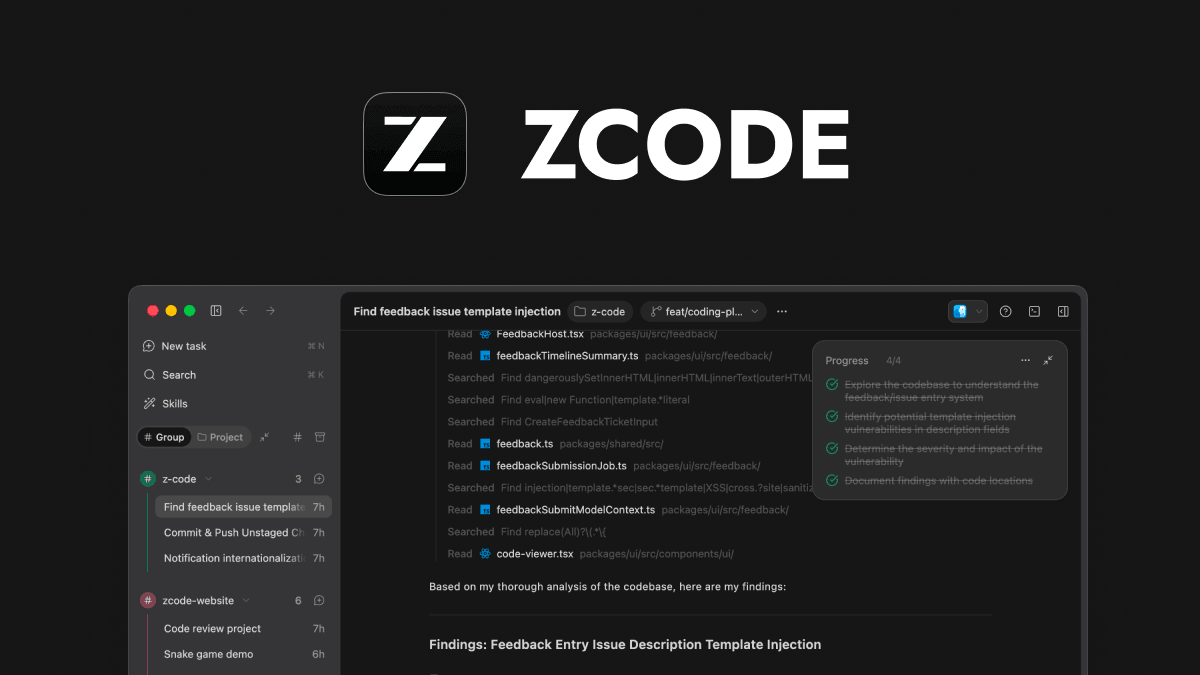
- ZCode launched as the official desktop IDE for GLM-5.2, available on macOS, Windows, and Linux (beta) at zcode.z.ai.
- GLM Coding Plan subscribers get a 1.5x usage quota boost inside ZCode; new users get a free trial quota.
- BYOK supported -- plug in OpenAI, Anthropic, DeepSeek, or any compatible endpoint alongside GLM-5.2.
- GLM-5.2 is a 753B MoE model with a usable 1M-token context window and MIT open-source license, targeting long-horizon agentic coding tasks.
- Pricing tiers run from $16.20/month (Lite) to $144/month (Max); the model itself can also be self-hosted commercially under MIT.
- Key limitation: ZCode is not open source, Linux support is beta, and it's less suited for teams needing VS Code-native or fully offline workflows.
ZCode is Z.ai's official desktop environment for GLM-5.2, and it just went live. Think of it as the first-party GUI wrapper around the model -- the same relationship Cursor has to GPT-4, except ZCode is built by the same team that trained the model underneath it. That tight coupling is the whole pitch: no endpoint configuration, no API key juggling, just a workspace that's been tuned specifically for how GLM-5.2 thinks and works.
The model doing the heavy lifting
To understand ZCode, you first need to understand what's running inside it. GLM-5.2 is the flagship coding model from Z.ai (the international brand of Zhipu AI, a Beijing company spun out of Tsinghua University). It's a Mixture-of-Experts model -- reported at roughly 753B total parameters with about 40B active per token -- built for long-horizon, agentic software engineering rather than chat. MoE (Mixture-of-Experts) means the model routes each token through only a subset of its parameters, keeping inference costs manageable despite the massive total parameter count.
The headline features are a usable 1-million-token context window (with up to ~128K-131K output tokens per response), a new dual thinking-effort system (High and Max modes), and an architectural optimization called IndexShare that reduces per-token compute at extreme context lengths. IndexShare works by reusing the same indexer across every four sparse attention layers, reducing per-token FLOPs by 2.9x at a 1M context length.
The 1M-token window is the feature most relevant to real coding, because it changes what fits in a single context. At GLM-5.1's 200K window, you chunk a large codebase and lose cross-file context; at 1M, you can hold a substantial repository -- many files, their relationships, the relevant history -- in one pass.
What ZCode actually is
Z.ai officially describes ZCode as a desktop agent powered by GLM-5.2 -- an application that runs the GLM-5.2 model to do coding work, not the model itself. GLM-5.2 provides the intelligence (the reasoning, the code generation, the planning); ZCode provides the environment around it -- the desktop interface, the task structure, the workspace, the remote-control surfaces.
ZCode is best understood as an Agentic Development Environment rather than a traditional editor with a chat sidebar. The central organizing concept is the Goal. Rather than issuing one instruction at a time, you define a complex objective as a Goal (invoked as /goal), and the agent plans, executes, and verifies it across multiple steps. This is the long-horizon pattern: you state what you want accomplished, and the agent breaks it into steps, works through them, and checks its results, rather than needing you to direct each individual action.
What it's built for
The use cases ZCode targets are the ones where existing tools tend to fall apart -- tasks that span hours, not minutes:
- Large-scale refactors: GLM-5.2 is more stable in cross-file, multi-step, long-chain tasks. It first breaks down the goal, identifies dependencies and risks, then implements, verifies, and closes the task in stages.
- Paper reproduction: GLM-5.2 can turn the model architecture, loss functions, data pipelines, and training/inference scripts described in a paper into runnable code that aligns with the paper.
- Code-to-video workflows: In Code-to-Video scenarios, GLM-5.2 can use the Remotion framework to create videos programmatically with React code, including components, parameters, and animation logic, and then render them into MP4. In simple terms, it treats video creation as writing code.
- Remote and async work: You can start and steer ZCode from WeChat, Feishu, or Telegram so work can keep moving anywhere.
What people are saying
Early reactions to GLM-5.2 have been unusually positive for a model that launched without a benchmark sheet. The CEO of Vercel was quoted saying he was "genuinely impressed, almost shocked" at how good GLM-5.2 is at coding. One developer who tested it on a real production codebase noted that the model did something only frontier models usually do: it asked good questions before writing code. GLM-5.2 is a slower, more deliberate model than other open-weights options -- but a slow model that one-shots the feature beats a fast one you have to argue with.
The developer reaction to the release has been immediate and overwhelmingly positive. The team behind Kilo Code confirmed day-one integration. On the benchmark side, on FrontierSWE -- which measures whether an agent can complete open-ended technical projects at the scale of hours to tens of hours -- GLM-5.2 trails Opus 4.8 by only 1% while edging out GPT-5.5 by 1% and Opus 4.7 by 11%.
The BYOK angle and what it costs
One of the more practical additions in this launch is BYOK (Bring Your Own Key) support. ZCode supports flexible BYOK for OpenAI-compatible and Anthropic-compatible providers. That means you can route tasks through Claude, GPT, DeepSeek, or any OpenAI-compatible endpoint alongside GLM-5.2 -- useful for teams that already have existing API contracts they want to leverage.
For GLM-5.2 access specifically, ZCode runs on Z.ai's GLM Coding Plan. The tiers currently listed on the site are:
- Lite: $16.20/month -- lightweight iteration on small repos, rolling access to flagship models
- Pro: $64.80/month -- 5x Lite usage, priority access, curated MCP tools, faster generation
- Max: $144/month -- 20x Lite usage, first access to new models, dedicated resources at peak
With today's announcement, new ZCode users can access a limited free GLM trial quota. Existing GLM Coding Plan subscribers get a 1.5x boost to their usage quota inside ZCode specifically.
Where it falls short
ZCode is not for everyone. A few honest limitations worth knowing before you commit:
- ZCode is not open source based on available official materials.
- Mac and Windows are the primary documented platforms; Linux is still positioned as beta.
- It is less ideal for teams that need an open-source editor, a VS Code-native workflow, or fully local/offline model execution.
- ZCode's privacy policy says it may collect account information, device/log data, user-provided prompts, generated content, and conversation records. Teams handling sensitive code should review the privacy policy, model-provider routing, BYOK configuration, and retention controls before rollout.
The bigger picture
The most disruptive aspect of the GLM-5.2 release is its licensing. Z.ai released the model's weights under an MIT open-source license, establishing it as a "Pure Open" system. For builders, MIT weights mean you can self-host GLM-5.2, customize it, and use it commercially without the restrictions that come with non-standard "open" licenses -- a meaningfully different deployment position than closed API-only models or open-weight models under restrictive community licenses.
This is an increasingly appealing option for enterprises, as state-of-the-art American proprietary models face an uncertain regulatory future, following the Trump Administration's export control directive prohibiting foreign nationals from using Anthropic's new Claude Fable 5 model. A fully MIT-licensed, self-hostable frontier coding model changes the calculus for teams that need sovereign infrastructure.
ZCode is available now for download on macOS (Apple Silicon and Intel), Windows (x64 and ARM64), and Linux (beta). If you're already using GLM-5.2 through Claude Code, Kilo Code, or the raw API, ZCode is worth a look as the first-party environment that's been co-designed with the model -- especially if long-running, multi-step tasks are your primary workload.
Comments
