

Z.ai's GLM-5.3-Flash Matches Claude Opus at One-Tenth the Price
Z.ai just dropped a 320B mixture-of-experts model with 18B active params, MIT-licensed weights, native multimodal input, and a 1M-token context window.
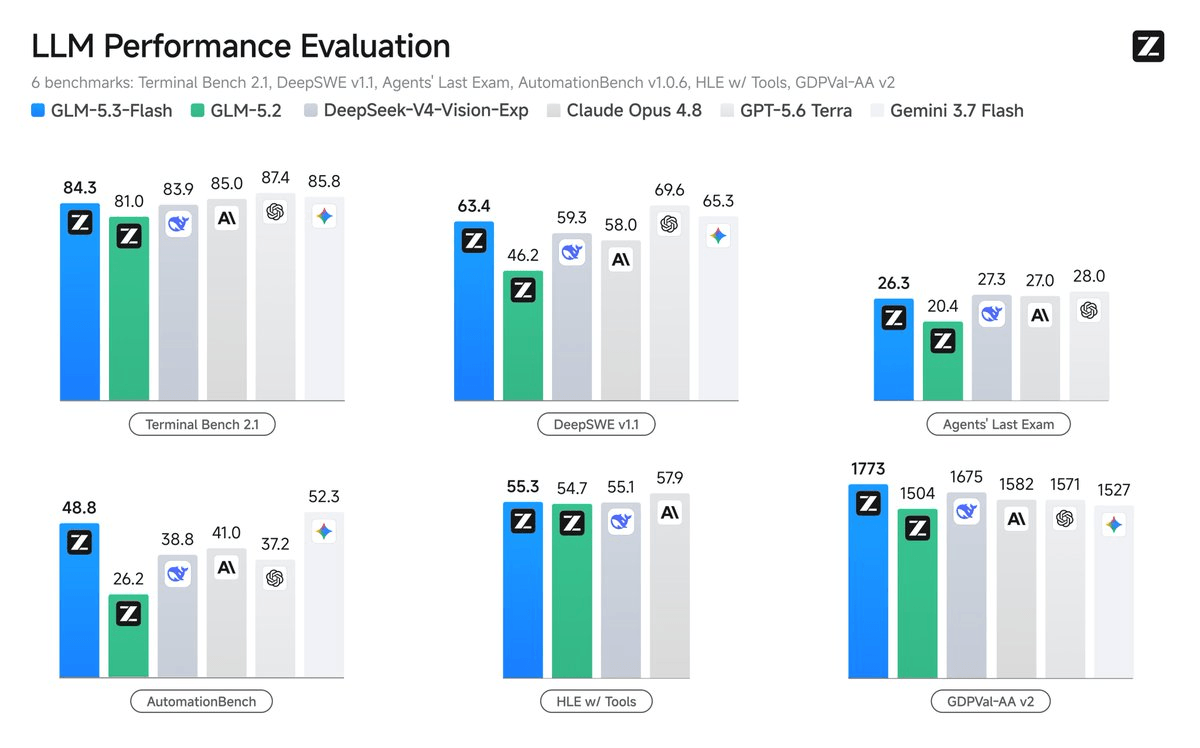
- Z.ai released GLM-5.3-Flash, a 320B MoE model with 18B active params under MIT license.
- Natively multimodal with a 1M-token context window, previously stealth-tested as Ox Alpha on OpenRouter.
- Pricing: $0.15/M input, $0.50/M output, $0.03/M cached; roughly one-tenth of Opus-class models.
- New hybrid sparse plus linear attention and Manifold-Constrained Hyper-Connections; 30T-token pretraining corpus.
- Matches Claude Opus 4.8 on Z.ai Code Bench using ~40% of the output tokens per task.
- Trained on Chinese AI chips; deployable via vLLM, SGLang, KTransformers.
Z.ai has released GLM-5.3-Flash, the first natively multimodal model in the GLM-5 series and the first flagship-class open-weight model that credibly claims parity with Claude Opus at a fraction of the cost. The model was previously running incognito on OpenRouter as Ox Alpha, where community sleuths flagged it as suspiciously good before Z.ai confirmed the identity.
The headline configuration is 320B total parameters with just 18B active, outperforming GLM-5.2 across benchmarks and real-world workloads at one-tenth the price, while approaching Claude Opus 4.8 on coding and agentic tasks. Weights ship under the MIT license on Hugging Face, and the model is live across Z.ai's API, ZCode, Chat, and AutoClaw surfaces.
Pricing that resets the floor
Per 1M tokens, the standard API charges:
- Input: $0.15
- Output: $0.50
- Cached input: $0.03
For context, that puts GLM-5.3-Flash roughly an order of magnitude below Opus-class closed models while landing in the same benchmark neighborhood for coding tasks. On Z.ai's own in-house Code Bench, at the High reasoning-effort tier, GLM 5.3 reportedly scored around 31.4% accuracy while emitting roughly 50,000 tokens per task on average, beating Claude Opus 4.8's Max tier score of about 29.5%, which needed roughly 120,000 tokens to get there. That token-efficiency delta compounds when you pay by the token.
Rebuilt from the ground up
Unlike GLM-5.3 (the larger sibling), which reused the GLM-5.2 base, Flash is a ground-up rebuild. GLM-5.3-Flash starts from a newly trained base model, with its architecture and training recipe redesigned around capability and efficiency. For the first time in the GLM series, Z.ai introduces a hybrid architecture combining sparse and linear attention, sharply reducing long-context serving costs while preserving precise long-context capabilities.
Two innovations do most of the heavy lifting:
- Hybrid sparse plus linear attention. Sparse attention only computes scores between selected token pairs instead of every pair, and linear attention approximates the full attention matrix with a math trick that scales linearly with sequence length. Combining them lets the model serve 1M-token contexts without the quadratic cost blowup that normally makes long-context inference prohibitively slow.
- Manifold-Constrained Hyper-Connections (mHC). Hyper-connections generalize residual connections by letting information flow across layers along multiple learned pathways. The manifold constraint keeps those pathways from collapsing as the model scales.
Combined with Z.ai's latest 30T-token multimodal pre-training corpus, these changes let GLM-5.3-Flash deliver more capability per unit of compute.
Trained on Chinese silicon
The Ox Alpha preview was running entirely on Chinese AI chips. This tracks with Z.ai's broader trajectory. Their previous flagship was developed using domestically manufactured chips for inference, including Huawei's Ascend and products from Moore Threads, Cambricon, and Kunlunxin. For anyone tracking whether US export controls have meaningfully slowed Chinese frontier training, this is another data point in the direction of no.
What it's good at
On real coding tasks, the improvements over GLM-5.2 are not subtle. Terminal-Bench 3.0 jumps from 4.6 for GLM-5.2 to 28.3 for GLM-5.3 in Z.ai's table. AutomationBench 1.0.6 rises from 26.2 to 48.2. DeepSWE 1.1 moves from 46.2 to 66.9. Those shifts are much larger than a typical point release produces on static question answering.
Z.ai's framing is that GLM-5.3-Flash clearly outperforms GLM-5.2 at every effort level on its internal Code Bench and performs on par with Claude Opus 4.8. That benchmark is private, so treat the exact numbers with the usual vendor-reported skepticism, though the direction is corroborated by the public ones.
Where it stumbles
The model does not dominate every frontier competitor. Z.ai's own benchmark table shows GPT-5.6 Sol at 34.6 and Claude Fable 5 at 33.7 on Terminal-Bench 3.0, compared with GLM-5.3's 28.3. On DeepSWE v1.1, GLM-5.3 scores 66.9, compared with 72.7 for GPT-5.6 Sol and 69.7 for Fable 5. For workloads focused on deep terminal automation or long-horizon software engineering at the absolute frontier, closed models still edge it out.
Community reactions have been enthusiastic but not uncritical. Early hands-on threads on X mix praise with pointed asks. AshutoshShrivastava, who had early access, called it a massive upgrade. The consistent request is for smaller distilled variants for local inference.
Running it locally
Weights are already on Hugging Face at ~321B parameters in mixed BF16 / FP8_E4M3 precision. Deployment paths documented at launch:
- vLLM with an OpenAI-compatible server
- SGLang with a matching launch script
- KTransformers for CPU/GPU hybrid inference
- TokenSpeed via a dedicated recipe
A minimal vLLM startup looks like this:
pip install vllm
vllm serve "zai-org/GLM-5.3-Flash"
curl -X POST "http://localhost:8000/v1/chat/completions" \
  -H "Content-Type: application/json" \
  --data '{
    "model": "zai-org/GLM-5.3-Flash",
    "messages": [{"role": "user", "content": "Refactor this function..."}]
  }'
With 18B active parameters routing through a 320B MoE, you still need serious hardware to host it, though inference cost per query sits closer to a mid-sized dense model than the total parameter count suggests.
Why this matters
The interesting shift is the shape of the release, not the fact that another Chinese lab hit frontier benchmarks. Fully open weights under MIT, native multimodal, 1M context, priced below the rest of the market, and trained on non-NVIDIA silicon. Every one of those choices removes a lever that closed labs currently use to lock in customers.
For teams building coding agents or long-context document pipelines, the practical decision has narrowed. You can now self-host a model that trades roughly evenly with Opus on the workloads you actually run, or hit the API at 15 cents per million input tokens. The gap between open and closed on agentic coding, which was the last defensible moat, has effectively closed.
Comments
