

Z.ai's GLM-5.3 Brings Frontier Cybersecurity AI to the Open-Weight World
Z.ai's GLM-5.3 pushes its 743B base model further with post-training focused on agentic coding and cybersecurity, with open weights coming after safety review
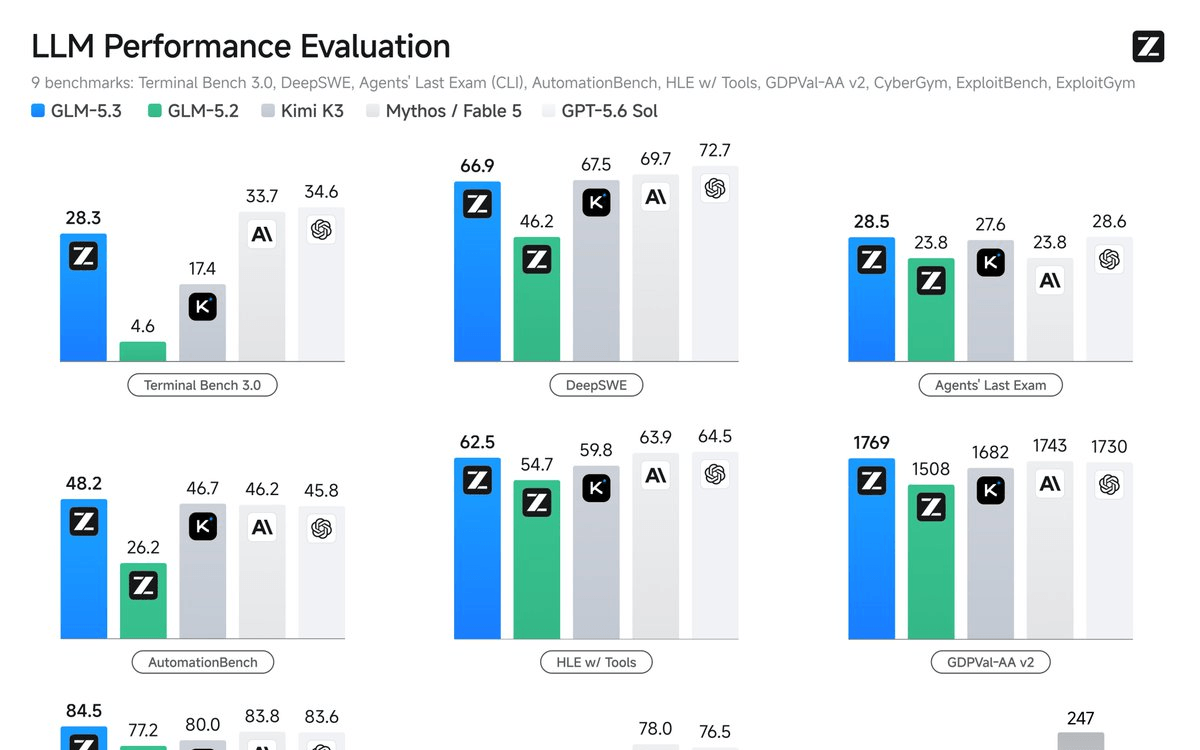
- GLM-5.3 released: Z.ai's new model applies post-training on the 743B base to improve agentic coding and cybersecurity capabilities over GLM-5.2.
- Token efficiency improved: Z.ai claims GLM-5.3 achieves better results with fewer output tokens, addressing a known weakness of the GLM-5.2 line.
- Cybersecurity focus: Builds on GLM-5.2's security credentials, which beat Claude Code on IDOR vulnerability detection (39% vs 32% F1) in independent Semgrep tests.
- Staged open-weight release: Unlike GLM-5.2, open weights will be released in stages after safety evaluations, a notable shift given cybersecurity misuse concerns.
- Available now via GLM Coding Plan ($18/mo) and ZCode; API access and open weights to follow.
- Weaknesses remain: Still text-only (no vision), and the GLM line trails Claude Opus 4.8 on SWE-Marathon and tool-heavy agentic benchmarks.
Z.ai just announced GLM-5.3, the latest iteration of its General Language Model series, and the pitch is blunt: this one is built to code and built for cyber defense. The model doesn't introduce a new architecture or a new base model. Instead, it applies targeted post-training on top of the same 743B-parameter foundation that powered GLM-5.2, squeezing out better agentic coding performance and a significant leap in cybersecurity capabilities.
Same bones, sharper skills
To understand GLM-5.3, you need to understand what post-training means here. The base model, a massive Mixture-of-Experts (MoE) architecture, stays frozen. Post-training refers to the additional fine-tuning and reinforcement learning applied on top of it, teaching the model to behave better on specific tasks without relearning everything from scratch. Z.ai says GLM-5.3 delivers a "dramatic improvement" over GLM-5.2 in agentic coding while also achieving better results with fewer output tokens, which matters a lot in practice since token efficiency directly translates to cost and latency.
The underlying architecture is the same one introduced with GLM-5: a 744B parameter MoE model with 40B parameters active per token, trained on 28.5 trillion tokens . The key efficiency trick is IndexShare, an optimization to sparse attention that reduces per-token compute by 2.9x at the full 1-million-token context length . That's what makes serving a 744B model economically viable.
The cybersecurity angle is the real headline
Z.ai is positioning GLM-5.3 as setting "a new standard among open models" for cybersecurity. That's a bold claim, but the GLM lineage has earned some credibility here. With GLM-5.2, the predecessor, the security community took notice fast.
- Semgrep benchmarked GLM-5.2 against leading models on IDOR detection (a class of access-control vulnerability) using the same prompt they use to evaluate frontier coding agents. GLM-5.2 scored 39% F1, beating Claude Code at 32%, at roughly $0.17 per vulnerability found.
- Graphistry ran a separate evaluation on the CyBT-CTF benchmark, a capture-the-flag evaluation used by security researchers, and found GLM-5.2 matched Opus 4.8 on solve rate, making it the first open-weight model Graphistry said it would recommend for a "frontier-like" cybersecurity experience.
- The 1M-token context window is particularly relevant for security tasks, since things like IDOR detection require reasoning across different files through an authorization framework.
GLM-5.3 claims to push this further. The cybersecurity improvement is described as a major leap, though specific benchmark numbers haven't been published yet pending the staged rollout.
What it's good at, and where it still falls short
The GLM-5.x line has a clear profile. It excels at long-horizon agentic coding tasks, the kind where a model needs to plan, execute, and self-correct across a full engineering workflow. On SWE-bench Pro, GLM-5.2 scored 62.1, beating GPT-5.5 (58.6), and on FrontierSWE it hit 74.4%, surpassing GPT-5.5 (72.6%) and finishing in a near-tie with Claude Opus 4.8 (75.1%).
But the weaknesses are real. On SWE-Marathon, a difficult long-duration agentic coding benchmark, GLM-5.2 completed just 13% of tasks. Claude Opus 4.8 doubled that score. There's also a token efficiency concern: community threads on Hacker News and Reddit report that GLM-5.2 can burn 50 to 100 times more tokens than GPT-5.5 on the same task, a gap that pure benchmark scores hide. Z.ai explicitly says GLM-5.3 addresses this, delivering better results with fewer output tokens. Claude Opus 4.8 also handles images natively; the GLM line remains text-only.
The open-weight question
One of the most consequential things about the GLM series is that it ships as open weights under an MIT license. The MIT license grants developers the right to download, modify, fine-tune, and commercially deploy the model's weights without restriction. Weights installed on your own servers cannot be switched off by a US or Chinese government directive, which directly addresses the access-revocation risk demonstrated by recent export control actions.
GLM-5.3 is taking a different approach. Z.ai says API access and open weights will be released in stages following rigorous safety evaluations. This is a notable departure from the GLM-5.2 playbook, where open weights followed the initial release within days. The reason is likely the cybersecurity focus: unlike Anthropic's Mythos, which is export-controlled by the US government, GLM-5.2 was open-weight under an MIT license, and Axios reported Russian-language hacker forums were already sharing jailbreak techniques within days of the open-weight release. Z.ai appears to be threading the needle between openness and responsibility.
There's also a data question hanging over the GLM line. Graphistry researchers flagged a statistical anomaly: GLM-5.2's outputs correlated unusually highly with both GPT-5.5 and Opus 4.8 responses on identical prompts, with Cohen's Kappa values of 0.80 and 0.76 respectively, against a baseline of 0.63 between the two US models. Z.ai has not publicly addressed these distillation allegations.
How to access it now
GLM-5.3 is available immediately through two channels:
- GLM Coding Plan at z.ai/subscribe: A subscription tier starting at $18/month for the Lite tier. This is the flat-rate path for developers who live in an IDE all day.
- ZCode: Z.ai's coding CLI, which has historically offered generous free token allowances to pull developers onto the platform.
For API access, GLM-5.2 was priced at $1.40 per 1M input tokens, $0.26 per 1M cached input tokens, and $4.40 per 1M output tokens , and GLM-5.3 pricing is expected to follow a similar structure. The model's Chinese origin complicates its use for companies wary of routing sensitive data through Chinese-linked infrastructure, but the open weights provide an out: any organization can host the model on its own hardware.
The bigger picture
GLM-5.3 lands in a specific moment. Anthropic's most capable cybersecurity model, Mythos, is restricted to vetted partners. Mythos identified thousands of zero-day vulnerabilities across every major operating system and browser during testing, developed working exploits in over 83% of cases on the first attempt, and scored 83.1% on the CyberGym vulnerability reproduction benchmark. That capability is locked behind a gate. GLM-5.3 is explicitly trying to bring frontier-class security AI into the open-weight world, which restructures the calculus for both defenders and attackers.
For security teams, the practical case is straightforward: an open-weight model can run entirely inside your own environment, which matters for security teams working in sensitive areas where data cannot leave internal systems. For the broader field, Z.ai's rapid release cadence (GLM-5, 5.1, 5.2, and now 5.3 all within months) is a signal that post-training iteration, not just base model scaling, is becoming the primary lever for capability gains at the frontier.
Comments
