

Z.ai's GLM-5.2 Hits 1M Context Window to Challenge Claude Code
Z.ai's GLM-5.2 arrives as the new coding flagship with 1M-context support, two thinking-effort modes, and a full open-source MIT release coming next week
- GLM-5.2 is Z.ai's new coding flagship, available now for all GLM Coding Plan users (Lite, Pro, Max, Team).
- 1M-token context window is the headline upgrade, up from 200K in GLM-5 and GLM-5.1, enabling whole-codebase analysis.
- Two thinking-effort modes (High and Max) let developers trade latency for deeper reasoning; Z.ai recommends Max for coding tasks.
- Full API and chatbot launch next week, along with an open-source MIT License release on Hugging Face.
- Integrates with Claude Code, OpenClaw, and Cline via OpenAI-compatible API at docs.z.ai.
- Priced below Claude Opus 4.6 (~$1.40/M input tokens vs $5/M), continuing Z.ai's aggressive open-weight pricing strategy.
Z.ai just announced GLM-5.2, the newest entry in its rapidly iterating GLM model family and its current coding flagship. The model is already live for all GLM Coding Plan subscribers, with a full API launch and open-source release under the MIT License arriving next week. For a company that only went public on the Hong Kong Stock Exchange in January 2026, the pace of releases is striking.
A lineage built for engineering, not just chat
To understand what GLM-5.2 is, you need to know what came before it. GLM-5 is a 744B-parameter Mixture-of-Experts model with 40B active parameters per token, roughly a 2x scale-up from GLM-4.5. It was trained entirely on Huawei Ascend chips using the MindSpore framework, with zero dependency on NVIDIA hardware. That model set the tone: open-weight, aggressively priced, and laser-focused on agentic coding tasks.
GLM-5.1, released in April 2026, was a post-training upgrade to GLM-5, built on the same 744B-parameter MoE architecture with a 200K token context window. The key improvement was sustained productivity in long-running tasks: where GLM-5 and many other models produce final output within a certain token budget, GLM-5.1 cycles through planning, execution, evaluation of intermediate results, and evaluation of its approach until it judges the task to be complete. On SWE-Bench Pro, GLM-5.1 achieved a score of 58.4, outperforming GPT-5.4, Claude Opus 4.6, and Gemini 3.1 Pro.
GLM-5.2 is the next step in that progression, and it brings a headline feature that the previous models lacked: a true 1M-token context window.
What's actually new
The announcement highlights three core additions in GLM-5.2:
- Usable 1M-token context -- previous GLM models topped out at 200K. The jump to 1M puts it in the same tier as Gemini's long-context offerings and opens up whole-codebase analysis, large document ingestion, and multi-file refactoring in a single pass.
- Two thinking-effort levels -- High and Max. Thinking effort controls how much internal reasoning the model does before responding. High is the default; Max unlocks deeper reasoning chains at the cost of more latency and tokens.
- Continued long-horizon task strength -- building on GLM-5.1's ability to run autonomous loops for hours, iterating on its own output rather than stopping at a first-pass answer.
The thinking-effort dial
The two-tier effort system is the most immediately practical feature for developers. The model supports per-turn control over reasoning within a session -- you can disable thinking for lightweight requests to reduce latency and cost, and enable it for complex tasks to improve accuracy and stability. In GLM-5.2, that control is formalized into two named levels.
If you're running GLM-5.2 through Claude Code (which Z.ai's Coding Plan routes through), the mapping works like this:
| Claude Code effort setting | GLM-5.2 actual effort |
|---|---|
| low, medium, high (default) | High |
| xhigh, max, ultracode | Max |
Z.ai explicitly recommends using Max effort for coding tasks. The tradeoff is real: Max effort will consume more tokens and take longer, but for complex multi-file bugs or architecture-level refactors, the deeper reasoning chains produce more reliable results.
How to get it running now
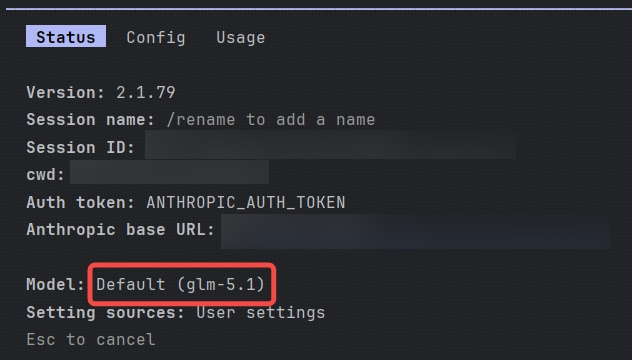
GLM-5.2 is available today for all GLM Coding Plan tiers (Lite, Pro, Max, and Team). The API and chatbot interface launch next week. To switch to it in Claude Code, update your ~/.claude/settings.json:
{
  "env": {
    "CLAUDE_CODE_AUTO_COMPACT_WINDOW": "1000000",
    "ANTHROPIC_DEFAULT_HAIKU_MODEL": "glm-4.5-air",
    "ANTHROPIC_DEFAULT_SONNET_MODEL": "glm-5.2[1m]",
    "ANTHROPIC_DEFAULT_OPUS_MODEL": "glm-5.2[1m]"
  }
}
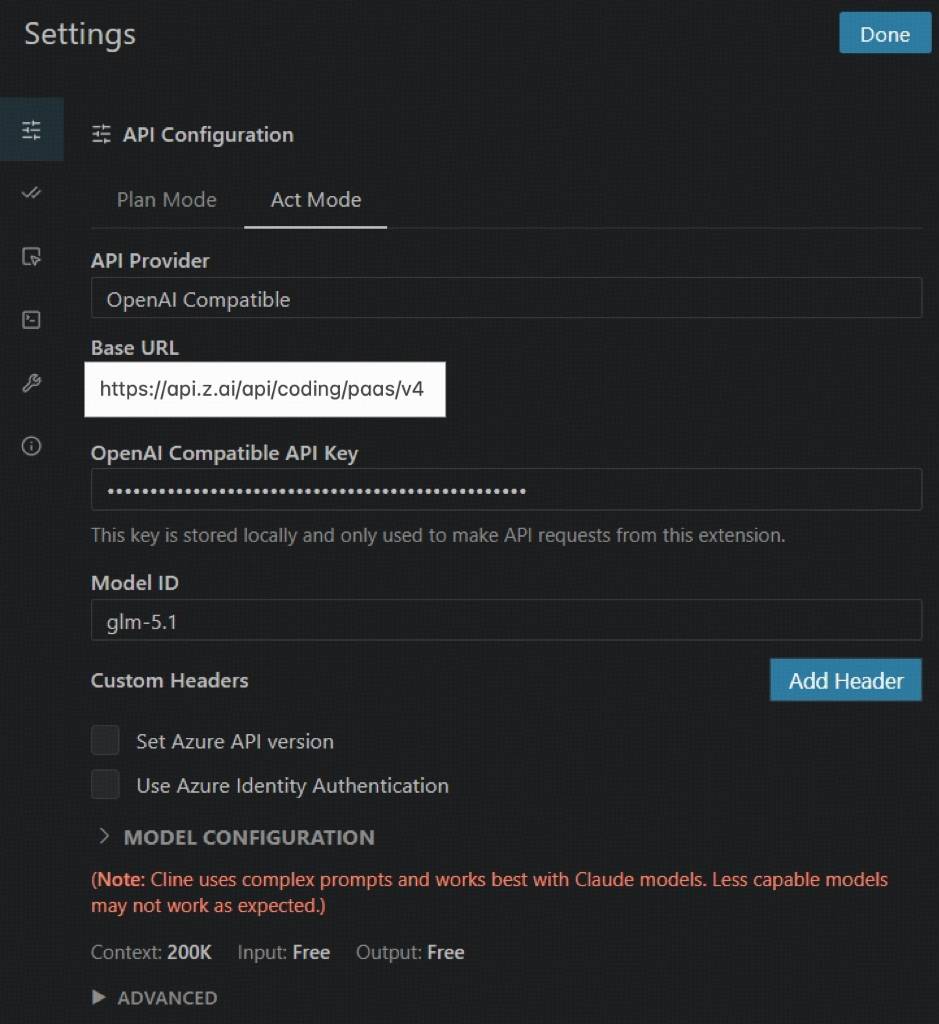
Then open a new terminal, run claude, and type /status to confirm the model switch. To toggle effort level mid-session, use the /effort command. For other OpenAI-compatible tools like Cline, point your base URL at https://api.z.ai/api/coding/paas/v4, enter your Z.ai API key, and set the model name to glm-5.2.
Where it shines, and where it doesn't
The GLM series has been consistently strong on engineering-heavy benchmarks. On SWE-bench Verified, the prior GLM-5 reached 77.8, remaining close to Claude Opus 4.5 at 80.9 and GPT-5.2 at 80.0. On SWE-bench Multilingual, it scored 73.3, surpassing GPT-5.2 at 72.0. GLM-5.1 then pushed further ahead on SWE-Bench Pro specifically.
The sweet spots for GLM-5.2 are:
- Long-running autonomous coding agents (the model is built to keep improving over hundreds of iterations, not just deliver a first-pass answer)
- Large codebase analysis, now that 1M context is available
- Multi-language software engineering tasks, where the GLM series has historically outperformed Western-lab models
- Cost-sensitive production deployments -- the GLM-5.1 API was priced at $1.40 per million input tokens versus $5 per million for Claude Opus 4.6, and Z.ai has maintained that aggressive pricing philosophy
On general reasoning benchmarks, the GLM series is competitive but not the leader -- GPT-5.4 and Gemini 3.1 Pro lead on AIME 2026 and GPQA-Diamond. The model is clearly tuned for coding and agentic execution rather than pure mathematical reasoning. If your use case is theorem proving or advanced math olympiad problems, this is not the model to reach for.
The bigger picture
Founded in 2019 as a Tsinghua University spinoff, Z.ai is now China's largest independent large language model developer, listed on the Hong Kong Stock Exchange with a stated market cap of HK$52.83 billion. As of late 2025, its models had been used by more than 12,000 enterprise customers, more than 80 million end-user devices, and more than 45 million developers worldwide.
The GLM Coding Plan is explicitly positioned as China's answer to Claude Code, which remains unavailable in the country. But the open-source MIT release next week means the model will be accessible globally, self-hostable (with the right hardware), and free to fine-tune commercially. The MIT license matters a lot here -- most models in this parameter range from Western labs are closed-source, accessed only via API.
The 1M context window is the headline, but the more interesting signal is the cadence: GLM-5 in February, GLM-5.1 in April, GLM-5.2 now. Z.ai is iterating faster than most Western labs on the open-weight frontier, and each release has brought measurable improvements on the benchmarks that matter most for production engineering work.
Comments
