

Y Combinator's Executor Shrinks 278,800 AI Agent Tokens Down to 1,044
An open-source MCP gateway lets any agent share one governed tool catalog, collapsing 1,600+ tools into a single sandboxed call.
 PRO
- Executor is an open-source MCP gateway unifying OpenAPI, GraphQL, and MCP tools into one catalog.
- Cuts prompt size from ~278,800 tokens for 1,640 tools to ~1,044 tokens using a single code-mode tool.
- Credentials stay host-side and never enter the sandbox heap, so the model never sees raw tokens.
- Per-tool policies preserve GET/DELETE, destructiveHint, and mutation semantics for auto-approve or human-in-loop.
- Runs as cloud, CLI daemon, desktop app, Docker, or Cloudflare Worker; MIT licensed.
- Free tier includes 10k executions/month; Team plan is $150/org/month for 250k executions.
A new open-source project called Executor targets one of the messiest parts of running AI agents at scale: every client (Claude Code, Cursor, ChatGPT, Codex) needs its own copy of every integration, its own API keys, and its own idea of what each tool is allowed to do. Executor ships as an MCP gateway that sits between your agents and your services, with a single catalog, shared credentials, and per-tool policies.
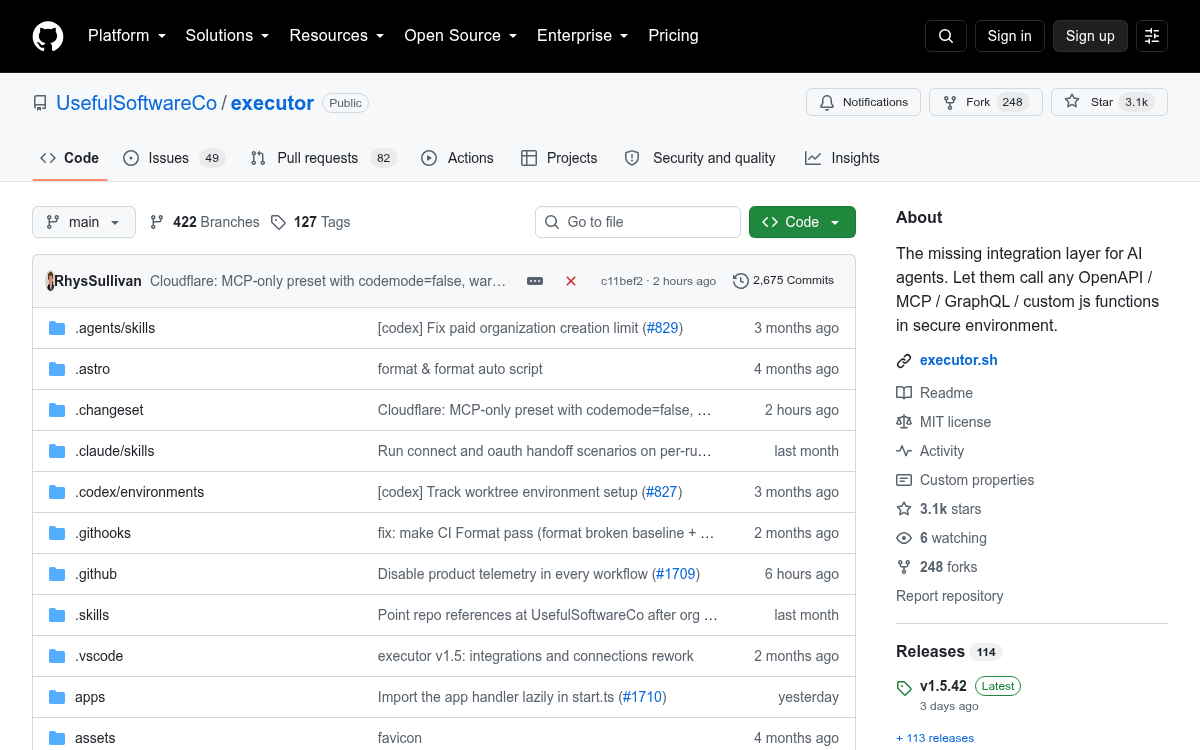
The repo has climbed past 3.1k stars and is backed by Y Combinator. It is MIT licensed, written in TypeScript on Bun and Turborepo, and can run as a hosted cloud service, a desktop app, a CLI daemon, a Docker container, or a Cloudflare Worker.
Token bloat, meet code mode
Wiring lots of MCP servers directly into a model destroys the context window. Executor's own benchmark claims that exposing roughly 1,640 tools from services like GitHub, Stripe, Jira, Sentry, Linear, Gmail, Notion, and Slack burns around 278,800 tokens, while routing through Executor exposes a single tool at about 1,044 tokens.
The mechanism is a code-mode MCP surface. Rather than dumping every tool schema into the prompt, the model sees one execute tool that runs TypeScript in a sandbox. The agent searches the catalog, fetches a tool's schema only when it needs it, then calls it:
const { items } = await tools.search({ query });
const path = items[0]?.path;
const details = await tools.describe.tool({ path });
const result = await tools[path](input);This story is for Pro members
You've reached the end of the free preview. Upgrade to AlphaSignal Pro to read the full article - and everything else behind the paywall.
Comments
