

Xi'an Jiaotong's DLW Teaches Tiny AI to Fix Classical Image Denoisers Automatically
A new bilevel training scheme teaches a tiny neural network to predict per-pixel weights that make classical denoisers handle complex, mixed noise.
 PRO
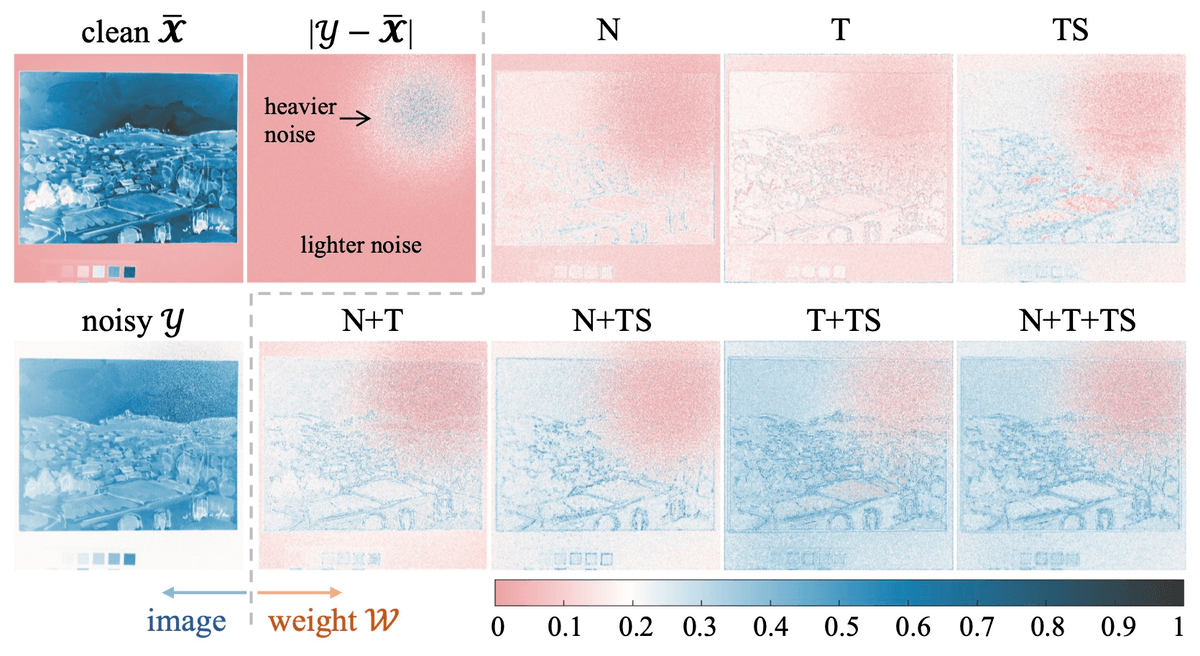
- DLW trains a small CNN (DLWnet) to predict per-pixel weights for the data fidelity term in variational image denoisers.
- Training uses bilevel optimization: unrolled ADMM in the lower level, MSE against ground truth in the upper level.
- The trained weight function transfers to unseen denoising models like LRTV, E3DTV, LRTFDFR, plus DIP and plug-and-play setups.
- DLW-augmented models beat originals by 2-3 dB PSNR on complex noise (stripes, deadlines, mixtures) despite training only on Gaussian+impulse.
- DLWnet is 0.11M parameters for HSI and 0.02M for color images, adding negligible inference cost.
- Theoretical generalization bound ties transfer error to the divergence between source and target regularizer gradients.
Classical image denoisers built on variational optimization have a knob almost nobody knows how to tune correctly: the per-pixel weight in the data fidelity term. Get it right and the model gracefully separates signal from noise. Leave it constant or set it poorly, and performance craters when the noise gets messy. A group from Xi'an Jiaotong University, Hong Kong Baptist University, and UESTC has proposed a way to let a small neural network figure that weight out automatically, and the resulting scheme transfers cleanly between denoising models it was never trained on.
The method is called Data-driven Loss Weighting (DLW). Instead of hand-designing a formula for the weight matrix W in a weighted L2 fidelity term, the authors train a tiny CNN (called DLWnet) that maps a noisy image straight to its weight map.
Why the weight resists hand-tuning
In a variational denoiser, you minimize a data fidelity term plus a regularizer. Adding a weight to the fidelity term improves noise removal because heavily corrupted pixels should be trusted less than clean ones. Choosing that weight becomes painful once noise stops being simple Gaussian. Existing approaches fall into three flavors, all imperfect:
- Empirical formulas like setting the weight as exp(-ξ(Y-X)²) and updating it each iteration, which don't capture the intrinsic weight structure.
- Assuming a noise distribution (Gaussian mixtures, Poisson, etc.) and deriving W from the negative log-likelihood, which fails when the assumption is wrong.
- Iterative inference via EM or variational Bayes, which is model-specific and expensive.
This story is for Pro members
You've reached the end of the free preview. Upgrade to AlphaSignal Pro to read the full article - and everything else behind the paywall.
Comments
