

xAI Ships Grok 4.6 to Match Claude Fable 5 at 5x Lower Cost
SpaceXAI's Grok 4.6 matches Claude Fable 5 on agentic knowledge work benchmarks at a fraction of the cost, with API pricing starting at $2/M input tokens.
- Grok 4.6 is live today via the xAI API, Cursor, Grok Build, OpenRouter, Vercel, and Cloudflare.
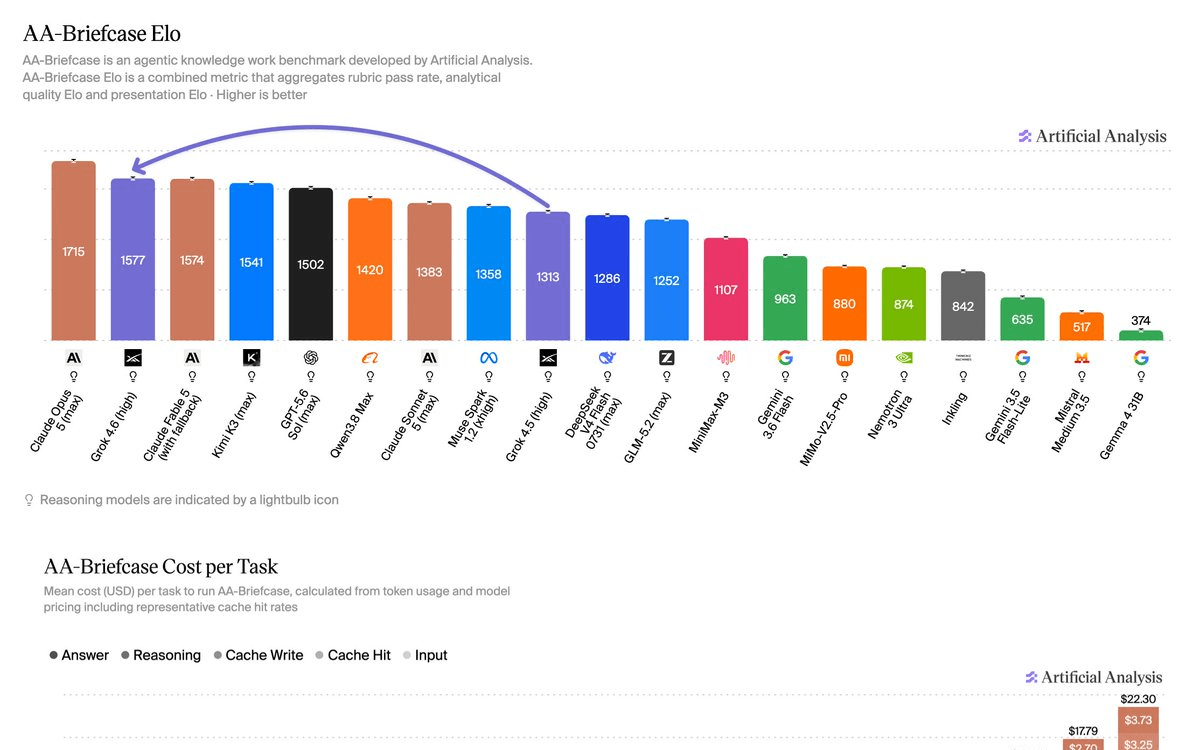
- Matches Claude Fable 5 on AA-Briefcase (1577 vs 1574 Elo) at ~5x lower cost per task ($4.42 vs $22.30).
- API pricing starts at $2/M input tokens and $6/M output tokens -- same as Grok 4.5, no price increase.
- Built on the same 1.5T V9 base as Grok 4.5; gains come from improved post-training (SFT + RL), not a new architecture.
- 500K token context, four reasoning effort levels (low/medium/high/xhigh), text and image input supported.
- Grok 4.7 (2.1T parameters) is already teased for release in the coming weeks.
SpaceXAI just shipped Grok 4.6, and the headline number is not the benchmark score -- it's the price. The model lands neck-and-neck with Anthropic's Claude Fable 5 on Artificial Analysis's agentic knowledge work benchmark while costing roughly five times less per task to run. That combination is rare enough to be worth paying attention to.
What changed under the hood
Instead of training a new base model, SpaceXAI kept the same 1.5 trillion parameter V9 foundation from Grok 4.5 and concentrated the improvement in post-training: the supervised fine-tuning and reinforcement learning that turn a raw model into a useful one. Grok 4.6 builds on Grok 4.5 with a particular focus on long-running agents and more ambitious interactive and visual work -- staying with complex tasks across many steps, whether researching a topic, analyzing information, working across a codebase, or turning an idea into a polished application.
SpaceXAI says the gains come from a longer supplemental training run, stronger engineering data, and expanded reinforcement learning for coding and knowledge work. The result is a refinement release, not a new architecture -- but the benchmark numbers suggest the post-training investment paid off.
The benchmark that matters here
The key evaluation is AA-Briefcase, Artificial Analysis's agentic knowledge work benchmark. It is worth understanding what this actually tests, because it is quite different from the typical multiple-choice or coding leaderboard.
- AA-Briefcase evaluates models across four multi-week knowledge work projects, comprising thousands of input files and 91 tasks in total.
- Across the scenarios, models must complete realistic professional workflows in fields such as data science, product management, and corporate strategy.
- Each task produces a real deliverable -- a spreadsheet, a memo, a presentation -- graded on a binary rubric, analytical quality, and presentation quality.
- The test set is private to prevent contamination, which makes it harder to game than public benchmarks.
The grading combines three signals: a pass/fail rubric checking whether the model followed instructions and cited sources correctly, plus two pairwise comparisons (analytical rigor and presentation quality) against other model submissions. The final score is an Elo rating that aggregates all three.
Where Grok 4.6 lands on the leaderboard
On the AA-Briefcase leaderboard, Grok 4.6 (high) scores 1577 Elo, placing it fourth overall -- just above Claude Fable 5 at 1574, with overlapping confidence intervals. The top three spots are all held by Claude Opus 5 configurations at higher effort levels, which cost significantly more to run.
| Model | AA-Briefcase Elo | Cost per Task |
|---|---|---|
| Claude Opus 5 (Max Effort) | 1715 | $17.79 |
| Claude Fable 5 (Max Effort) | 1574 | $22.30 |
| Grok 4.6 (high) | 1577 | $4.42 |
| Kimi K3 (max) | 1541 | $6.73 |
| GPT-5.6 Sol (max) | 1502 | not listed |
On the Artificial Analysis Intelligence Index -- a composite of nine benchmarks -- Grok 4.6 scored 61, matching GPT-5.6 Sol at its maximum reasoning level and trailing Fable 5 Max by one point. SpaceXAI also reports gains over Grok 4.5 across CursorBench, FrontierCode, APEX-Agents, and Terminal-Bench.
The cost story is the real headline
Frontier-level performance at a fraction of the price is the actual narrative here. Running a full AA-Briefcase evaluation costs $4.42 per task with Grok 4.6 -- compared to $22.30 for Claude Fable 5 and $17.79 for Claude Opus 5. That is a 5x cost reduction for roughly equivalent output quality on long-horizon agentic tasks.
For anyone building agents that run many tasks in parallel or at scale, this gap is not academic. A workflow that costs $2,000/month on Claude Fable 5 would run for around $400 on Grok 4.6 at similar quality. API pricing starts at $2 per million input tokens and $6 per million output tokens, with a faster variant available at twice the price.
Where you can use it right now
Grok 4.6 is live across the xAI API, Grok Build, Cursor, and Grok Bot on X. Third-party access is also live via OpenRouter, Vercel, and Cloudflare, meaning developers who route requests through model marketplaces can switch without changing providers.
The model ID in the API is grok-4.6. It supports a 500,000 token context window, text and image input, and four reasoning effort levels: low, medium, high (default), and xhigh. For agent loops, SpaceXAI recommends setting a prompt_cache_key to route conversation requests to the same server and keep cache hits reliable -- without it, you pay full input price on every turn.
from xai_sdk import Client
from xai_sdk.chat import user
import os
client = Client(api_key=os.getenv("XAI_API_KEY"))
chat = client.chat.create(
    model="grok-4.6",
    reasoning_effort="high"   # low | medium | high | xhigh
)
chat.append(user("Analyze the attached financials and draft an executive memo."))
response = chat.sample()
print(response.content)
During the first week, Cursor and Grok Build users receive double the included Grok 4.6 usage. SpaceXAI also recently acquired Cursor, so the integration between the two is likely to deepen over time.
What this is good for -- and where to be cautious
According to SpaceXAI, Grok 4.6 is designed for long-running agents, coding, knowledge work, and more ambitious visual projects -- with the ability to stay on task across many steps, work through an unfamiliar codebase, and increasingly test its own output before moving forward. The AA-Briefcase results back up the knowledge work claims specifically.
Where to be more careful:
- The model's knowledge cutoff is February 1, 2026, so anything more recent requires tool use or retrieval.
- The top AA-Briefcase scores still belong to Claude Opus 5 at max effort -- if raw quality ceiling matters more than cost, that gap is real.
- The 1753 Elo figure cited by Elon Musk on X refers to a different arena leaderboard than AA-Briefcase; independent verification on public arenas is still pending.
- Context compaction is recommended for long agent loops -- without it, token costs can compound quickly across many turns.
The broader pattern here is that SpaceXAI is compressing the release cycle aggressively. According to people familiar with the matter, xAI has reorganized its engineering teams to compress development cycles, aiming to ship major updates every two to three weeks. Grok 4.7, expected to use a 2.1 trillion parameter model, is already slated for release a few weeks out. For teams evaluating which frontier model to build on, the cadence itself is now part of the value proposition.
Comments
