

xAI's Grok Voice Think Fast 2.0 Hits Sub-Second Response, Beating GPT-Realtime
SpaceXAI's new voice model hits #2 on the Speech-to-Speech Index with 0.70s latency, beating GPT-Realtime at half the price

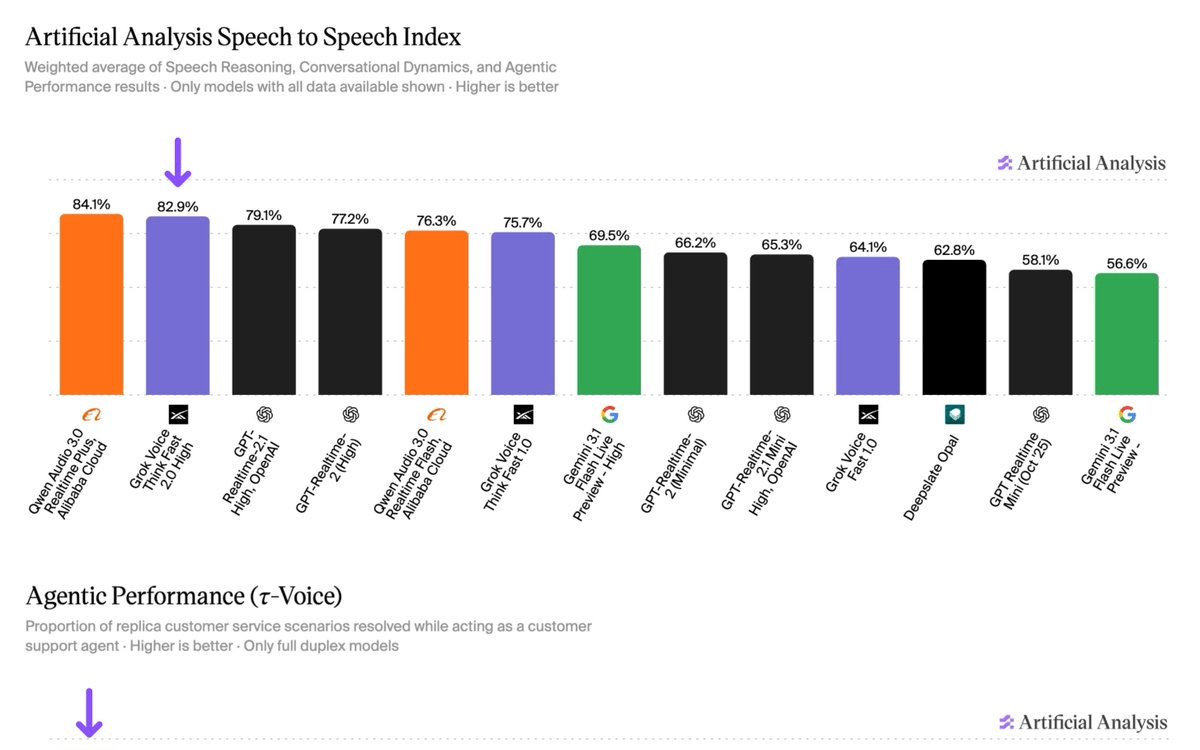
- Grok Voice Think Fast 2.0 debuts at #2 on the Artificial Analysis Speech-to-Speech Index with an 82.9% composite score.
- Takes #1 on Tau Voice agentic benchmark at 56.5%, beating Qwen Audio 3.0 Realtime Plus (54.6%) and GPT-Realtime-2.1 High (45.7%).
- Fastest model in the top 5 at 0.70s time-to-first-audio, vs. 4.02s for index leader Qwen Audio 3.0 Realtime Plus.
- Full Duplex Bench score jumped from 77.8% (v1.0) to 95.1% — the biggest driver of the overall quality improvement.
- Priced at $4.80/hr of input audio — more than GPT-Realtime-2 High ($4.14) but ~2.2x cheaper than GPT-Realtime-2.1 High ($10.75).
- Available now via the xAI API, with OpenAI Realtime API compatibility for easy migration.
xAI just released Grok Voice Think Fast 2.0, the successor to its April 2026 flagship voice model. On the Artificial Analysis Speech-to-Speech Index, the High variant debuts at #2 with an 82.9% composite score, up 7.3 percentage points from its predecessor, and takes the #1 spot on Tau Voice, the agentic benchmark most relevant to production deployments.
The latency gap nobody else has closed
The headline number is 0.70 seconds time-to-first-audio, making Grok Voice Think Fast 2.0 the only model in the top five of the Speech-to-Speech Index under one second. For comparison: GPT-Realtime-2 High sits at 1.14s, GPT-Realtime-2.1 High at 1.21s, and the overall index leader Qwen Audio 3.0 Realtime Plus at 4.02s. Sub-second response time is the threshold where a voice agent starts to feel like a real conversation rather than a walkie-talkie.
Speed alone doesn't explain the index gain. The 1.0 model already had low latency at 1.25s, but its conversational dynamics score was a weak point. On the Full Duplex Bench subset, 2.0 scores 95.1%, up from 77.8% for its predecessor, which was the largest single driver of the composite improvement. Full Duplex Bench measures the things that make or break a real phone call: knowing when to stop talking, handling a user who cuts in mid-sentence, and correctly ignoring filler words like "yeah" or "uh-huh" without treating them as turn-taking signals.
Where it leads, and where it doesn't
The benchmark breakdown tells a consistent story across categories:
- Tau Voice (agentic performance): Grok Voice Think Fast 2.0 High leads at 56.5%, just ahead of Qwen Audio 3.0 Realtime Plus at 54.6%. Tau Voice simulates real customer service calls, including flight changes, billing disputes, and telecom troubleshooting, and scores models on whether the task actually gets resolved.
- Big Bench Audio (speech reasoning): 97.2%, behind leader Qwen Audio 3.0 Realtime Plus at 99.2%. Strong, but not the top slot.
- Full Duplex Bench (conversational dynamics): 95.1%, narrowly behind Qwen Audio 3.0 Realtime Plus at 98.4%.
- Overall index: 82.9%, behind only Qwen Audio 3.0 Realtime Plus (84.1%) and ahead of GPT-Realtime-2.1 High (79.1%) and GPT-Realtime-2 High (77.2%).
Grok Voice Think Fast 2.0 is the strongest model for agentic, real-world voice tasks and the fastest among the top tier. Qwen Audio 3.0 Realtime Plus still edges it on raw reasoning and conversational dynamics, but at roughly 4x the latency.
What this model is built for
The Think Fast line targets complex, multi-step workflows across customer support, sales, and enterprise applications, particularly high-stakes scenarios requiring precise data entry and high-volume tool calling. The 1.0 model already powers Starlink's phone support line at +1 (888) GO STARLINK. xAI has disclosed a 20% sales conversion rate, a 70% autonomous resolution rate for customer support with no human in the loop, and a single agent operating across 28 distinct tools spanning hundreds of support and sales workflows.
The architecture runs listening, reasoning, and audio production simultaneously inside a single feedback loop rather than sequencing them as separate phases. xAI built this on an in-house stack including custom VAD, tokenizer, and audio models. Reasoning runs in the background concurrently with audio generation, which is why the model can work through complex queries without adding to response latency. Most voice models that incorporate chain-of-thought reasoning pay a latency penalty for it; this architecture sidesteps that tradeoff entirely.
The price equation
Grok Voice Think Fast 2.0 is priced at $4.80 per hour of input audio, up from $3.00 for the 1.0 model. That's a 60% increase generation-over-generation, but the competitive positioning still holds:
| Model | Index Score | Time to First Audio | Cost/hr Input |
|---|---|---|---|
| Qwen Audio 3.0 Realtime Plus | 84.1% | 4.02s | $4.42 |
| Grok Voice Think Fast 2.0 High | 82.9% | 0.70s | $4.80 |
| GPT-Realtime-2.1 High | 79.1% | 1.21s | $10.75 |
| GPT-Realtime-2 High | 77.2% | 1.14s | $4.14 |
| Grok Voice Think Fast 1.0 | 75.7% | 1.25s | $3.00 |
At $4.80/hr, it sits above Qwen Audio 3.0 Realtime Plus ($4.42) and GPT-Realtime-2 High ($4.14), but runs roughly 2.2x cheaper than GPT-Realtime-2.1 High ($10.75). Developers currently using GPT-Realtime-2.1 for its quality have a straightforward case for switching.
Getting started
The xAI Voice Agent API is OpenAI Realtime API-compatible, so migrating existing integrations is mostly a matter of swapping the endpoint and API key. xAI also offers a Voice Agent Builder, a no-code tool for creating voice agents with telephony, knowledge retrieval, tools, guardrails, MCP support, observability, SIP number support, call recordings, transcripts, and tool-use logs.
The model has been tested against telephony audio, background noise, heavy accents, and frequent interruptions, and natively supports 25-plus languages, which matters for global customer-facing deployments. It's available now via the xAI API. The clearest use cases are phone-based customer support, outbound sales, appointment booking, and any workflow where a voice agent needs to call tools mid-conversation without the user noticing a pause.
The broader trajectory is worth noting. In roughly eight months, the voice frontier moved from 30% on Tau Voice with OpenAI's gpt-realtime-1.0 to 67% with Grok Voice Think Fast 1.0, and 2.0 pushes further still on an updated benchmark. The assumption that latency and quality are fundamentally in tension is looking increasingly difficult to defend.
Comments
