

xAI's Grok 4.6 Matches GPT-5.6 Sol on Agentic Tasks at Half the Price
Grok 4.6 matches GPT-5.6 Sol on composite benchmarks at half the price, with a big focus on long-running coding agents
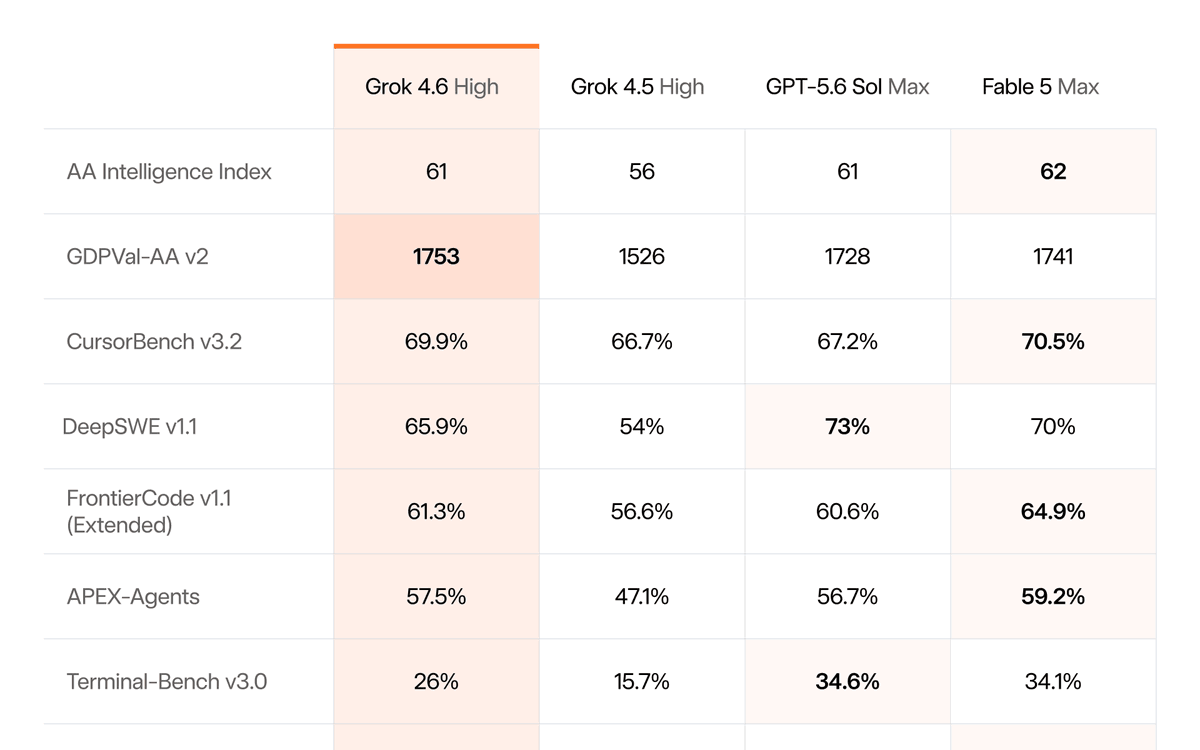
- SpaceXAI released Grok 4.6, matching GPT-5.6 Sol Max on the Artificial Analysis Intelligence Index (score: 61) at $2/$6 per million tokens.
- Built on the same 1.5T parameter base as Grok 4.5 -- improvements come entirely from post-training (SFT + RL), not model scale.
- Adds a new
xhighreasoning level; large benchmark jumps over 4.5 on DeepSWE (+11.9pts), APEX-Agents (+10.4pts), Terminal-Bench (+10.3pts). - Pricing caveat: the $2/$6 rate applies only below 200K prompt tokens -- above that threshold, all tokens in the request double to $4/$12.
- Available now via the xAI API (
grok-4.6), Cursor (all plans), Grok Build, OpenRouter, Vercel, and Cloudflare; 2x usage in Cursor and Grok Build for the first week. - Grok 4.6 trails GPT-5.6 Sol Max on DeepSWE (65.9% vs 73%) and Terminal-Bench (26% vs 34.6%), so it is not a universal winner.
Grok 4.6 is SpaceXAI's new frontier model, and the pitch is simple: match the best models on the market while charging significantly less. It ships today across the xAI API, Cursor, Grok Build, OpenRouter, Vercel, and Cloudflare, with double the included usage in Cursor and Grok Build for the first week.
Same weights, sharper training
Grok 4.6 runs on the same 1.5 trillion parameter V9 foundation as Grok 4.5. Rather than scale the base model, SpaceXAI reworked the post-training stack, with upgraded supervised fine-tuning and reinforcement learning aimed at coding, reasoning, and instruction following. The company positions the release as a rival to current top-tier models from Anthropic and OpenAI, framed less as a raw intelligence bump and more as a model built to stick with long, multi-step jobs.
Concretely, xAI used Grok 4.5 to regenerate training trajectories across different reasoning efforts, agent setups, and domains including STEM, software engineering, and general knowledge work, then filtered out low-quality examples with automated checks. On the RL side, training spanned agentic tasks from general coding to kernel optimization, web development, and CAD work.
One notable behavioral change: the model now self-checks its outputs during longer tasks rather than producing a single pass and stopping. A new xhigh reasoning effort level sits above the existing low, medium, and high settings, useful for squeezing out extra performance on the hardest tasks at the cost of more compute.
Benchmarks: strong on knowledge, mixed on code
Grok 4.6 matches GPT-5.6 Sol on the Artificial Analysis Intelligence Index, a composite score of nine benchmarks. Gains over Grok 4.5 are substantial across the board.
| Benchmark | Grok 4.6 | Grok 4.5 | GPT-5.6 Sol Max | Fable 5 Max |
|---|---|---|---|---|
| AA Intelligence Index | 61 | 56 | 61 | 62 |
| GDPVal-AA v2 | 1753 | 1526 | 1728 | 1741 |
| CursorBench v3.2 | 69.9% | 66.7% | 67.2% | 70.5% |
| DeepSWE v1.1 | 65.9% | 54.0% | 73.0% | 70.0% |
| Terminal-Bench v3.0 | 26.0% | 15.7% | 34.6% | 34.1% |
| APEX-Agents | 57.5% | 47.1% | 56.7% | 59.2% |
| Harvey LAB (Vals) | 15.8% | 12.9% | 2.5% | 11.3% |
Movement from the previous version is large: DeepSWE up 11.9 points, Terminal-Bench up 10.3, APEX-Agents up 10.4. Against GPT-5.6 Sol Max and Fable 5 Max the picture gets mixed. Grok 4.6 leads on knowledge-work evals like GDPVal and Harvey LAB but trails on pure software engineering, landing at 65.9% on DeepSWE v1.1 behind GPT-5.6 Sol Max at 73% and Fable 5 Max at 70%. On independent leaderboards, its strongest eligible category is Agentic, where it ranks #19.
Cheaper, with a long-context cliff
API pricing starts at $2 per million input tokens and $6 per million output tokens, which SpaceXAI frames as roughly half the going rate for comparable frontier models. There is a caveat worth knowing before you commit for long-context workloads.
Below 200K prompt tokens, Grok 4.6 costs $2 per million input tokens, $0.50 per million cached input tokens, and $6 per million output tokens. At 200K tokens and above, those rates double to $4, $1, and $12, and the higher rates apply to every token in the request. It is not a surcharge on the tokens above the threshold. Cross the line and the whole request reprices.
For agentic workloads with long histories, xAI recommends prompt caching via the prompt_cache_key parameter with the Responses API, or the x-grok-conv-id header with Chat Completions. A context-compaction feature can also drop stale tokens from long tool loops.
Where it earns its keep
SpaceXAI tuned Grok 4.6 to stay on task across long agentic runs, whether that means digging through a codebase, researching an unfamiliar topic over many steps, or taking a rough product idea to working software. Use cases that fit the model best:
- Multi-step coding agents: Large refactors, cross-file changes, or building a feature end-to-end without constant re-prompting.
- Research and knowledge work: Synthesizing information across many documents or tool calls, where context coherence matters.
- Interactive and visual projects: xAI claims stronger first-pass results on UI and app generation, often getting structure and design right in one shot.
- Legal and professional work: The Harvey LAB score of 15.8% versus GPT-5.6 Sol Max's 2.5% points to real strength in professional knowledge domains.
If your workload leans heavily on terminal-based automation or pure software engineering benchmarks, GPT-5.6 Sol Max or Fable 5 Max may still be the better pick given their DeepSWE and Terminal-Bench margins.
Wiring it up
The model is available through the xAI API as grok-4.6, plus Grok Build, Cursor, and OpenRouter as x-ai/grok-4.6, with support for the Responses API and Chat Completions. Minimal setup:
import os
from xai_sdk import Client
from xai_sdk.chat import user
client = Client(api_key=os.getenv("XAI_API_KEY"))
chat = client.chat.create(model="grok-4.6")
chat.append(user("Review this codebase and identify the three highest-risk assumptions."))
response = chat.sample()
print(response.content)
xAI says Grok 4.6 is available in Cursor on all plans, with twice the included usage during launch week. The same double-usage offer applies inside Grok Build. Teams already running Grok 4.5 in production only need to swap the model ID, since pricing and context window are identical.
Why this release lands
SpaceXAI has closed much of the gap with OpenAI and Anthropic on agentic tasks without raising prices or growing the model. If Grok 4.6 delivers comparable results at half the cost for most workloads, the case for paying premium rates elsewhere gets harder. The soft spots on DeepSWE and Terminal-Bench keep it from being a clean sweep, but for teams running knowledge-heavy or long-horizon coding agents, Grok 4.6 belongs on the shortlist.
Comments
