

Why Kimi K3's architecture is a masterclass in AI efficiency
How Moonshot fit a 2.8 trillion parameter model into real hardware without breaking it.


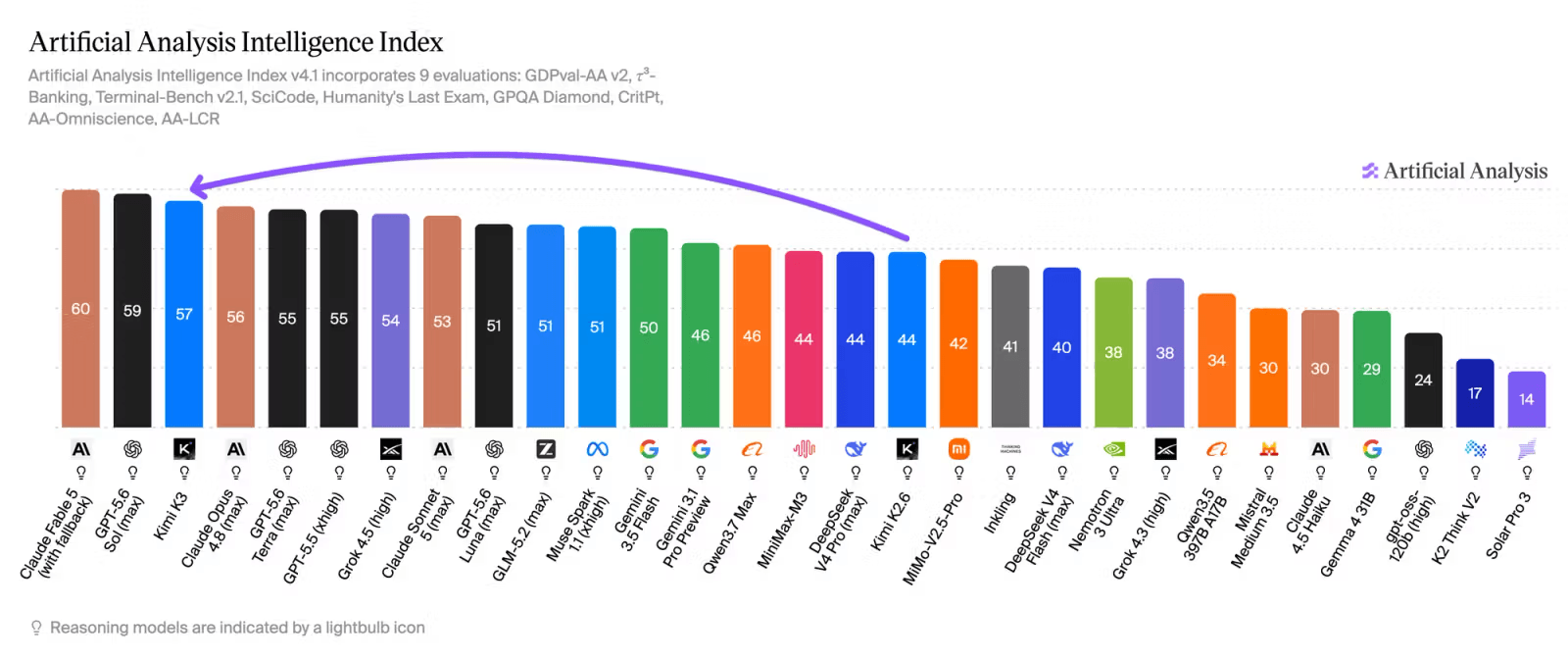
- Kimi K3 is a 2.8 trillion parameter multimodal MoE model with only ~104 billion parameters active per token, a 1 million token context window, and ranks third on the Artificial Analysis intelligence index, trailing only Claude Fable 5 and one other model.
- The model uses LatentMoE, which compresses input tokens to a 3,584-dimensional latent space before expert routing, dramatically cutting activation memory and cross-node communication overhead at trillion-parameter scale.
- A hybrid attention scheme combines Kimi Delta Attention (linear, fixed-size state) with Gated Multi-Head Latent Attention in a 3:1 ratio, keeping the KV cache from growing with sequence length and making the 1M-token context window practically deployable.
- Quantization-Aware Training (QAT) in FP4/FP8 mixed precision reduces the deployed memory footprint well below the ~5 TB that raw BF16 storage would require, and Unsloth demonstrated further compression to 1–2-bit GGUF (~594 GB) with ~79% top-1 accuracy retention.
- Two additional accuracy-preserving innovations—learned Attention Residuals replacing fixed residual connections, and a NoPE (No Positional Embeddings) architecture replacing RoPE—help the model maintain reasoning quality despite extreme sparsity and low-bit quantization.
Moonshot AI recently released the weights for its flagship Kimi K3 model, making it the largest open-weights LLM to date, rivaling Opus 4.8 and GPT-5.6.
Running a model at this scale is a serious engineering problem. You cannot spin up 2.8 trillion parameters efficiently without innovations at every level of the stack. The choices Moonshot made to solve that problem reveal how modern mega-models actually get deployed.
Kimi K3 by the numbers
Kimi K3 is a multimodal Mixture-of-Experts (MoE) model with 2.8 trillion total parameters. Through extreme sparsity, only about 104 billion parameters activate per token, roughly 16 out of 896 experts. It natively supports a 1 million token context window.
K3 currently ranks third on the Artificial Analysis index. Its strongest area is agentic knowledge work: on the AA-Briefcase benchmark it places second overall, trailing only Claude Fable 5, and beats both GPT-5.6 Sol and Opus 4.8 in that category. It also ranks in the 97th percentile for coding and visual tasks like reading charts and document screenshots.
 |
Those capabilities only become practical because of four architectural decisions that tame the underlying compute and memory requirements.
LatentMoE: Cheaper expert routing
MoE solves a fundamental scaling problem by activating only a small subset of parameters per token, avoiding the cost of running the full network on every calculation. The catch is that traditional MoE setups introduce heavy communication overhead: data movement across massive linear expert layers burns through memory bandwidth fast.
Don't miss what's next in AI
Join 300,000+ engineers and researchers who get the signal, not the noise. Create a free account to read the rest of this story.
- Full access to in-depth AI research breakdowns
- Be the first to know what's trending before it hits mainstream
- Daily curated papers, repos, and industry moves
Comments
