

What DeepSeek-V4.1-Flash teaches us about efficient AI
A 552B model with 890-byte KV cache, 8B active on input, and an Artificial Analysis 40 versus Gemini 3.8 Flash High at 41


- DeepSeek-V4.1-Flash is a 552B Mixture-of-Experts model that activates 8B parameters on input and 16B on output, versus around 13B for both in V4-Flash.
- Global KV cache falls to 890 bytes per token from 3,514 in V4-Flash, about 890 MB versus 3.5 GB at a 1 million token window.
- Persistent KV-cache storage is about one-eighth of V4-Flash, because local sliding-window state does not need to stay on SSD.
- At maximum reasoning effort it scores 40 on the Artificial Analysis Intelligence Index, just behind Gemini 3.8 Flash High at 41, at about a quarter of the cost per task.
- Peak API pricing is $0.30 per million input tokens, $1.20 per million output tokens, and $0.006 per million cache-hit tokens.
DeepSeek's new V4.1-Flash is almost twice as large as its predecessor. But its KV cache footprint is four times smaller.
That matters if you're building long-running agents, where context keeps growing and memory costs can quickly become a bottleneck. DeepSeek gets around this with a series of architectural changes that rethink how a model reads, stores, and retrieves its context.
Today we break down how it works, and what it tells us about the next frontier of LLM efficiency.
How DeepSeek made a bigger model cheaper to run
DeepSeek released V4.1-Flash on September 10 with an unusual combination of numbers. It is almost twice the size of V4-Flash but is 4x more efficient than its predecessor when it comes to KV cache storage.
The model is also competitive with leading proprietary models. At maximum reasoning effort, V4.1-Flash scores 40 on the Artificial Analysis Intelligence Index, just behind Gemini 3.8 Flash High at 41, while having a quarter of the cost per task.
Sebastian Raschka called the release a "big overhaul" and argued that DeepSeek could have called it V5.
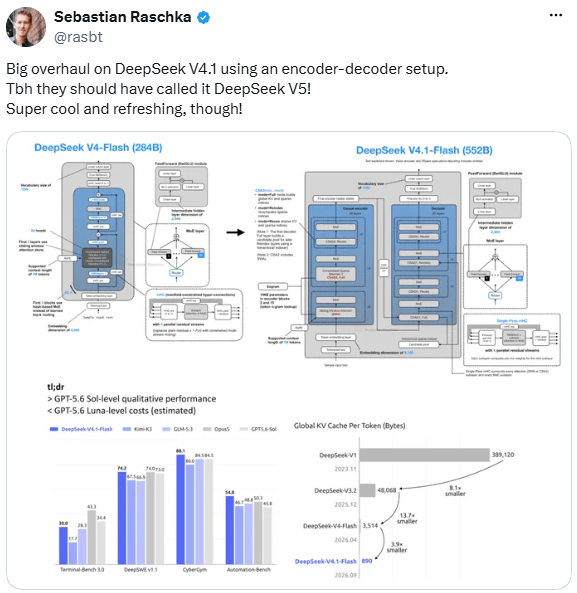
For engineers, the interesting part is how DeepSeek separated model capacity from the resources needed to serve it. Parameter count alone says less about production cost when architectures can change how much of the model runs on each token, how much context must stay in memory, and how much work is required to retrieve it. V4.1-Flash provides a useful case study in all three.
A much bigger model
DeepSeek-V4.1-Flash is a 552B Mixture-of-Experts (MoE) model (one shared, 384 routed with six shared experts per token) with a 40-layer Transformer backbone, divided into a 20-layer causal encoder and a 20-layer decoder (more on this in a bit). The model accepts text and images, generates text, and supports a context window of up to one million tokens.
(You might see other figures, such as 763B params. This is because V4.1-Flash has some other auxiliary components that are separate from the main backbone.)
Prefill, decode and the KV cache
When you send a prompt to an LLM, inference starts with "prefill." The model processes all the input tokens and constructs the internal attention state it will need to produce an answer. Then comes "decode," where the model generates new tokens sequentially while repeatedly referring back to the tokens it has already processed.
The KV cache connects these phases. Transformer attention creates key and value representations for previous tokens. Keeping those representations in memory saves the model from recomputing the entire history for every new output token.
KV cache efficiency matters for agents because their contexts accumulate. A coding agent might carry source files, conversation history, retrieved documentation and dozens of tool results. DeepSeek has steadily reduced the global KV footprint for these workloads, from around 48 KB per token in V3.2 to 3,514 bytes in V4-Flash and 890 bytes in V4.1-Flash.
Don't miss what's next in AI
Join 300,000+ engineers and researchers who get the signal, not the noise. Create a free account to read the rest of this story.
- Full access to in-depth AI research breakdowns
- Be the first to know what's trending before it hits mainstream
- Daily curated papers, repos, and industry moves
Comments
