
vibecode-pro-max-kit Fixes Claude Code's Worst Habit of Coding Before Thinking
A spec-driven harness bolts twelve agents, thirty-one skills, and phase-locked tool restrictions onto Claude Code and Codex to kill context rot.
 Pro
Takeaways
- Vibecode-pro-max-kit is a spec-driven agent harness for Claude Code and Codex, MIT licensed.
- Ships 12 agents, 31 skills, and 7 hooks that install into any project via a curl one-liner.
- Enforces a RIPER-5 workflow (Research, Innovate, Plan, Execute, Update Process) with explicit approval gates.
- Phase-locked tool restrictions physically remove capabilities like Bash or file writes during research and planning.
- Plans live on disk with blast-radius and verification sections, so progress survives context window compaction.
- Includes specialist skills for STRIDE plus OWASP security audits, 12-dimension edge case generation, and autonomous metric optimization.
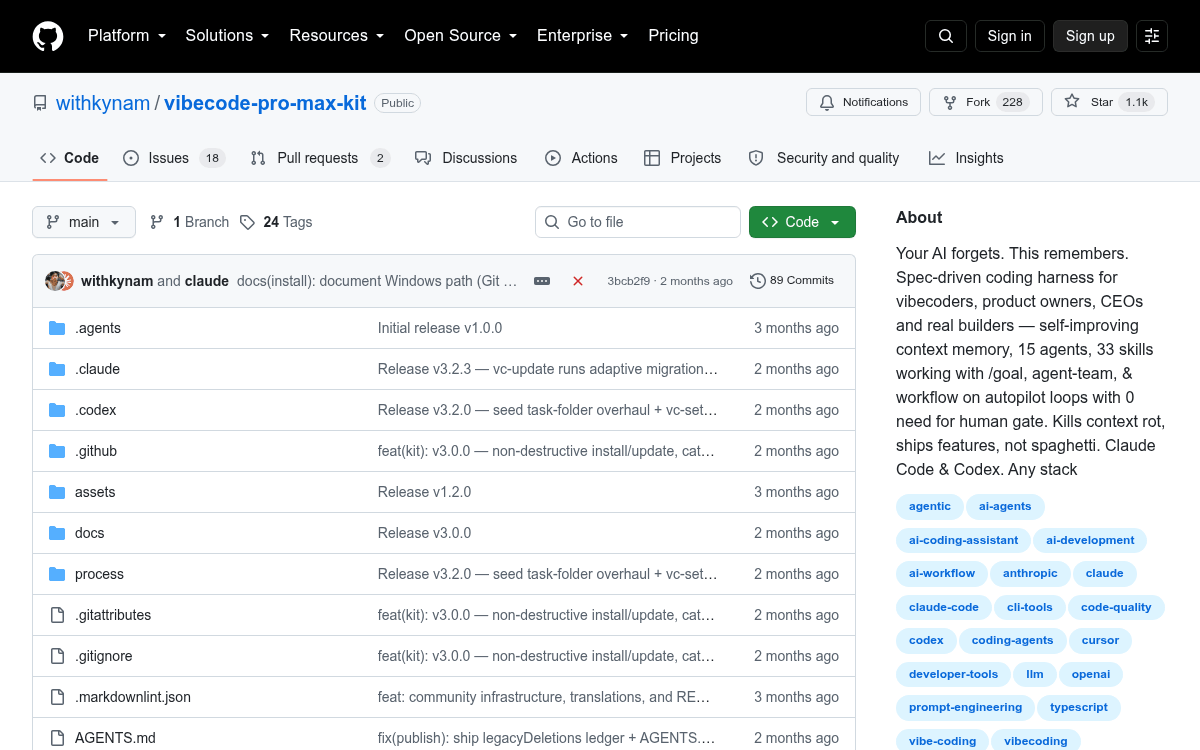
A new open-source project called vibecode-pro-max-kit is picking up traction on GitHub as an attempt to fix one of the most frustrating failure modes of AI coding assistants: they start writing code without understanding your project, forget everything between sessions, and let their context docs go stale. The repo bills itself as a RIPER-5, spec-driven, self-improving agent harness for Claude Code and Codex, with 12 specialist agents, 31 skills, and phase-locked safety that works with any codebase.
The core idea is to stop treating your agent as a code generator and start treating it as a junior engineer that has to research, plan, and get explicit approval before touching files. Everything ships under an MIT license and installs into an existing project in about thirty seconds.
Why coding agents keep face-planting
Anyone who has used a coding agent on a real codebase knows the pattern: you ask for webhook support, and 400 lines land in your repo that ignore your existing conventions. The maintainers argue the deeper issues are worse than that surface annoyance. Agent context dies every session, docs written last week are already stale, long tasks collapse when the context window fills, and architecture decisions get hallucinated instead of researched.
An outside writeup frames the project as a direct response to context rot inside AI coding assistants and a way to streamline the feature delivery pipeline. That is the promise the whole system is organized around.
RIPER-5 and phase-locked tools
The workflow runs on a five-phase loop the project calls RIPER-5: Research, Innovate, Plan, Execute, and Update Process. Every transition requires you to explicitly say go or ENTER EXECUTE MODE. Nothing auto-advances.
The more interesting piece is how the phases are enforced. Rather than telling the agent to behave, each phase strips its capabilities. RESEARCH is read-only, INNOVATE has no Bash access, and PLAN can only write to process/ directories. These are not instructions that can be ignored, they are actual tool removals at the agent level. A self-policing interrupt also detects when an agent is about to cross a phase boundary and stops it with a message like PHASE JUMPING PREVENTED. The maintainers call this a structural hallucination guard.
What is in the box
Once installed via a one-line curl command, the harness drops a small forest of config into your project:
- 12 agents including
vc-research-agent,vc-plan-agent,vc-execute-agent,vc-debugger,vc-tester,vc-code-reviewer, andvc-git-manager - 31 auto-discovered skills such as
vc-predictfor a five-persona pre-implementation debate,vc-scenariofor a twelve-dimension edge case generator,vc-securitycombining STRIDE threat modeling with OWASP Top 10, andvc-autoresearchfor autonomous metric optimization - 7 lifecycle hooks covering privacy blocks on
.envand SSH keys, scout blockers that keep the agent out ofnode_modules, and a session-init hook that re-injects approval gate state after context compaction - A
process/directory that stores plans, reports, and per-domain context routers likeall-tests.md,all-container.md, andall-uxui.md
The install script backs up any existing .claude/ config and CLAUDE.md before touching anything. The install.sh is a single shell script you can inspect before running.
Plans as the primary artifact
The headline is memory, but the more interesting shift is treating plans as the primary artifact. Every non-trivial feature generates a written spec with a blast-radius section listing every file that will be modified, public contracts that change, and verification evidence. That plan lives on disk in process/general-plans/active/, then moves to completed/ when done. Six months later, when someone asks why auth was built a certain way, the answer is a file in git rather than a lost Slack thread.
Context routing is the second quieter innovation. Instead of shoving everything into one giant CLAUDE.md, knowledge is split into domain folders with router files. When the agent works on billing, it loads billing context, not your entire codebase docs. Topics with three or more docs automatically get promoted to their own group.
Where it shines and where it grates
Good fits for this harness look like:
- Multi-hour autonomous runs where progress needs to survive context window compaction, because state lives in files rather than memory
- Large multi-phase programs where an umbrella plan plus per-phase plans with validation gates keeps things honest, with phases carrying explicit statuses like
PLANNED,CODE DONE,TESTING,VERIFIED, orBLOCKED - Teams that want product managers to review the same plan artifact the agent will execute against
- Security-sensitive changes touching auth, billing, or schema migrations, which trigger required evidence packs before work can be called done
The tradeoffs are real. This is heavy machinery for a quick script or a weekend prototype. The workflow demands you actually read plans and type go at each gate, which is the opposite of one-shot vibecoding. A fast mode compresses research, innovate, and plan into one pass, but even that pauses before execute. And a repo with a Tanjiro water-style gif at the top of the README will not land the same way in every engineering culture.
Industry context
The project sits inside a growing wave of spec-driven and agent-orchestration frameworks that have appeared alongside Claude Code and Codex. The premise across all of them is that raw model quality has outrun the scaffolding around it, and that the next round of productivity gains comes from process, memory, and gated workflows rather than better base models. Vibecode-pro-max-kit is one of the more opinionated entries in that category, and its steady climb past a thousand stars suggests plenty of developers agree that letting the agent write first and think later has stopped being fun.