

USTC Breaks QuDDPM's Five-Qubit Wall by Fixing Haar-Random Training Collapse
Researchers pinpoint why quantum diffusion models stall past five qubits, then add an auxiliary circuit that restores gradients and enables Hamiltonian-conditioned state generation.
 PRO
- QuDDPM stalls at 5 qubits due to a barren plateau caused by Haar-random inputs to the denoising PQC. Paper
- Authors prove gradient variance decays as 8 / (|S|^4 · (2^(2n) - 1)), an exponential collapse with qubit count.
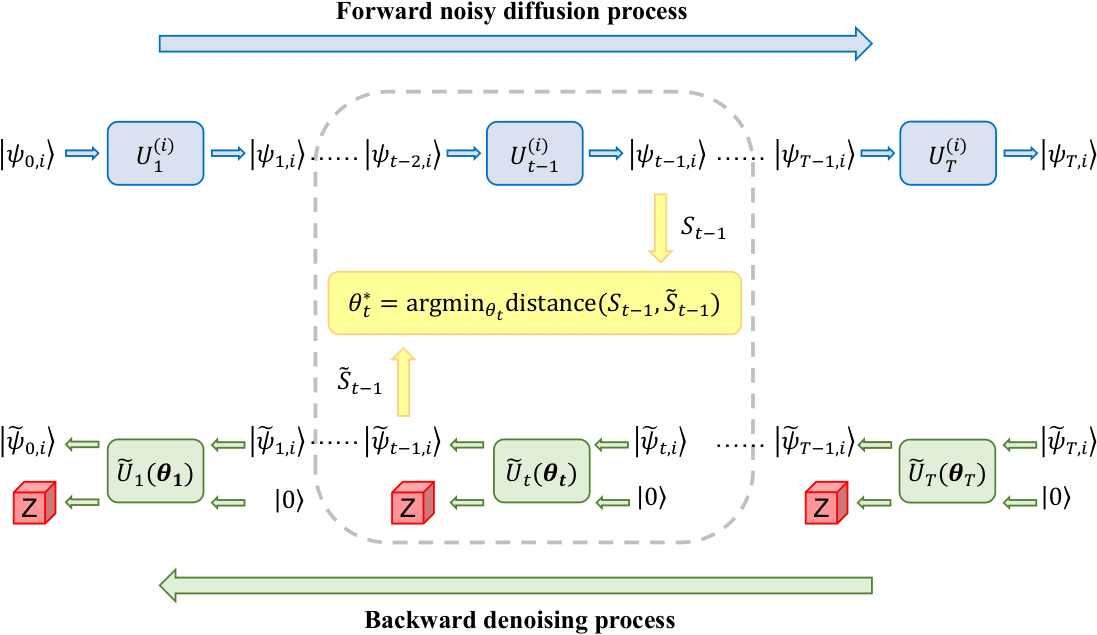
- Fix adds a parallel PQC on auxiliary qubits initialized to zero, breaking Haar symmetry in the output.
- Improved model trains successfully on 10-qubit transverse-field Ising and Heisenberg systems.
- Conditional QuDDPM generates Hamiltonian ground states from parameters using a classical tanh(Wx+b) mapping.
- t-SNE of 5,000 generated Ising states cleanly separates paramagnetic and ferromagnetic phases.
Quantum diffusion models were supposed to answer the training instabilities plaguing quantum GANs and variational autoencoders. Instead, they hit their own wall around five qubits, where gradients quietly collapsed and nobody could quite explain why. A new paper from USTC, NTU Singapore, and Hong Kong PolyU tracks the collapse to a specific mathematical culprit, proves it rigorously, and proposes an architectural fix that keeps training alive on 10-qubit systems.
The five-qubit ceiling
The Quantum Denoising Diffusion Probabilistic Model (QuDDPM), introduced in 2024, borrows the hierarchical noise-and-denoise logic of classical diffusion but operates on quantum states. The forward process feeds samples from a target distribution through a quantum scrambling circuit that adds noise until they become Haar-random states, and the backward process trains parameterized quantum circuits (PQCs) to invert that diffusion. Once trained, you feed in a Haar-random state and out comes a sample from the learned distribution, which is useful for reconstructing many-body phases, correlated noise models, and topological structures that classical models struggle with.
The problem the authors identify is blunt: QuDDPM's efficacy is currently restricted to systems of five qubits or fewer, and a severe barren plateau emerges as the system size increases. A barren plateau (BP) is the quantum ML equivalent of a vanishing gradient catastrophe, defined mathematically by a zero mean gradient and a variance that decays exponentially with the number of qubits. That combination turns the loss landscape into a featureless plain that gradient descent cannot navigate.
Why Haar-random inputs poison the gradient
Previous BP literature blamed overly expressive ansatzes, deep circuits, or noise. This paper isolates a different origin. The backward denoising process starts from Haar-random states by construction, and the authors prove that this specific input distribution is what kills the gradient.
This story is for Pro members
You've reached the end of the free preview. Upgrade to AlphaSignal Pro to read the full article - and everything else behind the paywall.
Comments
