

UsefulSoftwareCo's Executor Shrinks 1,640 AI Tools Down to One
UsefulSoftwareCo open-sourced Executor, an MCP gateway that collapses thousands of API tools into one sandboxed endpoint any agent can call.
 PRO
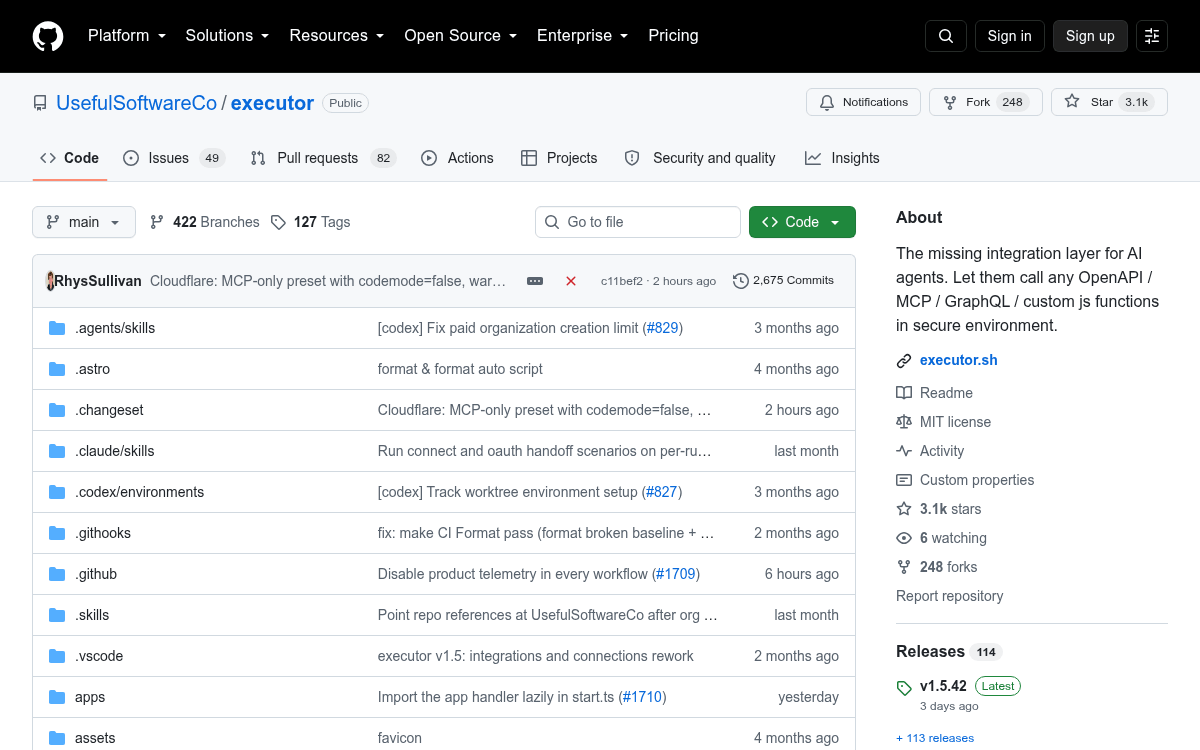
- UsefulSoftwareCo open-sourced Executor, an MIT-licensed MCP gateway with 3.1k GitHub stars.
- Collapses 1,640 tools and 278,800 tokens into one tool at roughly 1,044 tokens.
- Normalizes MCP, OpenAPI, GraphQL, and Google Discovery into one input and output shape.
- Tool calls run in a sandboxed JS runtime; secrets injected host-side and never touch the model.
- Ships as CLI, desktop app, Docker, Cloudflare Worker, or hosted Executor Cloud.
- Cloud is free up to 10k executions/month; Team tier is $150 per org per month.
Wiring integrations into AI agents has become a tax on everyone building with them. Every client, from Claude Code to Cursor to Codex, needs its own copy of your API keys, its own MCP servers, its own policies. Executor, an MIT-licensed TypeScript project from UsefulSoftwareCo, tries to fix that by acting as a single gateway that any MCP-compatible agent can point at.
The pitch: configure each integration once with credentials and per-tool policies, then let every agent share the same catalog over MCP. The repo has crossed 3.1k stars and ships as a Bun and Turborepo monorepo, with a CLI, a desktop app for Mac, Windows, and Linux, Docker and Cloudflare self-host options, and a hosted cloud tier.
Shrinking the tool-list tax
The most interesting technical claim sits in the landing page benchmark. Connect GitHub, Stripe, Jira, Sentry, Linear, Gmail, Notion, and Slack directly and the model sees roughly 1,640 tools totaling about 278,800 tokens. Route them through Executor and the model sees one tool at roughly 1,044 tokens.
That single tool is an execute function that runs TypeScript in a sandboxed runtime. Rather than stuffing every schema into the prompt, the model searches the catalog and pulls in a schema only when its generated code actually calls that tool. The workflow shown in the docs looks like this:
This story is for Pro members
You've reached the end of the free preview. Upgrade to AlphaSignal Pro to read the full article - and everything else behind the paywall.
Comments
