

Upstage's Solar Pro 4 Jumps 28 Points to Beat Human Agents
Upstage's Solar Pro 4 jumps 28 points on the AI Intelligence Index, with massive gains on agentic tasks, long-context work, and hallucination control
- Upstage releases Solar Pro 4, scoring 42 on the Artificial Analysis Intelligence Index -- a 28-point jump over Solar Pro 3's 14.
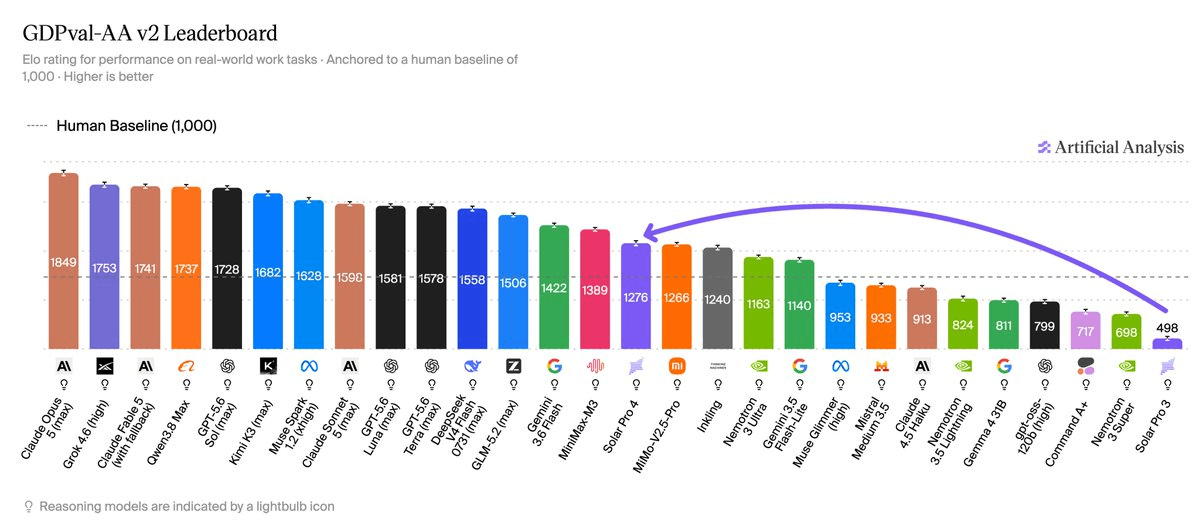
- Biggest gains are on agentic tasks: Terminal-Bench jumps from 12% to 57%, long-context reasoning from 31% to 71%, and real-world agent Elo from 498 to 1276 (above the human baseline of 1000).
- Hallucination rate drops from 88% to 24%, but the model achieves this by abstaining on 59% of knowledge questions rather than improving raw accuracy.
- Priced at $0.30/$1.20 per 1M input/output tokens; 90% launch discount ($0.03/$0.12) runs on Upstage Console and OpenRouter through September 10.
- Supports 512K context, 128K output, English/Korean/Japanese, tool calling, and structured output; OpenAI-compatible API endpoint.
- Most benchmark numbers are self-reported -- no independent third-party evaluation has been published yet.
Korean AI lab Upstage has released Solar Pro 4, its new proprietary flagship reasoning model and a significant step up from Solar Pro 3. On the Artificial Analysis Intelligence Index, it scores 42 -- a 28-point jump from Solar Pro 3's 14 -- placing it alongside models like xAI's Inkling (42) and just behind MiMo-V2.5-Pro (43). The headline number is striking, but the real story is in what changed and why it matters for agent builders.
Built on Finished Work, Not Just Benchmarks
Solar Pro 4 is built to carry real work to the finish -- reading documents, running tools, producing deliverables -- and to stop and say so when the evidence runs out. The work you hand an AI rarely ends with a single question; it's reviewing a contract, reconciling numbers across files, and verifying intermediate results before passing them to the next step.
The key training innovation behind this is OfficeVerse, Upstage's data synthesis pipeline. Solar Pro 4 finishes work because it was trained on finished work. OfficeVerse synthesizes office tasks from real public data across 11 industry domains and 12 task types and grades each one pass or fail on the final deliverable. This is a meaningful departure from training on Q&A pairs or synthetic reasoning chains -- the model was optimized against whether the job got done, not whether individual steps looked plausible.
Where the Gains Are Biggest
The improvements are not evenly distributed. Solar Pro 4's biggest wins are on the tasks that define whether an agent is actually useful in production:
- Terminal-Bench v2.1: 57% (up from 12%) -- completing multi-step jobs in a live shell, not just generating commands
- AA-LCR (long-context reasoning): 71% (up from 31%) -- synthesizing answers scattered across ~100K tokens of documents
- GDPval-AA v2 (real-world agentic tasks): Elo of 1276 (up from 498, well below the human baseline of 1000) -- Solar Pro 4 now sits above the human baseline, slightly ahead of Qwen3.7 Max (1272) and MiMo-V2.5-Pro (1266)
- τ³-Banking (multi-turn tool use): 23% (up from 9%) -- finding the right policy in a large knowledge base and acting on it across a multi-turn, tool-calling conversation
Solar Pro 4 is the largest context the Solar line has shipped -- Solar Pro 3 offered 128K -- and the only Solar to date with a published reasoning story and tool-calling surface aimed at autonomous agents. It supports a 512K context with up to 128K output tokens, and handles English, Korean, and Japanese for both input and output. Response speed is configurable: set reasoning effort high for deep analysis, or low for real-time interaction.
The Hallucination Problem, Partially Solved
One of the more nuanced results is on AA-Omniscience, Artificial Analysis's knowledge and hallucination benchmark. Solar Pro 4's score improves from -53 to -1 -- but the mechanism matters. It attempted only 41% of questions compared to 92% for Solar Pro 3, and its hallucination rate dropped from 88% to 24%. Its raw accuracy on answered questions stayed flat at 19%.
In other words, the model got smarter about what it doesn't know, not necessarily smarter overall. When the evidence isn't there, it says it can't verify instead of making something up. For agent pipelines where a hallucinated number or clause flows silently into a downstream step, this behavior is arguably more valuable than raw accuracy. The 24% hallucination rate is still higher than Command A+ (14%) and MiniMax-M3 (18%), so it's not a solved problem -- but the direction is right.
The Latency Trade-off
The intelligence gains come with a real cost. Solar Pro 4 takes 9.5 minutes to complete an average Intelligence Index task, up from 6.9 minutes for Solar Pro 3 -- despite using 17% fewer output tokens (43K vs 52K). The model is thinking longer per token, not generating more of them. For interactive use cases, Upstage exposes a reasoning effort dial that can bring response speed down to chatbot-level latency, but for deep agentic tasks, you're looking at near-10-minute runs.
Where It Fits (and Where It Doesn't)
Solar Pro 4 is suited for agentic workflows, office productivity, document-intensive work, and coding. Upstage also ships Solar Open 2, an open-weights general-purpose model for on-premises deployment. The two serve different needs:
- Solar Pro 4: API-only, proprietary, built for long multi-step agent jobs -- contracts, terminal tasks, multi-document synthesis
- Solar Open 2: Open weights, self-hosted, fits organizations that can't let data leave their own network
On knowledge, math, and coding benchmarks, the two models are roughly level. The gap shows up squarely in agent execution: Terminal-Bench (+13.8), BrowseComp web research (+11.9), and work deliverables (+7.4).
Where Solar Pro 4 is not the obvious pick: latency-sensitive applications, tasks where a cheaper model covers 90% of the quality, or workloads where you need open weights. It's worth trying now if you are prototyping an agent and the dominant cost is tokens, you need a long context window and your pipeline can tolerate an unproven model, or you are evaluating Korean-language and East-Asian document workloads where Upstage has consistently trained well.
Pricing and Access
Solar Pro 4 went live with a price of $0.30 per million input tokens and $1.20 per million output tokens on Upstage's own API, with a launch promo that cuts that to $0.03 and $0.12. Cached input tokens are $0.06 per million -- an 80% discount on the input price, which matters for agent loops that re-read the same documents repeatedly. The 90% launch discount runs on Upstage Console and OpenRouter through September 10.
At list price, Solar Pro 4 is in line with MiniMax-M3 ($0.30/$1.20), which scores 3 points higher at 45 on the Intelligence Index. It's more expensive than DeepSeek V4 Flash 0731 ($0.14/$0.28), which scores 52. The value proposition is the agentic specialization and the multilingual coverage -- not raw price efficiency.
Getting started is a one-line change if you're already on an OpenAI-compatible stack:
from openai import OpenAI
client = OpenAI(
    api_key="UPSTAGE_API_KEY",
    base_url="https://api.upstage.ai/v1"
)
response = client.chat.completions.create(
    model="solar-pro4",
    messages=[{"role": "user", "content": "Summarize this contract."}]
)
print(response.choices[0].message.content)
Solar Pro 4 supports function/tool calling, structured JSON output, extended reasoning/chain-of-thought, and streaming responses. It's available through the Upstage Console API, OpenRouter, SolarChat (browser, no API key), Hermes Agent from Nous Research, and Upstage Studio for no-code document workflows. On-premises deployment is available for enterprise customers.
A Korean Lab Bet on the Agentic Layer
The broader context here is that Upstage is making a deliberate bet: rather than competing on general intelligence benchmarks against OpenAI, Anthropic, and Google, it's staking out the agentic document-work niche -- with particular depth in Korean and Japanese enterprise contexts. Developing agentic capabilities requires training data that captures the full complexity of real-world tool use: decision-making, planning, tool selection, argument generation, result analysis, error handling, memory and context handling, and environment awareness. OfficeVerse is their answer to that data problem.
The honest caveat is that most of these benchmark numbers are self-reported. No third-party leaderboard had a Solar Pro 4 entry at time of writing, and no independent evaluation has been published. That is the honest summary: this is a what-we-know-so-far moment, not a verified-benchmarks moment. The Artificial Analysis Intelligence Index score of 42 is the most credible external signal available right now. Independent evals will be the real test of whether the agentic gains hold up outside Upstage's own evaluation environment.
Comments
