

Unsloth Makes DeepSeek-V4-Flash Finally Runnable Locally on 160 GB
Unsloth ships lossless GGUF builds of DeepSeek-V4-Flash, making the 284B MoE model locally runnable on 110GB RAM after a critical llama.cpp fix landed July 7th.
 PRO
PRO- Unsloth released production-ready GGUF builds of DeepSeek-V4-Flash, the 284B/13B-active MoE model, following a critical llama.cpp multi-turn fix on July 7th.
- Lossless quantization: Unsloth's UD-Q8_K_XL is bit-identical to official weights; other community GGUFs re-quantize already-FP4 experts, introducing 5–30% weight error.
- Hardware requirements: 3-bit quant (103 GB) runs on 110 GB RAM; lossless 8-bit needs 169 GB — fits a 2×H100 or large Mac.
- Strong benchmarks: V4-Flash scores 79% SWE-bench Verified, 88.1% GPQA Diamond, and 91.6% LiveCodeBench in Think Max mode.
- Extremely cheap via API: $0.14/$0.28 per million input/output tokens — roughly 1% of Claude Opus 4.7's output price, with 10x cache-hit discounts for agentic loops.
- Migration deadline: Legacy
deepseek-chatanddeepseek-reasonerendpoints retire July 24, 2026 — migrate to deepseek-v4-flash now.
DeepSeek's V4 family arrived in April with a genuinely new architecture, and the smaller of its two models, DeepSeek-V4-Flash, has been one of the most-watched open-weight releases of 2026. Now, Unsloth has published a properly quantized GGUF version that finally makes local inference practical, following a key llama.cpp bug fix that landed on July 7th.
What got released, and why it took a while
DeepSeek-V4-Flash is a Mixture-of-Experts model with 284B total parameters and only 13B activated per token, supporting a context length of one million tokens. The open weights dropped under the MIT license, but running them locally was a mess for months. llama.cpp added DeepSeek V4 support, but multi-turn conversations would not function well when using KV cache quantization , it has since been fixed and merged in llama.cpp since July 7th, 2026. Before that fix, the model would produce garbled output mid-conversation.
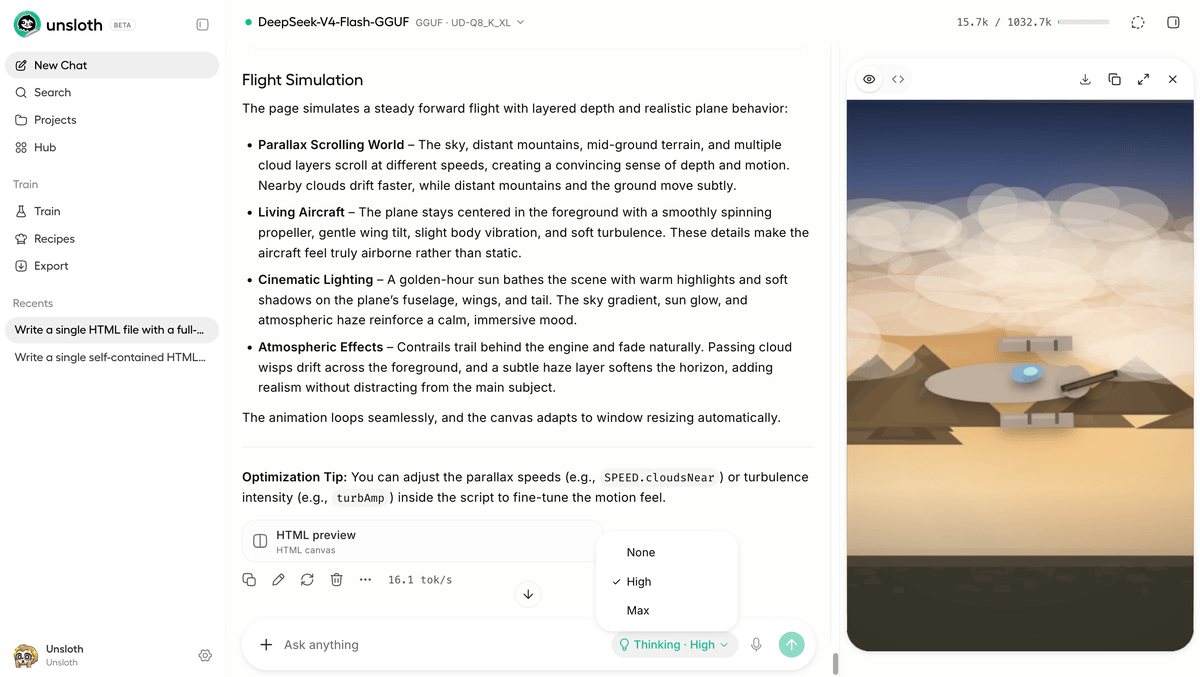
You can now run DeepSeek-V4-Flash in Unsloth Studio with toggles for High and Max thinking. The unsloth/DeepSeek-V4-Flash-GGUF repo is the first set of GGUF builds that Unsloth considers production-ready for this model.
The quantization problem is unusual here
V4-Flash is not a standard BF16 model that you compress down. DeepSeek-V4-Flash is quantization-aware-trained: the official checkpoint stores its routed experts , 96% of the model , natively in MXFP4, and everything else in FP8 or BF16. GGUF's MXFP4 is exactly that format, so Unsloth repacks the experts bit-for-bit, and FP8 dequantizes into BF16 with no rounding.
This matters because other GGUF conversions got it wrong. Unsloth checked every tensor against the official DeepSeek weights: all 1,328 are bit-identical, and it stays lossless at inference with KL-divergence ~0 and 100% top-token agreement. Non-Unsloth DeepSeek-V4-Flash GGUFs were converted without these paths, thus deviating from the official weights. The practical consequence: other community GGUFs re-quantize the already-FP4 experts to Q4_K or IQ2_XXS, introducing 5–30% weight error per layer. Unsloth's builds keep those expert weights untouched.
This story is for Pro members
You've reached the end of the free preview. Upgrade to AlphaSignal Pro to read the full article - and everything else behind the paywall.
Comments
