

Unitree's UnifoLM-WLA-1.0 Runs 64 Robot Tasks From One Set of Weights
Unitree open-sourced a 6B-parameter humanoid foundation model that runs 64 tasks with one network across grippers, dexterous hands, and full-body motion.
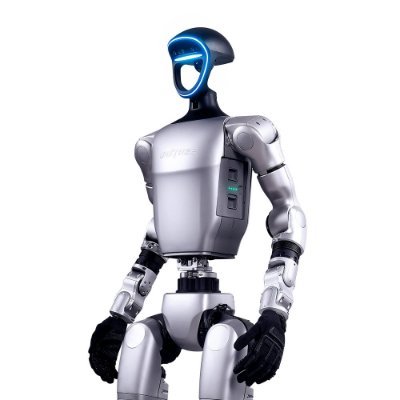
- Unitree open-sourced UnifoLM-WLA-1.0, a 6B humanoid foundation model unifying tabletop and whole-body manipulation
- Single model handles 64 tasks across grippers and multiple five-finger dexterous hands on the G1 humanoid
- Trained on approximately 2,500 hours of real-robot data including Unitree Open Datasets and BitRobot-HIW-500
- 4B embodied reasoner built on Qwen3-VL-4B leads open-source models on 7 of 16 spatial benchmarks
- Uses optical-flow-derived dynamic region prediction via VQ-VAE for interaction-centric world modeling
- Code, weights, and datasets listed as coming soon on the Unitree Hugging Face org
Unitree has released UnifoLM-WLA-1.0, a humanoid robot foundation model that runs tabletop manipulation, whole-body mobile manipulation, two-finger grippers, and multiple five-finger dexterous hands from a single set of weights. Most vision-language-action systems still cannot span that range. The 6B parameter model is built on large-scale multimodal perception data and interaction-centric world modeling, trained on roughly 2,500 hours of high-quality real-robot data covering 64 tasks across desktop and whole-body manipulation.
The release continues a fast cadence from Unitree, which earlier this year shipped UnifoLM-VLA-0 and the UnifoLM-WMA world-model line. WLA-1.0 is the first version where perception, an interaction world model, and an action decoder are unified into one training pipeline rather than glued together after the fact.
Inside the 6B stack
The system has two stacked components. The first is UnifoLM-ER-1, a 4B embodied reasoner built on Qwen3-VL-4B. It trains on more than 5 million samples spanning image point prediction, object detection, multi-image reasoning, 2D trajectory prediction, 3D object detection, and multi-image spatial question answering, co-trained with general image-text data to preserve broad vision-language capability. The second is an action expert built with MMDiT, a multimodal diffusion transformer, that consumes the VLM hidden state plus noisy action tokens and denoises them into continuous control.
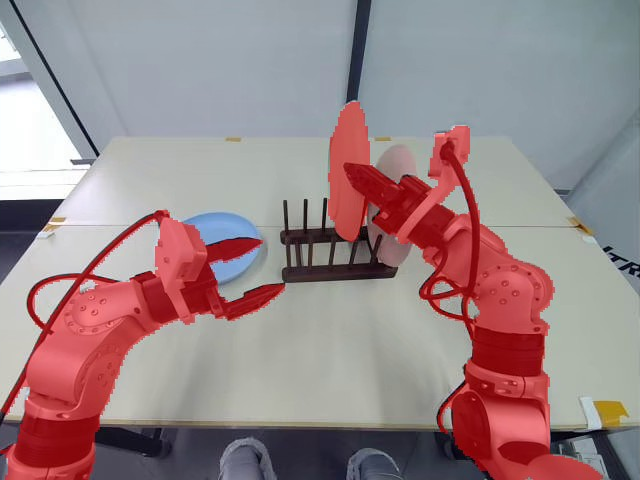
Between the reasoner and the action expert sits the piece that makes this release interesting: a world model that predicts dynamic regions rather than full future frames. The pipeline runs optical flow between consecutive robot-view frames, extracts the moving pixels, and trains a VQ-VAE to compress those masks into a short sequence of discrete tokens. The VLM then learns to predict those mask tokens conditioned on the current image and a task or action, forcing it to model what will change in the scene instead of reconstructing everything.
One action space, many bodies
To let the same weights drive a G1 humanoid with a gripper or with a dexterous hand, Unitree splits the unified action space into three streams and quantizes each one separately with residual vector quantization (RVQ):
- End-effector poses encoded as
<EEF_START> ... <EEF_END>token spans - Gripper or five-finger hand joints as
<HAND_START> ... <HAND_END> - Lower-body joints as
<LOWER_START> ... <LOWER_END>
These discrete tokens share timesteps and are fed synchronously into the VLM alongside language and vision, so cross-embodiment priors transfer between, say, a gripper picking task and a dexterous hand folding task. Training draws from the Unitree Open Datasets and the BitRobot Humanoids-in-the-Wild 500-hour corpus, among others.
Punching above its parameter count
On the reasoning side, the 4B ER model outperforms models several times its size. Unitree reports leading open-source scores on 7 of 16 spatial and multimodal benchmarks, with results comparable to closed proprietary systems. A few standouts from their table:
| Benchmark | UnifoLM-ER-1-4B | Qwen3-VL-8B | RoboBrain2.0-7B |
|---|---|---|---|
| Where2Place | 82.0 | 61.9 | 63.6 |
| Pixmo-Point | 73.8 | 51.0 | 54.7 |
| EmbSpatial | 88.9 | 78.5 | 76.3 |
| RoboSpatial | 73.1 | 66.9 | 54.2 |
| VSR | 88.1 | 83.2 | 84.0 |
The pattern is consistent: WLA-1.0 beats similarly sized and larger open VLMs on spatial grounding while staying competitive on general multimodal understanding like MME (2223.3) and MMMU_VAL (54.7).
What it does on real hardware
Unitree shows the model driving a G1 humanoid across 10 whole-body manipulation tasks and 54 tabletop tasks without swapping weights. The demo reel includes wiping a table, folding a towel, installing a phone into a mount, and placing dishes on a rack. Practical implications for anyone building humanoids:
- You can train once and deploy across gripper and dexterous-hand end-effectors without retraining a per-embodiment policy head
- The dynamic-region world model gives you an interpretable intermediate output you can inspect when a policy fails
- Whole-body tasks such as walking to a target or bending to pick share the same token stream as tabletop pick-and-place, moving toward mobile manipulation without a separate high-level planner
Where it fits in the current VLA landscape
This lands in a crowded month for open embodied foundation models. EO-1 from EO-Robotics recently pushed a 3B unified embodied foundation model trained on the EO-Data1.5M interleaved embodied dataset, and Unitree itself is running parallel tracks with UnifoLM-WMA and the UnifoLM-X2-1.0 real-time world model, which lets robots plan, decide, and react autonomously, reading an opponent's movements and predicting the next move while keeping balance in their humanoid sparring demo.
WLA-1.0 bets that interaction-centric world modeling, predicting what changes rather than what stays the same, combined with a shared discrete action vocabulary, is enough to unify manipulation across bodies. If that holds up in independent testing, the field can retire the practice of maintaining separate policies for each end-effector.
Caveats worth flagging
- Code, weights, and datasets are marked coming soon on the project page, so nothing is downloadable yet despite the open-source framing
- Earlier Unitree releases like UnifoLM-VLA-0 shipped under CC BY-NC-SA 4.0, meaning non-commercial only, and WLA-1.0 will likely follow suit
- Benchmark numbers are self-reported; the ER benchmarks use varying subsets and some scores were re-run internally, so cross-paper comparisons deserve scrutiny
- Every reported robot evaluation runs on Unitree's own G1 platform, leaving generalization to other humanoid hardware unproven
For teams working on humanoid manipulation, the practical move is to watch the Hugging Face org for the weight drop and plan to benchmark WLA-1.0 against EO-1 and Pi-0.5 on your own robot before committing to a stack. The architectural ideas, particularly the dynamic-region VQ-VAE and the per-component RVQ action tokenizer, are worth studying regardless of whether you end up shipping the weights.
Comments
