

UNC and Microsoft's WebXSkill Pushes Web Agents to 86% on Real Sites
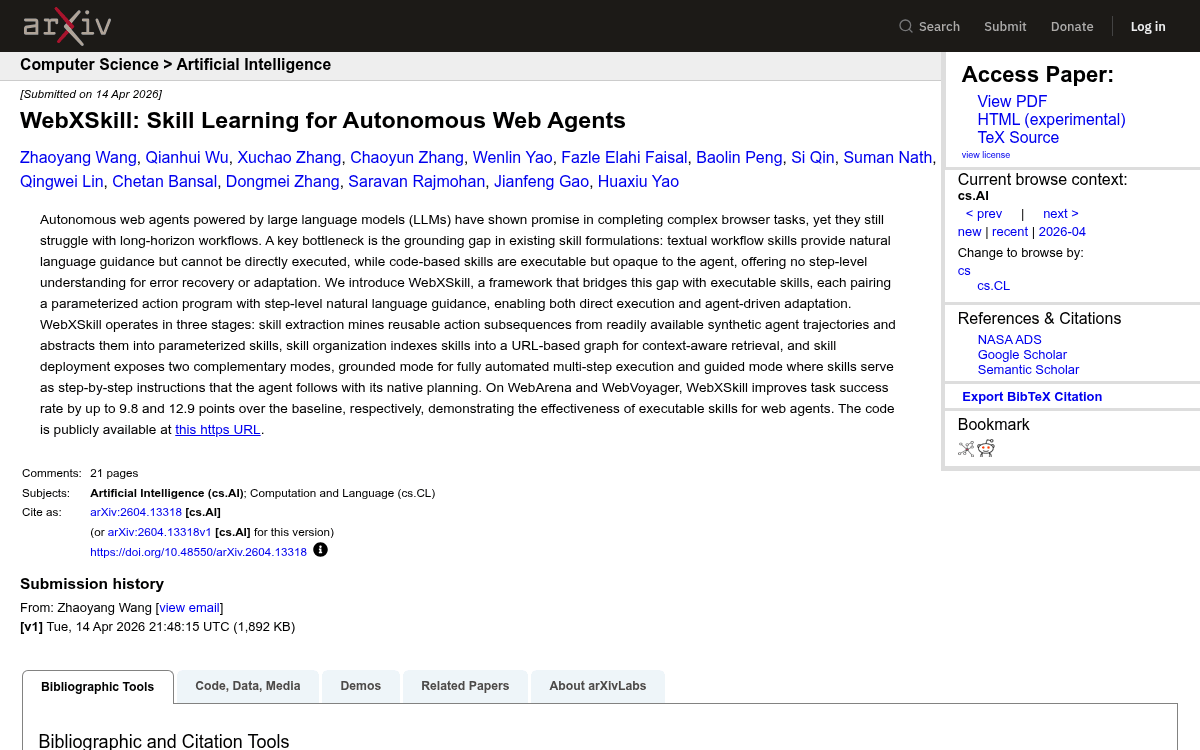
A Microsoft and UNC team gives web agents reusable skills that are both executable and inspectable, boosting task success by up to 12.9 points.
 PRO
- WebXSkill pairs executable action programs with step-level natural language guidance, closing the grounding gap in web agent skills.
- Three-stage pipeline: extract skills from synthetic trajectories, organize into a URL-based skill graph, deploy via grounded or guided mode.
- Improves task success by up to 9.8 points on WebArena and 12.9 points on WebVoyager over baselines.
- Grounded mode suits strong models like GPT-5; guided mode benefits weaker models and cross-site skill transfer.
- Ablations show skill validation and the URL graph are the most critical components for reliable deployment.
- Code repo at aiming-lab/WebXSkill is a placeholder; implementation built on browser-use.
Web agents built on large language models can click buttons and fill forms, but they still fall apart on long, multi-page workflows. A new framework called WebXSkill, from researchers at UNC Chapel Hill and Microsoft, gives agents a library of reusable skills they can either execute directly or follow step-by-step, closing what the authors call the grounding gap between plain-text workflows and opaque code.
Why agents keep forgetting what they just learned
When a web agent successfully completes a checkout flow or navigates a complex admin panel, the procedural knowledge embedded in that trajectory is often discarded. The next time a similar task appears, the agent re-plans the entire sequence from scratch, wasting steps and inviting new hallucinations.
Prior work has tried to fix this with skills, and each approach compromises something. Workflow-based systems such as AWM represent skills as natural language instructions that guide planning but cannot be directly executed, forcing the agent to translate each instruction into concrete browser actions and reintroducing grounding errors. Code-based approaches like SkillWeaver and WALT go the other direction, grounding skills in executable scripts but deploying them as opaque black-box calls without step-level guidance, leaving the agent unable to understand, adapt, or recover when execution fails mid-way.

Executable skills with a voice
This story is for Pro members
You've reached the end of the free preview. Upgrade to AlphaSignal Pro to read the full article - and everything else behind the paywall.
Comments
