

UIUC's ReasoningFlow Reveals 85% of AI Reasoning Errors Never Reach the Final Answer
ReasoningFlow converts LLM reasoning traces into fine-grained DAGs with 8 node types and 14 edge types, revealing that most errors in reasoning models never actually affect the final answer
 PRO
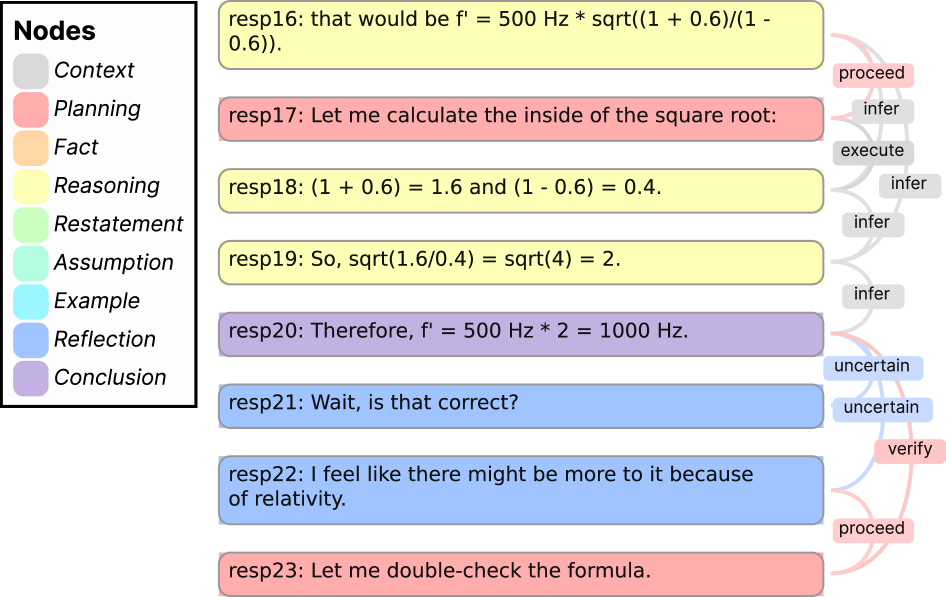
- ReasoningFlow converts LLM reasoning traces into DAGs with 8 node types and 14 edge types, the most expressive schema to date, validated with inter-annotator agreement (Krippendorff's alpha > 0.8).
- 79.6% of erroneous steps in reasoning models never reach the final answer, explaining why Process Reward Models fail to reliably improve accuracy when used for filtering.
- All tested reasoning models (DeepSeek-R1, QwQ, GPT-o3) produce structurally similar traces regardless of base model or training data; task type is the dominant structural factor.
- Local verification (mid-reasoning corrections) is more frequent and more impactful than global solution re-checking, which mostly just restates the original answer.
- Self-reflection sentiment is a real signal: steps with positive reflection are 78.1% correct, dropping to 45.6% for negatively-reflected steps.
- Dataset and annotation pipeline are open-sourced; 1,260 annotated traces spanning AIME, GPQA-Diamond, and ArgKP across 5 models.
When a model like DeepSeek-R1 or QwQ works through a hard math problem, it doesn't think in a straight line. It backtracks, second-guesses itself, makes assumptions, and corrects errors mid-stream. That messy, non-linear process is exactly what makes these reasoning traces so hard to evaluate, monitor, or improve. A new paper from the University of Illinois Urbana-Champaign introduces ReasoningFlow, a framework that turns these sprawling traces into structured graphs, and the findings it surfaces are genuinely surprising.
The problem with "thinking" models
Large Reasoning Models (LRMs) like DeepSeek-R1, QwQ-32B, and GPT-o3 generate extended reasoning traces that contain what researchers call non-linear behaviors: verification loops, self-reflection, backtracking, and hypothetical reasoning. This non-linearity complicates both correctness evaluation and faithfulness monitoring. For instance, stepwise evaluation may flag an erroneous step, yet the trace as a whole may still be correct if the self-verification overrides the previous error.
Existing tools for analyzing these traces are either too coarse (working at the paragraph level) or too narrow (only capturing logical entailments). Recent attempts to understand the non-linear structure of LRM traces either lack expressive relation labels or only annotate inter-paragraph structures, which are too coarse for annotating fine-grained reasoning behaviors. None of the prior frameworks had been validated with inter-annotator agreement studies, leaving open whether the categories were even consistently interpretable by humans.
A grammar for reasoning traces
ReasoningFlow converts reasoning traces into a directed acyclic graph (DAG) with 8 node types and 14 edge types. The team released 31 manually annotated and cross-verified reasoning traces (2.1k steps), along with 1,260 automatically annotated traces (247.7k steps) generated by five models across math, science, and argumentation tasks.
The 8 node types capture distinct functional roles in the reasoning process:
- Reasoning -- deductions, calculations, logical inferences
- Planning -- meta-steps that introduce what comes next ("Let me verify this...")
- Reflection -- sentiment or evaluation of a prior step ("This seems off")
- Fact -- external parametric knowledge invoked from memory
This story is for Pro members
You've reached the end of the free preview. Upgrade to AlphaSignal Pro to read the full article - and everything else behind the paywall.
Comments
