
UCLA's FetchMan Trains Humanoid Robots to Fetch Objects With 73% Real-World Success
A UCLA and Allen AI team trained a humanoid to walk up and grab objects using only simulated data, hitting 73.3% real-world success on a Unitree G1.
 Pro
Takeaways
- FetchMan trains a vision-based humanoid policy entirely in simulation and deploys zero-shot to a real Unitree G1.
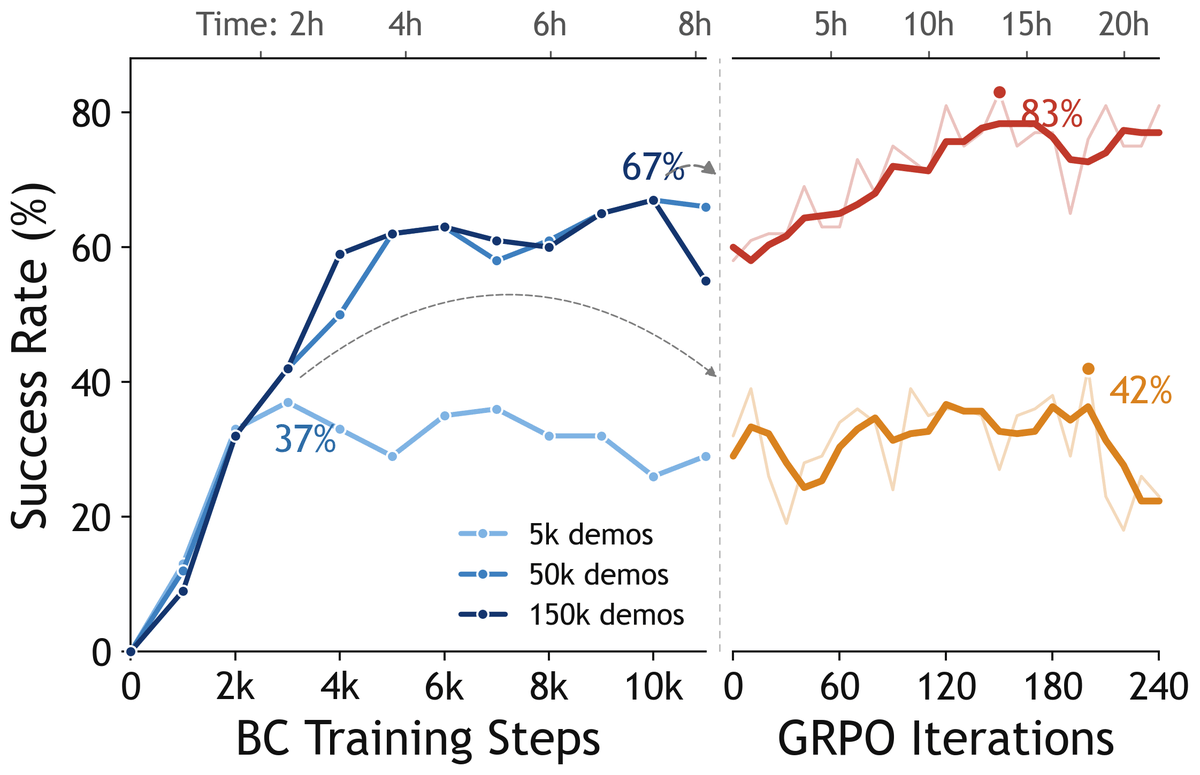
- Behavior cloning on 350,000 synthetic episodes saturated at 67% success no matter how much data was added.
- Flow-GRPO reinforcement learning on a single sparse reward lifted simulation success to 83% and real-world to 73.3%.
- Two design choices, frozen DINOv3 encoder and delta-action targets, are non-negotiable, swapping either drops real-world success to 0%.
- All Flow-GRPO gains land on locomotion; manipulation alone barely moves from 72.7% to 77.2%.
- Team releases code, data and FetchMan-Bench, a humanoid loco-manipulation simulation benchmark built on MolmoSpaces.
Getting a humanoid robot to walk across a room, spot the object you asked for, and pick it up sounds simple until you count the demonstrations it would take to teach one by imitation. A new paper from UCLA and Allen AI called FetchMan skips real-world teleoperation entirely. The team trained a vision-based policy purely in simulation across more than 150,000 scenes, then dropped it onto a real Unitree G1 with no fine-tuning and watched it reach and grasp objects across unseen rooms at 73.3% success.
Behavior cloning alone hit a wall no amount of extra data could push past. The fix was a reinforcement learning stage using a variant called Flow-GRPO on a single sparse reward, and that combination is what closed the sim-to-real gap.
Why cloning synthetic demos hits a ceiling
Locomotion policies have transferred from simulation to the real world for years. Manipulation has not, largely because collecting enough tabletop demonstrations is expensive, and collecting them for a robot that also has to balance on two legs is worse. The obvious workaround is to script a demonstrator in simulation and generate as many episodes as you want. The FetchMan team did exactly that, producing 350,000 episodes in two days across Allen AI's MolmoSpaces scene dataset.
Then cloning those demos saturates. On the single-object fetch task, behavior cloning peaked at 67% success and refused to improve whether they trained on 5k, 50k, or 150k demonstrations. On the multi-object version it topped out around 40%. Pouring more synthetic data into a supervised loss does not break through, because the policy inherits every quirk of the scripted demonstrator and averages over the noise instead of learning to recover from it.

Flow-GRPO, in plain terms
Stage two is where things get interesting. FetchMan's action head is a flow-matching diffusion transformer, meaning it generates action chunks by iteratively denoising a Gaussian sample. Normally that denoising is a deterministic Euler integration, which is fine for inference but gives you no stochasticity to explore with. Flow-GRPO replaces each denoising step with a Gaussian transition that matches the rectified-flow schedule, so every step has a closed-form log-likelihood and the policy becomes trainable with a policy-gradient method.
From there it is essentially GRPO, the group-relative variant of PPO that skips learning a value function. Each update collects 64 groups of 8 rollouts starting from the same reset state, differing only in the injected noise. The advantage is the standardized return within the group. The reward is as sparse as it gets: 1 if the robot grasps and lifts the target, 0 otherwise. A KL penalty to the frozen behavior-cloned policy keeps the refinement from wandering off.
That single stage lifted simulation success from 67% to 83% on single-object fetch, and from 40% to 62% on the multi-object version. On the real Unitree G1, loco-manipulation success jumped from 56.7% to 73.3%.
What actually transfers to hardware
The paper's ablation is the part worth studying. Two architectural choices carried the sim-to-real transfer, and removing either one dropped real-world performance on the full task to zero.
- Frozen DINOv3 ViT-B/16 encoder. Both the head fisheye and wrist RGB streams get tokenized by a frozen DINOv3 backbone. Swapping in SigLIP tanked real-world loco-manipulation from 56.7% to 0%.
- Delta-action targets. The 11 absolute upper-body target dimensions are re-parameterized as per-chunk deltas. Using absolute actions collapsed real-world success to 0% as well, even though simulation numbers only dropped modestly.

The architecture is a two-system stack. The high-level policy predicts a chunk of 16 commands and executes the first 8, sending upper-body joint targets to a PD controller and base velocity commands to a low-level walking controller called SONIC. The team also released a separate object-conditioned variant that takes the target's name as a text instruction.
Where the RL gains actually come from
One useful breakdown from the paper: when the task is manipulation only, with the object already within arm's reach, RL barely helps, moving success from 72.7% to 77.2% on hardware. The grasp was already cloned well. The walking was not. All of the meaningful improvement from Flow-GRPO shows up in the locomotion portion, where the scripted demonstrator's behavior was hardest to imitate and where recovery from small errors compounds most.
Another sharp result: starting Flow-GRPO from a weaker 5k-demo checkpoint stalls at 42%. The BC initialization matters. RL is refining a competent starting policy rather than learning from scratch, so you still need the large synthetic dataset to get there.
What ships and what it is good for
Alongside the paper the team is releasing code and data and a simulation benchmark called FetchMan-Bench that extends MolmoSpaces-Benchmarks toward humanoids. The benchmark lets you run thousands of evaluation rollouts across scenes to get a quick read on any humanoid policy on the Fetch task.
Practically, this is a strong template for anyone building visuomotor policies on humanoid platforms who cannot afford to collect real-world demonstrations. The recipe is concrete: script a demonstrator in a large scene dataset, clone at scale, then refine with Flow-GRPO on a sparse task reward, and be careful about which visual encoder and action parameterization you use. The limits are also honest. This is a reach-and-pick policy, not a general manipulator. Multi-object numbers still trail single-object numbers, and complex interactions like articulated objects, bimanual tasks, or long horizons are not on the menu yet.