
UCLA and Princeton's SDPG Trains Reasoning Models Faster Without Collapse
SDPG unifies verifier-based RL and self-distillation into a single training objective, fixing the sparse-reward and mode-collapse problems that plague both approaches separately
 Pro
Takeaways
- SDPG combines GRPO-style verifier rewards with full-vocabulary on-policy self-distillation in a single principled loss, fixing sparse rewards and mode collapse simultaneously.
- A key theoretical result shows that reverse-KL self-distillation is locally equivalent to a policy gradient step with a centered log teacher/student ratio as the token advantage.
- Two stabilizers prevent the distillation signal from destabilizing training: positive advantage gating (only distill on correct rollouts) and a warmup-decay beta schedule.
- On Qwen3-4B, SDPG-UFKL reaches 0.408 on AIME24 and 0.870 on AMC23, outperforming GRPO (0.316 / 0.739) and RLSD (0.395 / 0.813) across all benchmarks.
- SDPG avoids the entropy collapse seen in pure self-distillation (RLSD entropy hits zero by step 250), maintaining healthy exploration throughout training.
- Code is open-sourced on top of the verl framework, with scripts for Qwen3-4B and Qwen3-1.7B experiments and all four KL regularization modes.
Reinforcement learning from verifiable rewards (RLVR) has become the go-to recipe for post-training reasoning models. Algorithms like GRPO sample groups of responses, score them with a rule-based verifier, and push the policy toward correct answers. The problem is that the reward signal is brutally sparse: a single binary score is spread uniformly across every token in a potentially thousand-token response. The model has no idea which tokens in a correct chain of reasoning actually mattered.
A parallel line of work tries to fix this with self-distillation. The idea is elegant: show the model the correct answer as a hint, run a forward pass to get a "privileged" token distribution, then train the model without the hint to match that distribution. Dense, per-token supervision for free. The catch is that pure self-distillation has no verifier, so it can happily reinforce locally plausible tokens on globally wrong trajectories, and it tends to collapse into mode-seeking behavior over time.
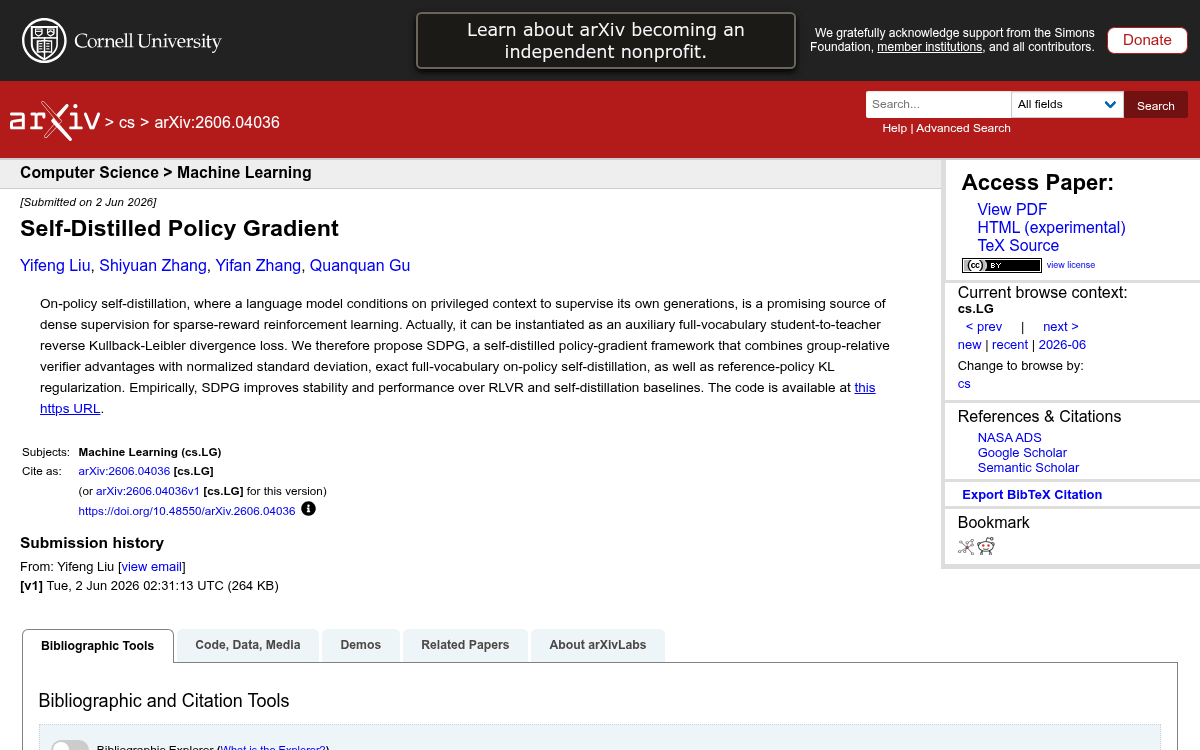
Researchers from UCLA and Princeton now propose SDPG (Self-Distilled Policy Gradient), a framework that combines both sources of supervision in a principled way, while adding two stabilizers that prevent each component from undermining the other.
The core insight: self-distillation is policy gradient in disguise
The key theoretical contribution is a gradient identity. For a fixed rollout prefix and with the teacher branch detached, the student-side gradient of the reverse-KL full-vocabulary OPD loss equals a detached-sampling policy-gradient update whose token advantage is a centered log teacher/student ratio. In plain terms: minimizing the KL between the model-without-hint and the model-with-hint is mathematically equivalent to running a policy gradient step where each token's advantage is proportional to how much the hint boosted its probability. This is a gradient identity, not an approximation, and it means the two training signals can be cleanly combined in a single loss.
This also reveals a failure mode of pure self-distillation: without a verifier, a privileged but imperfect distribution can reinforce locally plausible tokens on globally wrong trajectories. SDPG's fix is to keep the binary outcome reward from GRPO and add the self-distillation signal as an auxiliary term, not a replacement.
Three-part objective
SDPG has three components. First, it uses an on-policy objective as used in RLVR, with rewards supplied by a binary verifier. Second, it adds exact full-vocabulary OPD on prefixes sampled from the unprivileged rollout policy, so the privileged signal is dense but remains tied to the student's own state distribution. Third, it anchors the updated policy to a fixed reference policy through a rollout-policy-sampled KL surrogate.
The full loss looks like this:
# Pseudocode for SDPG loss
L_SDPG = L_out          # GRPO-style outcome reward (verifier)
       + beta(k) * L_OPD_plus  # gated full-vocab self-distillation
       + alpha * L_KL          # reference-policy KL regularization
# beta(k) follows a warmup-then-decay schedule
# L_OPD_plus only applies to positively-advantaged rollouts
Two variants are tested: SDPG-URKL uses an unnormalized reverse-KL for the reference regularization, and SDPG-UFKL uses an unnormalized forward-KL. The unnormalized KL (UKL) is preferred over the standard version because it is equivalent to the k3 estimator, which is an unbiased estimator of KL divergence but with lower variance.
Two stabilizers that make it work in practice
The self-distillation signal is noisy, especially early in training when the model hasn't yet learned to find correct trajectories. SDPG adds two lightweight controls:
- Positive advantage gating. When a rollout is incorrect, the privileged teacher can still assign high probability to locally plausible tokens on the sampled wrong prefix. Applying full-vocabulary OPD on such prefixes may conflict with the verifier signal: the outcome objective suppresses the trajectory, whereas the distillation objective can still imitate the privileged teacher around that prefix. The fix: the distillation loss is only applied to rollouts that the verifier endorsed (positive advantage).
- Beta warmup-decay schedule. The distillation coefficient starts at zero, ramps up after the model begins finding correct trajectories, then decays toward the end of training. The decay matters because distilling a teacher conditioned on information unavailable to the deployable student can leave an irreducible conditional mutual-information gap, so phasing out the signal late in training lets the student explore freely.

Experiments: faster convergence, no collapse
Experiments are conducted primarily on Qwen3-4B, using the DAPO-Math-17k dataset with 13.9k English samples. Privileged information (correct answers and solution hints) is generated using Gemini 2.5 Pro. Models are evaluated on AIME 2024, AIME 2025, and AMC 2023.
The results are clear-cut. Both SDPG-URKL and SDPG-UFKL outperform GRPO and RLSD across all benchmarks, with SDPG-UFKL achieving the top score in five and SDPG-URKL in the remaining one. The accuracy gap between SDPG and GRPO opens within the first 50 steps and persists throughout training, and SDPG reaches the high-reward plateau several hundred steps earlier than GRPO.

The stability story is equally important. SDPG-UFKL maintains substantially higher actor entropy throughout training, in contrast to RLSD whose entropy collapses toward zero by step 250, a known signature of mode collapse in pure self-distillation. The authors attribute this stability to the combination of positive-advantage gating and the warmup-decay beta schedule, which together prevent privileged distillation from over-constraining the policy.
In numbers on Qwen3-4B after 400 steps:
| Method | AIME24 (Best) | AIME25 (Best) | AMC23 (Best) |
|---|---|---|---|
| GRPO | 0.316 | 0.279 | 0.739 |
| RLSD | 0.395 | 0.304 | 0.813 |
| SDPG-URKL | 0.401 | 0.308 | 0.863 |
| SDPG-UFKL | 0.408 | 0.335 | 0.870 |
Limitations and when to use it
SDPG requires privileged context at training time, meaning you need ground-truth answers (and ideally solution paths) for every training example. In the paper's setup, privileged information is generated using Gemini 2.5 Pro, which adds cost and a dependency on a frontier model. The method is also more memory-intensive than vanilla GRPO because it needs to run two forward passes per training step (one with context, one without) to compute the full-vocabulary KL. The GitHub repo notes that SDPG materializes (B, T, V) actor and teacher logits simultaneously during the policy update step.
The method is best suited for settings where:
- You have access to verifiable ground-truth answers (math, code, logic)
- You can generate or retrieve solution traces to use as privileged context
- Training stability and sample efficiency matter more than raw compute cost
- You are working with models in the 1B-4B range where pure self-distillation tends to collapse
What's available
The SDPG repository implements the paper on top of the verl RLHF framework and includes training scripts for GRPO, SDPG, OPSD, and RLSD baselines. The repo ships with ready-to-run shell scripts for Qwen3-4B experiments, pre-processed datasets with and without teacher context, and support for all four KL regularization modes (fkl, rkl, ufkl, urkl). The default configuration requires 8 A100 or H100 GPUs.
The ablation studies confirm that both components earn their keep: removing the OPD term loses the fast early-training convergence on hard benchmarks, while removing the KL regularization causes response lengths to collapse and entropy to spike, suggesting the policy drifts away from coherent reasoning. The combination of a dense distillation signal and a policy anchor is what makes the difference.