

UCL Researchers Settle the Debate on Whether AI Agents Are Truly Creative
A new framework splits AI creativity into two lenses, arguing LLM agents produce creative outputs but lack the process behind genuine creativity.
 PRO
- New framework paper splits AI creativity into functionalist (output-based) and ontological (process-based) perspectives.
- LLM agents achieve combinational and exploratory creativity but not transformational creativity requiring hyperpolation.
- Agents do induction and deduction but cannot perform creative abduction to invent new premises from experience.
- Three ontological gaps identified: no intrinsic motivation, no continual learning, no intentionality or personal traits.
- Agentic loops solve the easy creativity problems through self-evaluation and environment interaction, not the hard ones.
- Output creativity strongly correlates with prompt creativity; existing benchmarks reward derivative outputs and need replacement.
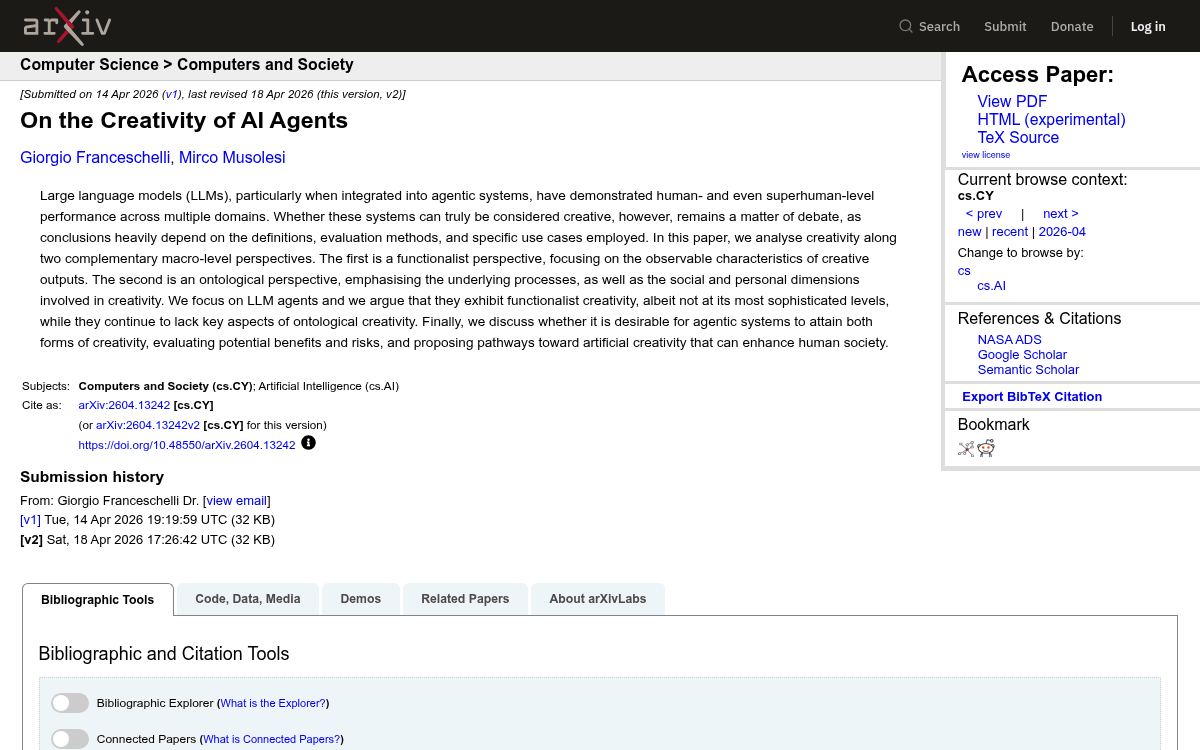
A pair of researchers from the University of Bologna and University College London have released a position paper that tries to end a shouting match. The debate over whether LLM agents are actually creative has been going in circles because everyone uses a different definition of creativity. Their paper proposes a dualistic framework that separates what a creative artefact looks like from what a creative process is, then measures modern agentic systems against both.
The verdict is nuanced. LLM agents exhibit functionalist creativity, though not at its most sophisticated levels, while they continue to lack key aspects of ontological creativity. In plainer terms, they can produce work that looks creative from the outside, but the machinery behind that work is missing several ingredients associated with genuine creative agency.
Two lenses for one messy question
The framework splits the problem in half. The functionalist view asks whether an output is novel, valuable, and surprising, judging creativity from observable traits of the artefact itself. The ontological view, drawn from psychology, asks about the process, the environment (the "press"), and the person doing the creating.
Within the functionalist camp, the authors lean on Margaret Boden's well-known taxonomy. Combinational creativity involves making unfamiliar combinations of familiar ideas. Exploratory creativity involves probing conceptual spaces to come up with new ideas that fit within them. Transformational creativity reshapes such spaces so that previously inconceivable thoughts become possible. Think mashing up two known concepts, versus wandering deeper into an existing style, versus inventing non-Euclidean geometry.
This story is for Pro members
You've reached the end of the free preview. Upgrade to AlphaSignal Pro to read the full article - and everything else behind the paywall.
Comments
