

TypeNet Catches AI Cheaters by Watching How Students Type
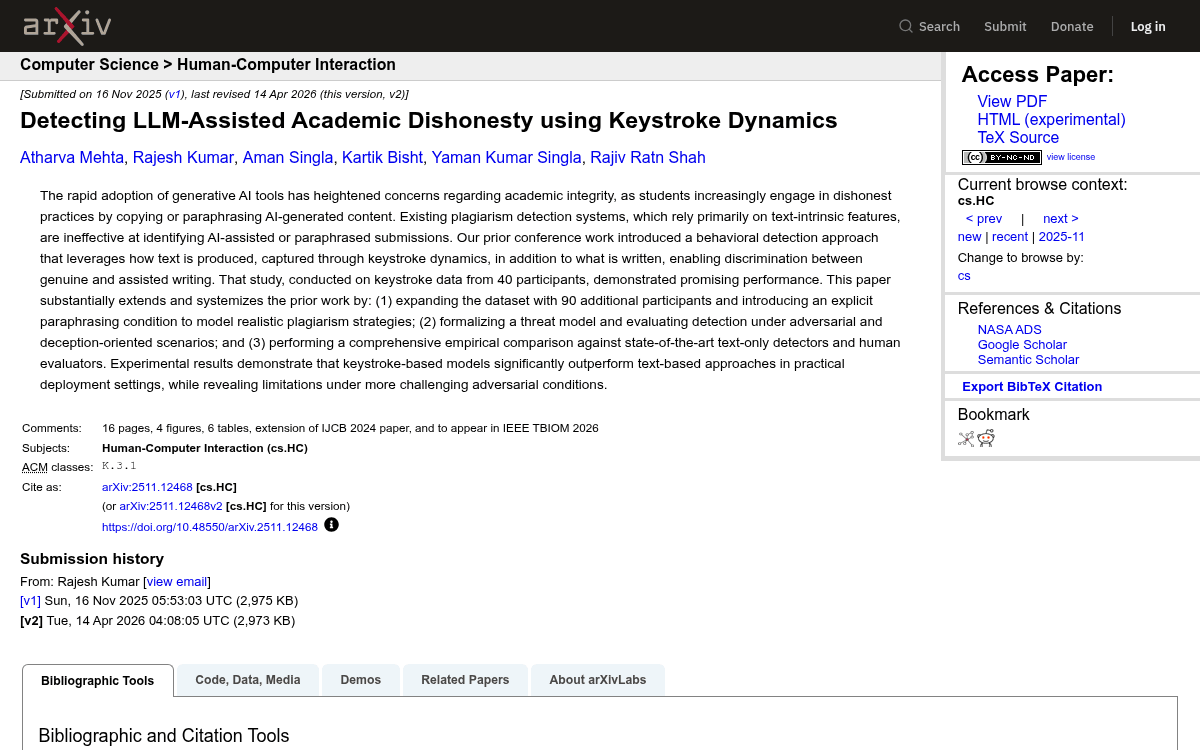
A new study shows keystroke timing patterns can spot AI-assisted writing with over 97% accuracy, while text detectors and humans hover near chance.
 PRO
- Keystroke dynamics detect LLM-assisted writing with 97%+ F1, far above text detectors and human graders.
- The paper extends earlier work with 90 new participants and a paraphrasing-specific dataset.
- LightGBM and CatBoost dominate structured tests; TypeNet leads on harder paraphrasing at 86.9% F1.
- DetectGPT scored under 11% F1 on paraphrased text; expert humans hovered near 45%.
- A forged-keystroke attack broke boosted models (97% false reject); TypeNet stayed robust at 0%.
- Code available at github.com/ijcb-2024/keystroke-llm-plagiarism.
Plagiarism detectors have a ChatGPT problem. Tools like Turnitin and GPTZero were built to compare what students wrote against a corpus of existing text, but when a student pastes an AI-generated essay into their own words, there is nothing to match. A group of researchers from MBZUAI, Bucknell, IIIT Delhi, and Adobe argue that the fix is to stop looking at the finished text and start looking at how the fingers moved to produce it.
Their new paper extends a line of work on keystroke dynamics, the millisecond-level rhythms of key presses and releases that are unique enough to authenticate a user from around 100 keystrokes. The models achieve F1 scores above 97% in structured settings, while a deep model called TypeNet performs best in detecting paraphrasing with an F1 score of 86.9%. Text-only detectors and human evaluators perform near-chance.
Why text-based detection keeps failing
Conventional plagiarism detectors, which rely on text-matching or text-intrinsic features, often fail to identify submissions that have been AI-assisted or paraphrased. Humans do only marginally better than a coin flip, and the cost of a false positive can be a wrongful academic misconduct charge.
The team's insight is that the writing process leaves behavioral fingerprints that the final prose cannot. Pauses while ideating, revisions, and the cadence of typing all reflect cognitive load. Someone transcribing a ChatGPT answer types differently from someone composing an argument from scratch, and unlike stylistic tics, typing rhythm is genuinely hard to fake without help.
Four datasets and a paraphrasing trap
To test this, the authors combined two public keystroke corpora with two new ones they collected. Building on an earlier study with keystroke data from 40 participants that trained a modified TypeNet model, they expanded the dataset by adding 90 new participants and introducing a paraphrasing-based plagiarism-detection mode.
This story is for Pro members
You've reached the end of the free preview. Upgrade to AlphaSignal Pro to read the full article - and everything else behind the paywall.
Comments
