

Tsinghua's Open-MOPD Merges Expert AI Models Into One, Recovering 83% of Lost Performance
A new open recipe from Tsinghua and ByteDance diagnoses why merging multiple RL specialists into one model fails, and more than doubles capability recovery.
 PRO
- Tsinghua and ByteDance Seed release Open-MOPD, the first open, reproducible multi-teacher on-policy distillation recipe.
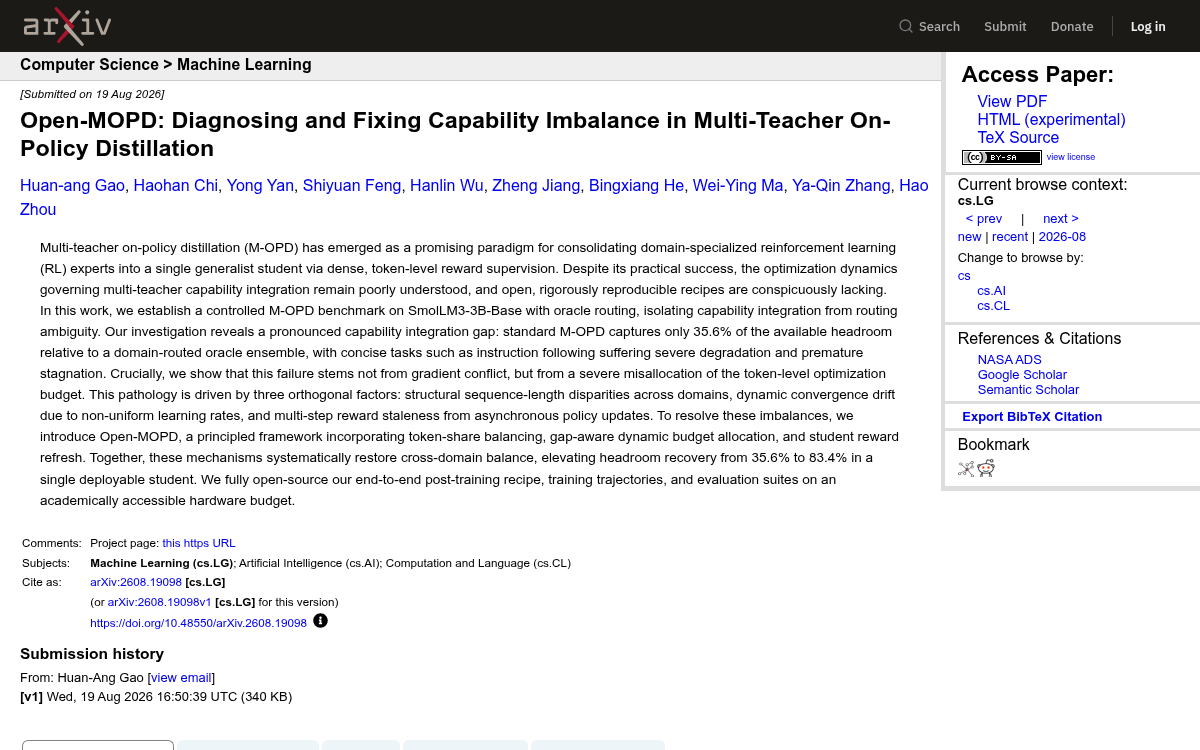
- Standard M-OPD recovers only 35.6% of the gap between mixed SFT and a per-domain oracle ensemble.
- Open-MOPD lifts that recovery to 83.4% using three targeted fixes on SmolLM3-3B-Base.
- Root cause is not gradient conflict but misallocation of the token-level optimization budget across domains.
- Fixes: token-share balancing, gap-aware dynamic budget allocation, and student reward refresh for staleness.
- Full recipe, trajectories, and evaluation suites reproducible on an 8-GPU academic node.
Merging several domain-expert LLMs into a single generalist student sounds like a solved problem in industry pipelines, but the recipe has stayed mostly behind closed doors. A new paper called Open-MOPD, from Tsinghua University and ByteDance Seed, is the first fully reproducible attempt to pull that pipeline apart, figure out why it fails, and fix it on hardware most labs can actually afford.
Standard multi-teacher on-policy distillation captures only 35.6% of the available headroom relative to a domain-routed oracle ensemble, with concise tasks such as instruction following suffering severe degradation and premature stagnation. With three targeted fixes, the authors push that recovery to 83.4% in a single deployable student.
Too many specialists, one deployment slot
Post-training with reinforcement learning is good at cultivating narrow skills. You can build a math expert, a coding expert, and an instruction-following expert independently, each with its own reward signal. Serving three models is expensive, and mixing their training data through Mix-RL, Cascade RL, or parameter merging tends to produce see-saw effects, where improving one domain degrades another, or catastrophic forgetting, where a model loses previously learned skills during sequential training.
Multi-teacher on-policy distillation, or M-OPD, is the paradigm that has been quietly winning inside frontier labs. In the recently published MOPD paper, the method was shown to work on Qwen3-30B-A3B and inside the industrial-scale MiMo-V2-Flash pipeline. The idea: first run per-domain specialised RL to obtain a set of domain teachers, then distill these teachers into the student on its own rollouts. This eliminates exposure bias and provides a dense optimization signal. The student generates, the appropriate domain teacher scores every token, gradients flow.
This story is for Pro members
You've reached the end of the free preview. Upgrade to AlphaSignal Pro to read the full article - and everything else behind the paywall.
Comments
