

Tsinghua's EvoSpark Turns AI Hallucinations Into Story Characters Across 250,000 Words
A new multi-agent framework tackles long-horizon story simulation by treating LLM hallucinations as narrative fuel and giving agents a mutable, evolving social memory.
 PRO
- EvoSpark is a multi-agent framework for long-horizon narrative simulation, accepted at ACL 2026.
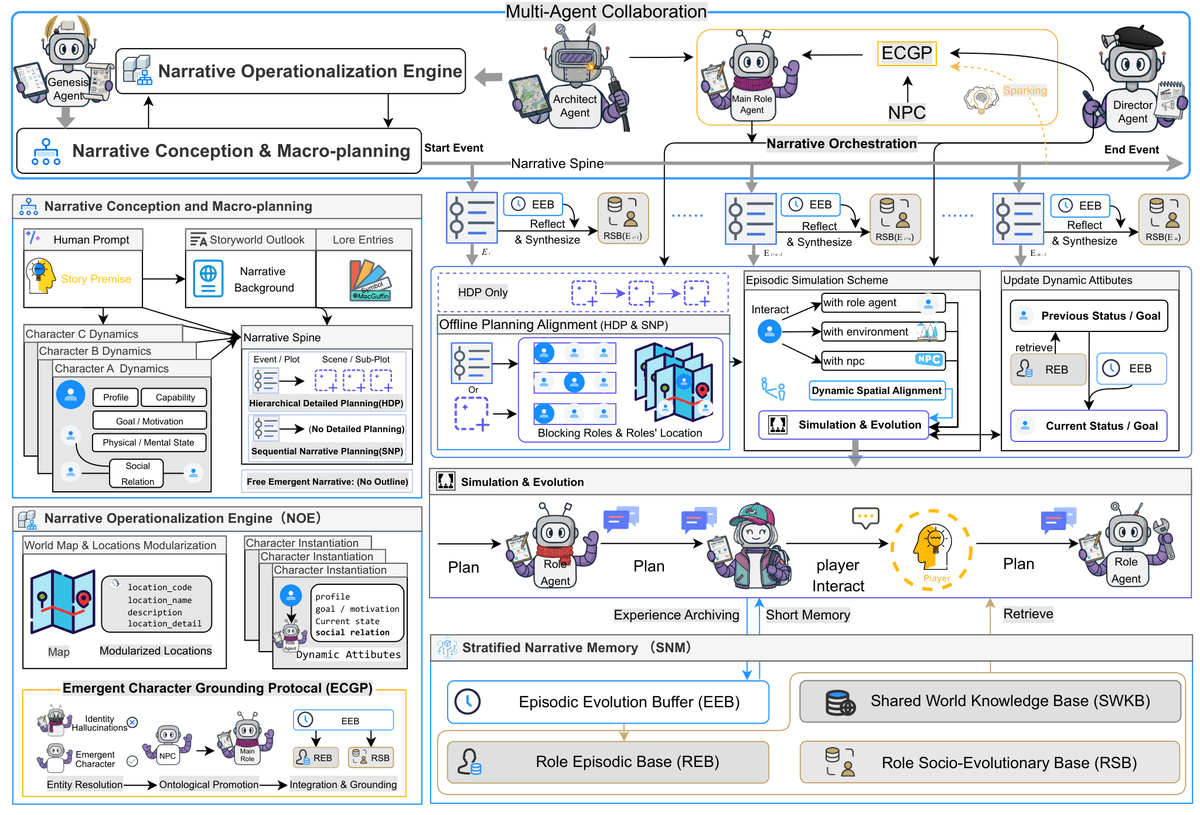
- It fixes social memory stacking with a mutable Role Socio-Evolutionary Base updated in place after each event.
- The Generative Mise-en-Scène module enforces Role-Location-Plot alignment through a stage-director agent.
- Emergent Character Grounding Protocol promotes LLM hallucinations into legitimate persistent characters.
- Runs of 15 events yield 200k to 250k words and beat BookWorld, Open-Theatre, and HoLLMwood.
- Main cost: 38-second average turn latency due to multi-agent coordination overhead.
Long-running story simulations built on LLM agents tend to fall apart in predictable ways. Characters remember being both allies and enemies. People teleport between rooms mid-conversation. A researcher from Xinjiang University and Tsinghua has proposed EvoSpark, a framework that tries to fix both problems at once, and it was accepted to ACL 2026.
The pitch: a minimal story premise plus a set of coordinating agents should be able to expand into a coherent, open-ended fictional world that stays consistent over hundreds of thousands of words. The authors treat stochastic hallucinations as drivers for creativity, promoting them into legitimate characters through what they call the Emergent Character Grounding Protocol.
Two failure modes that break long simulations
The paper identifies two systemic problems that trip up existing LLM-based agent societies. The first is social memory stacking: conventional append-only memory keeps piling up interaction logs, so an agent can end up holding contradictory relational states about the same character. If Alice and Bob fight, reconcile, then fight again, a naive log makes both the friendship and the feud simultaneously true.
The second is narrative-spatial dissonance. Text agents generate plausible dialogue but lose track of where characters physically are. The paper gives a concrete failure case: a character pivots to confront a guard in one turn, then in the next turn is described as maintaining unbroken eye contact with a different person across the room. Semantically fine, physically impossible.
Underneath both problems sits a paradigm split. Traditional interactive narratives follow rigid scripts (coherent but not autonomous), while recent LLM simulations optimize for open emergence (autonomous but chaotic). EvoSpark aims to be paradigm-agnostic, supporting three configurable control modes: Hierarchical Detailed Planning for rigorous event trees, Sequential Narrative Planning for linear milestones with improvisation between them, and Free Emergent Narrative where only the initial world and roles are seeded.
This story is for Pro members
You've reached the end of the free preview. Upgrade to AlphaSignal Pro to read the full article - and everything else behind the paywall.
Comments
