

TripoAI's TripoSplat Turns One Photo Into a Rotatable 3D Asset With 262K Gaussians
VAST-AI open-sources a single-image to 3D Gaussian generator with learnable density control, adjustable output size up to 262K primitives, and SIGGRAPH 2026 backing.
 PRO
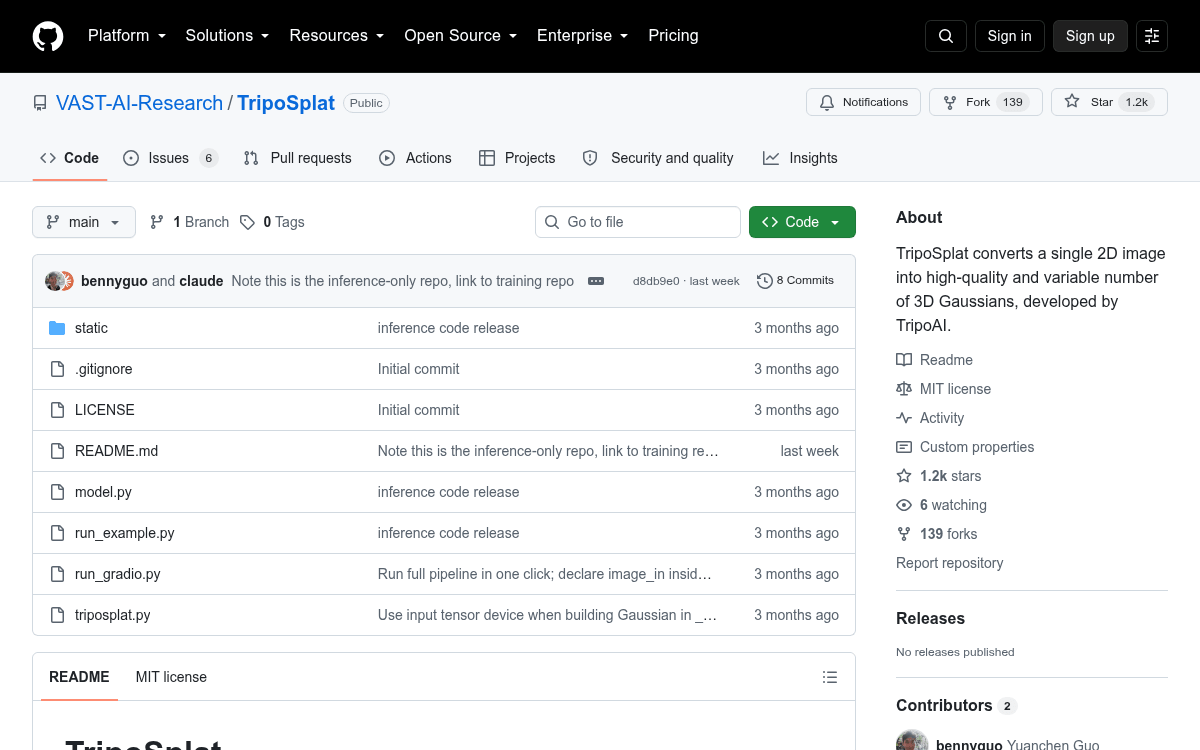
- VAST-AI open-sourced TripoSplat, single image to 3D Gaussian splats under MIT license
- Supports variable Gaussian count up to 262,144 chosen at inference time
- New Density-Sampled Gaussians (DeG) representation accepted to SIGGRAPH 2026
- Beats baselines by 140+ Elo points in a 32-participant human study
- Two files, ~2,000 LOC, no transformers or diffusers dependencies
- Official ComfyUI template, HuggingFace demo, and Gradio app included
Turning one photo into a rotatable 3D asset has been the demo-reel promise of image-to-3D for years, but most pipelines still lock you into a fixed number of primitives with dumb, uniform distribution. TripoSplat, just open-sourced by TripoAI and VAST AI Research, takes a different route: it learns where 3D Gaussians should actually go, and lets you dial the count from a few thousand up to 262,144 at inference time.
The repo is deliberately minimal. The core is two files, triposplat.py and model.py, totaling roughly 2,000 lines with near-zero dependencies. No transformers, no diffusers, no version-conflict hell, and it runs on any platform. Weights and code ship under MIT, so commercial use is on the table.
Why a variable Gaussian count matters
Existing feed-forward 3D Gaussian generators tend to bind their outputs to structural scaffolding: one Gaussian per input pixel, or one per voxel in a fixed grid. That works, but it caps how expressive the representation can get. Diffusion and flow-matching models rely on data of known, fixed lengths and highly vectorized computations, which makes traditional splitting and pruning operations awkward to apply during generative training. Current systems sidestep this by binding Gaussians to structural elements with predetermined dimensions, producing pixel-aligned or structure-aligned outputs. The lack of truly adaptive density control bottlenecks how much detail the generated scene can carry.
This story is for Pro members
You've reached the end of the free preview. Upgrade to AlphaSignal Pro to read the full article - and everything else behind the paywall.
Comments
