

Tianjin University's CSRA Cuts ICU Sepsis Prediction Error by 10% Without Bigger Models
A frequency-domain augmentation method reduces sepsis regression error by 10.2% MSE on MIMIC-IV, holding up under shorter observation windows and longer prediction horizons.
 PRO
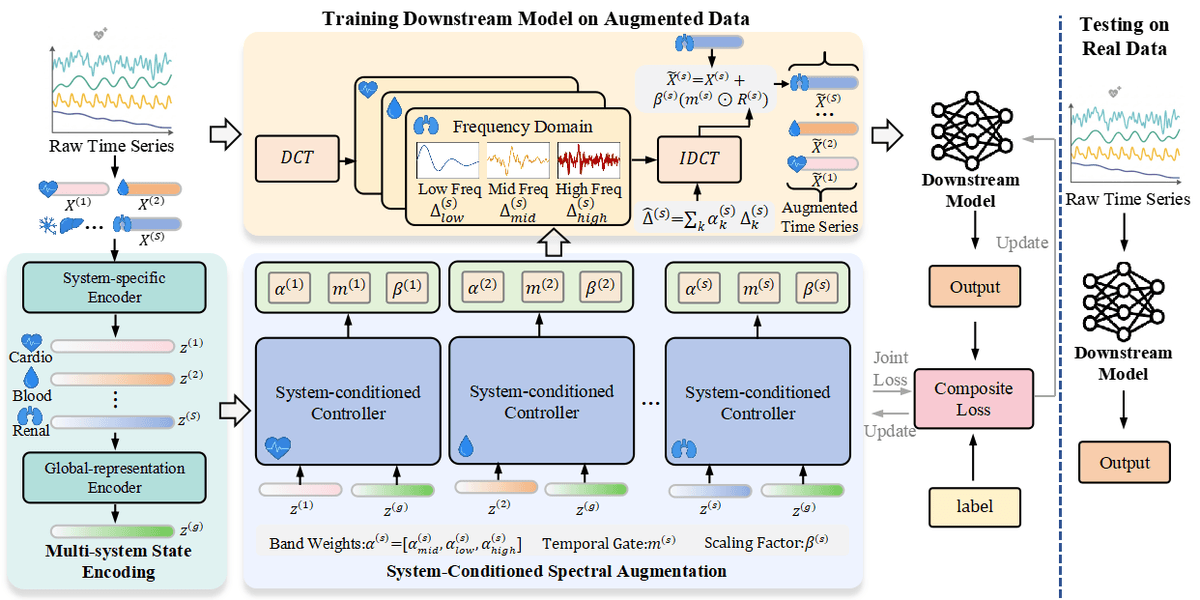
- CSRA is a frequency-domain augmentation framework for short-window ICU sepsis prediction on MIMIC-IV.
- Cuts regression MSE by 10.2% and MAE by 3.7% versus no-augmentation baseline across Linear, LSTM, Transformer backbones.
- Groups variables into 9 clinical systems, applies DCT-based residual perturbation over low, mid, and high frequency bands.
- Trained end-to-end with anchor consistency loss and controller regularization to keep augmentations clinically plausible.
- Holds up under shorter observation windows, longer prediction horizons, and training sets as small as 10%.
- Generalizes to external ZiGongICUinfection dataset; limitations include regular sampling assumption and predefined system partitions.
Predicting how a septic patient will deteriorate over the next several hours is one of the most consequential tasks in the ICU, and one of the most data-starved. A new method called CSRA tackles the problem by generating synthetic patient trajectories in the frequency domain, respecting the physiological structure of the underlying signals rather than scaling up model size. The paper, from a team at Tianjin University and collaborating Chinese hospitals, reports meaningful gains on MIMIC-IV sepsis cohorts and generalizes to a separate Chinese ICU dataset.
The scarcity trap in ICU forecasting
Short-window sepsis prediction is hard because brief observation windows provide limited historical evidence, while longer prediction horizons reduce the number of patient trajectories with valid future supervision. In practice this creates a squeeze from both directions: patients tend to arrive at the ICU only after symptoms become obvious, so early-stage observations are rare, and few trajectories run long enough to supervise multi-hour forecasts.

Generic time-series augmentation such as jittering, scaling, time warping, and contrastive views tends to fail here. ICU variables are tightly coupled across physiological systems, and unconstrained noise can produce trajectories that no real patient could exhibit. The authors argue for
This story is for Pro members
You've reached the end of the free preview. Upgrade to AlphaSignal Pro to read the full article - and everything else behind the paywall.
Comments
