

Thinking Machines Lab's Inkling Hits Databricks as a 975B Open-Weights Rival
Thinking Machines Lab's first open-weights model lands on Databricks with enterprise governance, coding agent integrations, and a 975B-parameter MoE architecture
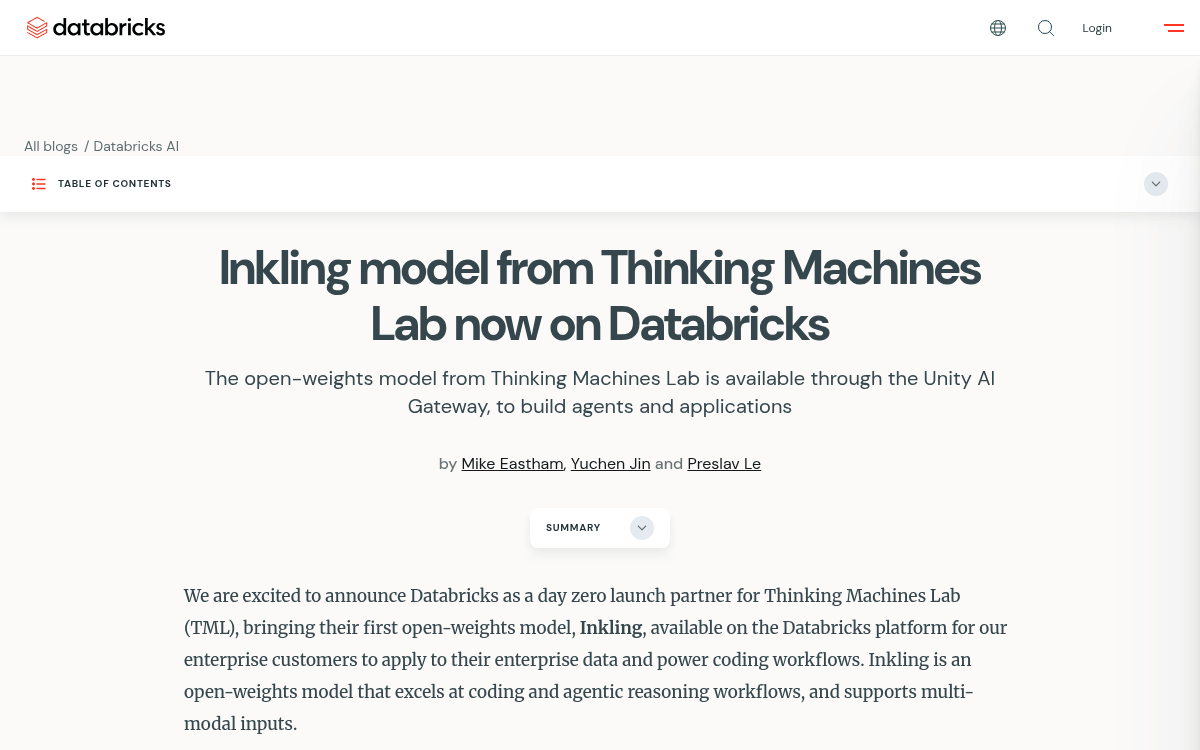
- Day-zero launch: Thinking Machines Lab's first open-weights model, Inkling, is now available on Databricks via Unity AI Gateway.
- Architecture: 975B total / 41B active parameter MoE transformer, pretrained on 45 trillion tokens of text, image, audio, and video.
- Top U.S. open-weights model: Scores 41 on the Artificial Analysis Intelligence Index, beating Nvidia Nemotron 3 Ultra (38) and leading on agentic benchmarks.
- Token efficient: Uses one-third the tokens of Nemotron 3 Ultra to match coding performance; priced at $1.87/M input tokens via Tinker API.
- Enterprise governance: Connects to Cursor and OpenCode through Unity AI Gateway with centralized security, cost controls, and audit logging.
- Open weights + Apache 2.0: Weights available on HuggingFace with a 1M token context window; fine-tunable via Tinker.
Inkling, the debut open-weights model from Mira Murati's Thinking Machines Lab, is now available on Databricks as a day-zero launch partner. The model ships through Databricks' Unity AI Gateway, giving enterprise teams a governed, customizable path to one of the most capable open-weights models to come out of a U.S. lab in years. For teams already living inside the Databricks ecosystem, this is a meaningful shortcut: no separate API keys to manage, no separate billing pipeline, and no data leaving your governed environment.
The model behind the announcement
Inkling is the first in-house AI model from Thinking Machines Lab, the startup founded by former OpenAI CTO Mira Murati. Unlike flagship models from OpenAI, Anthropic, or Google, it is open-weight, meaning companies can download and modify it directly. It is a Mixture-of-Experts (MoE) system with 975 billion total parameters, though it only draws on about 41 billion for any given task -- a design that keeps inference fast and cheap despite the enormous total parameter count.
The model was pretrained on 45 trillion tokens of text, images, audio, and video. It is also the first in a planned family: alongside it, Thinking Machines is sharing a preview of Inkling-Small, a lighter-weight model with 12B active parameters trained with a similar recipe.
Architecturally, Inkling is a 66-layer decoder-only transformer with a sparse Mixture-of-Experts feed-forward backbone, where each token is routed to 6 of 256 experts, plus 2 shared experts active on every token. That routing mechanism is what makes the 975B parameter count practical -- most of the network is idle for any given forward pass.
One standout design choice is controllable thinking effort. Inkling reasons natively over text, images, and audio, and balances cost with performance through efficient and controllable thinking effort. Teams can dial reasoning up or down depending on whether they need fast responses or deep chain-of-thought, without switching models.
Where it actually stands on benchmarks
Inkling debuts at 41 on the Artificial Analysis Intelligence Index, making it the leading open-weights release from a U.S. lab. It scores 3 points higher than the previous leading U.S. open-weights model, Nvidia's Nemotron 3 Ultra (38), and also beats Gemma 4 31B (29) and gpt-oss-120b (24).
On agentic benchmarks specifically, Inkling scores an Elo of 1238 on GDPval-AA v2, higher than Kimi K2.6 (1190) and DeepSeek v4 Flash max (1189), and scores 24% on the tau-cubed Banking benchmark, above both competitors. That agentic edge matters given the use case Databricks is pushing: coding agents and multi-step enterprise workflows.
Token efficiency is another headline number. On one benchmark, Inkling uses a third as many tokens as Nvidia's Nemotron 3 Ultra to hit the same coding performance. For enterprise teams paying per token, that gap compounds quickly at scale.
Pricing on the Tinker API runs at $1.87 per million input tokens and $4.68 per million output tokens at a 64K context window, scaling to $3.74 input / $9.36 output at 256K context. The open weights are available on HuggingFace under an Apache 2.0 license, so self-hosted deployments have no per-token cost at all.
What Databricks actually gives you
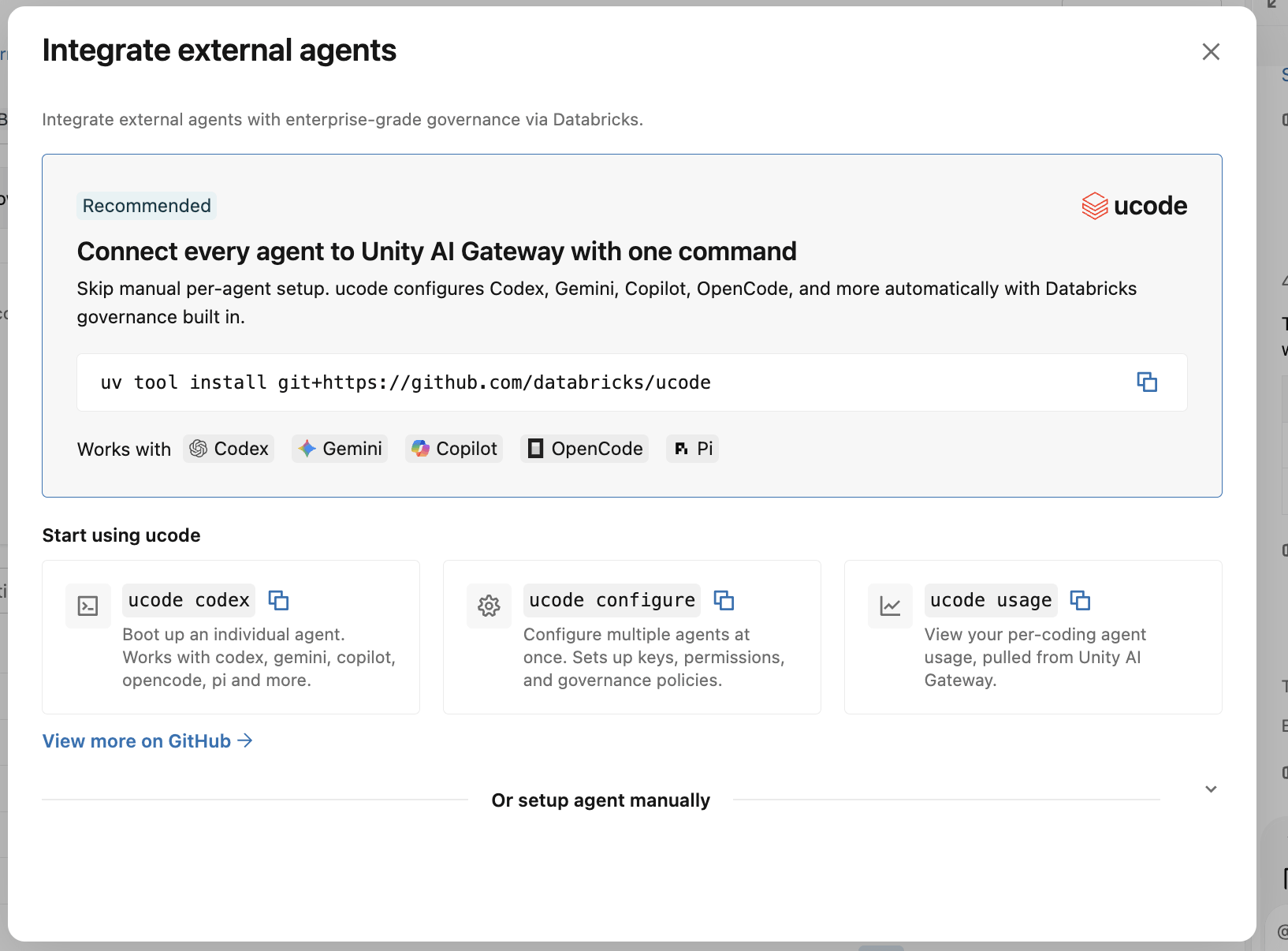
Inkling is available on the Databricks platform through Unity AI Gateway, making it easy to build and deploy AI agents and coding applications on enterprise data. Teams can build with an open-weights model optimized for coding, agentic reasoning, and multimodal inputs, while retaining flexibility to customize the model for their business. Governance comes through Unity AI Gateway's centralized security, permissions, cost controls, and observability, with connections to coding agents such as Cursor and OpenCode.
The practical workflow looks like this:
- AI Playground: Try Inkling interactively, adjust parameters, and export prompts directly into notebooks or SQL.
- Unity AI Gateway: Deploy a governed Inkling endpoint with built-in security, cost limits, and observability. Connect it to Cursor or OpenCode for IDE-level access.
- Agent Bricks: Build full agentic pipelines that analyze data, automate complex work, and deploy at scale.
- Foundation Model API: Full REST API access for programmatic integration.
Open-weight models like Inkling can be fine-tuned on proprietary codebases, internal documentation, and domain-specific data to achieve higher accuracy on specific tasks. Governance runs through Unity AI Gateway with the same security, permissions, audit logging, and policy enforcement that enterprises apply to all models on Databricks.
The bigger story: a comeback narrative
Thinking Machines Lab is an American AI startup founded by Mira Murati, the former CTO of OpenAI. The company was founded in February 2025, and by July had completed an early-stage funding round led by Andreessen Horowitz, raising $2 billion at a valuation of $12 billion from investors including Nvidia, AMD, Cisco, and Jane Street.
The road to Inkling was not smooth. The founding team included Barret Zoph, former OpenAI VP of Research, Lilian Weng, former OpenAI VP, and OpenAI co-founder John Schulman. By January 2026, Zoph and Luke Metz had departed the startup to return to OpenAI. A planned $50 billion fundraising round also collapsed without closing. Inkling is the first concrete proof that the lab survived that turbulence and shipped something real.
Media outlets have described Inkling as an American alternative to existing open-weights models, noting that the most competitive open-weights models at the time were largely developed by Chinese AI firms. That framing is not incidental -- it is part of TML's pitch to enterprise buyers who want a capable open model without supply-chain concerns tied to foreign labs.
Thinking Machines is explicit that Inkling is not the strongest overall model available today, open or closed. Instead, a combination of qualities makes it a good open-weights base for customization: multimodal capabilities, efficient thinking, and availability on Tinker for fine-tuning. That honesty is itself a positioning move -- it signals the lab is not chasing benchmark leaderboards but building infrastructure for customization.
Who wins from this
The Databricks partnership is a distribution play as much as a technical one. Databricks sits at the center of enterprise data infrastructure for thousands of companies. Dropping Inkling directly into that ecosystem -- governed, observable, and connected to coding agents out of the box -- removes the biggest friction points that slow open-model adoption in regulated industries.
Rather than claiming to have built the world's most capable model, Thinking Machines is positioning Inkling as a customizable foundation for companies, researchers, and developers that want greater control over how their AI behaves. Its weights can be downloaded through Hugging Face under an Apache 2.0 license, while the model can also be fine-tuned through Thinking Machines' Tinker training platform.
For teams evaluating whether to adopt Inkling, the key questions are practical: Does your workload skew toward coding and agentic tasks? Do you need multimodal inputs including audio? Are you already on Databricks? If the answer to all three is yes, Inkling is worth a serious look. The token efficiency numbers alone could justify the switch from heavier alternatives, and the Apache 2.0 license means you can take the weights anywhere if your needs evolve.
Comments
