

Tencent's WorldClaw Builds Editable 3D Open Worlds From a Single Text Prompt
Tencent's WorldClaw uses an LLM agent pipeline to turn a text prompt into a fully editable, game-ready 3D open world — no video, no Gaussian splatting.
- WorldClaw is Tencent Hunyuan's agentic framework that generates large-scale, freely explorable 3D open worlds from a single text prompt.
- Every output is composed of independent, editable textured meshes — not video, not Gaussian splats — making scenes game-engine ready.
- The pipeline has three stages: intent analysis, global terrain generation, and regional object placement, all orchestrated by Claude Opus 4.8 as the agent backbone.
- It uses GPT-Image-2, SAM3D, and Hunyuan3D as specialist tools, running inside Blender 5.1.1 on 4 NVIDIA H20 GPUs.
- Key limitations: quality is tightly coupled to frontier model access, and LLM-generated code for terrain construction can produce scale/placement errors.
- The
WorldClaw is Tencent Hunyuan's latest push into AI-generated 3D content, and it takes a fundamentally different approach from everything that came before it. The team introduces WorldClaw as an agentic framework for generating large-scale, explicit, and editable 3D open-worlds from open-ended text prompts. The key word here is explicit: every tree, rock, and building is a real, independently editable mesh , not a baked video, not a cloud of Gaussian splats (a popular but hard-to-edit 3D representation technique), and not a panoramic illusion.
Generating large-scale, freely explorable 3D worlds from open-ended text remains challenging because a system must jointly maintain global spatial coherence, rich local content, and explicit assets suitable for downstream editing and reuse. WorldClaw's answer to that challenge is an agentic workflow , a chain of AI agents that each handle a different layer of the problem, from high-level planning down to per-object geometry refinement.
One prompt, three stages
WorldClaw employs a coarse-to-fine, global-to-regional agentic framework with three stages: Intent Analysis and Planning, Global Terrain Generation, and Regional Object Generation and Placement. Think of it as a tiny automated game studio: one agent reads the brief, another builds the landscape, and a third populates it with props.
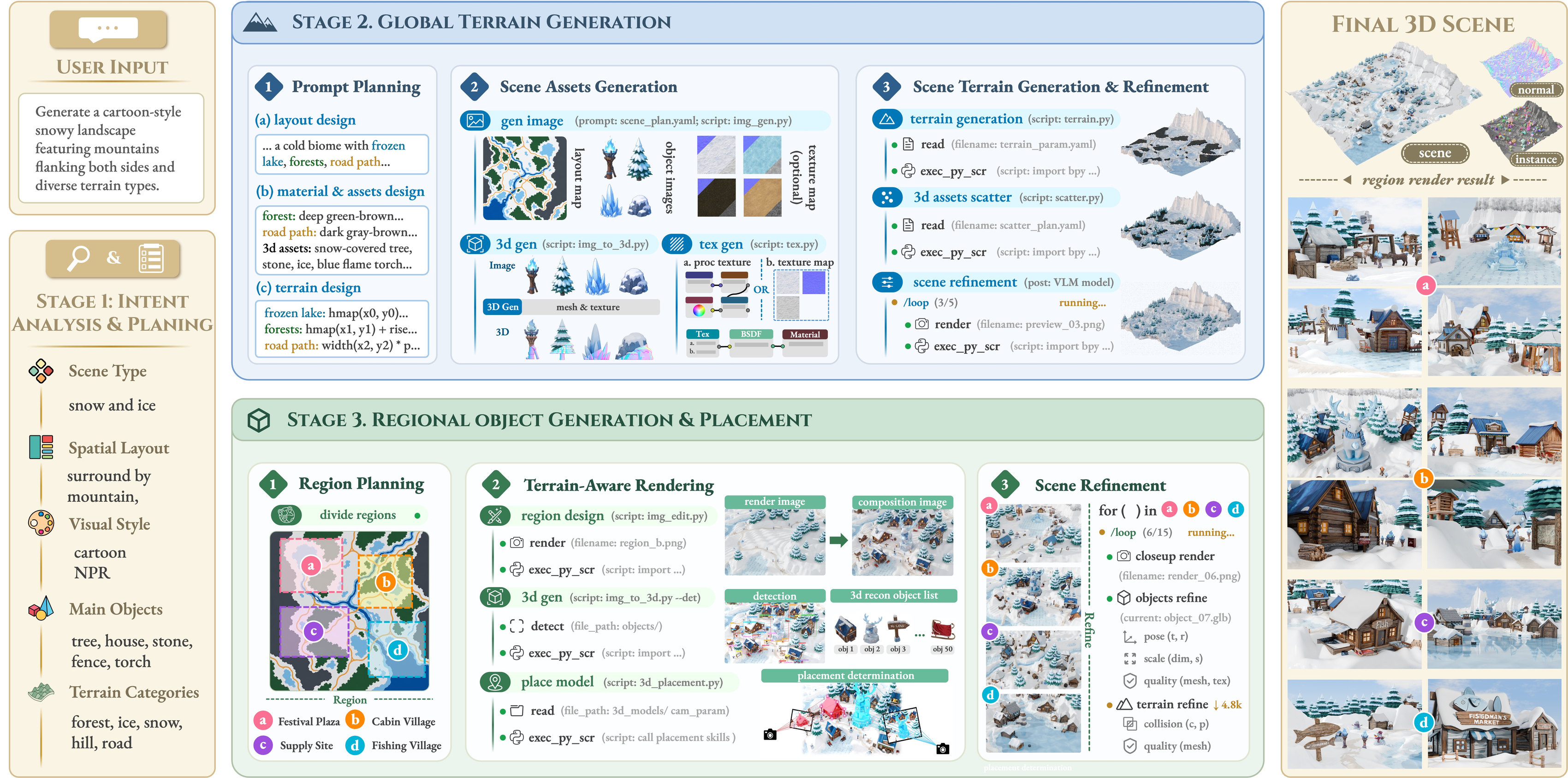
- Stage 1 , Intent Analysis: Planning agents translate a text prompt into a structured specification of regions, terrain, assets, materials, and spatial relations.
- Stage 2 , Global Terrain: A semantic-layout-guided procedural terrain generator creates controllable landforms and asset scattering based on region-aware plans.
- Stage 3 , Regional Detail: For detail-demanding regions, it generates terrain-conditioned compositions, reconstructs editable textured meshes, and recovers their placement on the terrain; render-based agents further refine terrain, objects, appearance, and contacts.
An iterative agentic refinement loop, connected to a 3D renderer, continually improves terrain and object quality, corrects scales and poses, and resolves object-terrain contact issues. That last part , automatically fixing a floating tree or a building clipping into a hillside , is the kind of tedious work that would eat hours in a manual pipeline.
The model stack underneath
WorldClaw is not a single model. It is an orchestration layer on top of several powerful foundation models. WorldClaw uses Claude Opus 4.8 as the underlying agent model, and the team developed a set of task-specific agent skills that extend it with pretrained foundation models including GPT-Image-2, SAM3, SAM3D, and Hunyuan3D, plus executable 3D tools required for scene generation. All experiments are run on a server equipped with 4 NVIDIA H20 GPUs, and terrain generation, object generation and placement, scene refinement, and image rendering are all conducted in Blender 5.1.1.

The choice to run everything through Blender is notable: it means the output is already inside a production-grade 3D environment, not a proprietary format you need to convert. The final 3D scenes can be exported into standard formats compatible with popular simulation and rendering engines like Unity and Unreal Engine, and these meshes can then be further edited, animated, or integrated into real-time applications.
What it can actually generate
The paper showcases four representative worlds generated from open-ended prompts: a tropical pirate island, a river canyon with tribal settlements, a desert battlefield, and a snow-covered mountain valley with futuristic facilities , spanning different terrain structures, scene scales, content densities, and visual styles.
Across diverse open-world prompts, WorldClaw produces large-scale scenes with coherent spatial organization, visually compelling local content, and editable instance-level assets while preserving a consistent global terrain structure. That combination , global coherence and per-object editability , is what prior systems consistently failed to deliver together.
Where it still struggles
The paper is refreshingly honest about the current limitations. There are two main failure modes to be aware of:
- Model dependency: Open-source image generation models frequently failed to produce usable semantic layout maps or to preserve object appearance and pose. The visual quality of the final scene is also directly bounded by the 3D generation backbone, and fully validating this decoupled pipeline at the current stage still requires capable models such as Claude Opus 4.8, GPT-Image-2, and Hunyuan3D. In other words, swap in weaker models and quality drops fast.
- Code generation instability: Several stages rely on LLM-generated programs for terrain construction, procedural material generation, asset placement, and local refinement. Consistently translating high-level natural-language requirements into concrete programs remains difficult, and errors in scale estimation, numerical parameters, or node connectivity directly manifest in the resulting 3D scene as inconsistent landforms or inaccurate material effects.
The bigger picture
WorldClaw sits at the intersection of two trends that have been converging for a while: agentic AI workflows and 3D content generation. Multimodal LLM agents leverage world knowledge for intent understanding, spatial planning, tool orchestration, and render-based refinement, enabling natural-language instructions to drive executable scene-construction pipelines. WorldClaw is one of the most complete implementations of that idea applied to 3D worlds.
The context within Tencent's own ecosystem matters too. Tencent released Hunyuan3D 2.1, a production-ready 3D asset generation model, which WorldClaw builds on for per-object mesh generation. The Hunyuan3D family has been iterating rapidly, and WorldClaw represents the first time those per-object capabilities have been assembled into a full world-scale pipeline.
Who should pay attention
The practical use cases are clearest in a few areas:
- Game development prototyping: Rapidly generate explorable level layouts from a brief description, then hand-edit the meshes in Blender or Unreal.
- Simulation environments: The method enables versatile applications in virtual reality, physical simulation, game development, and interactive content creation.
- Pre-visualization: Film and XR teams can spin up a navigable world from a script note to validate spatial storytelling before committing to production assets.
- Procedural content pipelines: The structured, region-aware output is well-suited for integration into existing PCG (procedural content generation) tools.
The paper is available on arXiv. The project page hosts video walkthroughs of generated worlds. As of now, WorldClaw is presented as a research system , the pipeline requires access to frontier models like Claude Opus 4.8 and GPT-Image-2, so it is not a one-click tool you can run locally today. But the architecture is modular enough that as open-source alternatives to those components improve, the dependency on closed APIs should shrink.
Comments
