
Tencent's WeKnora Turns Scattered Documents Into a Self-Updating Wiki
Tencent open-sources WeKnora, a Go-based platform that turns raw documents into a RAG pipeline, an agentic reasoner, and a self-maintaining Wiki — all self-hostable.
 Pro
Takeaways
- What: Tencent open-sourced WeKnora, a Go-based platform combining RAG Q&A, a ReAct reasoning agent, and an auto-generating Wiki mode.
- Wiki Mode: Agents automatically read raw documents and generate structured, cross-linked Markdown wikis with a visual knowledge graph — and keep them updated.
- Integrations: Supports 20+ LLMs (OpenAI, Claude, DeepSeek, Ollama), 7 vector DBs, and IM channels including Slack, Telegram, WeCom, and WeChat.
- Enterprise-ready: Ships with 4-tier multi-tenant RBAC, AES-256-GCM credential encryption, per-tenant audit logs, and full Langfuse observability.
- Deployment: Self-hostable via Docker Compose or Helm; also available as WeKnora Cloud. Free under MIT license.
- Traction: 15,500+ GitHub stars, 2,000+ forks, and used as the core engine for Tencent's WeChat Dialog Open Platform.
WeKnora is Tencent's open-source answer to a problem every engineering team eventually hits: you have documents everywhere , PDFs, Notion pages, Feishu wikis, Word files , and no good way to query them, reason over them, or keep them organized. Rather than building yet another chatbot wrapper, WeKnora ships three distinct modes in a single self-hostable platform: a fast RAG Q&A layer, a ReAct reasoning agent, and an auto-generating Wiki engine. It has crossed 15,500 GitHub stars and 2,000 forks, signaling serious traction in the enterprise tooling space.
Three Modes, One Platform
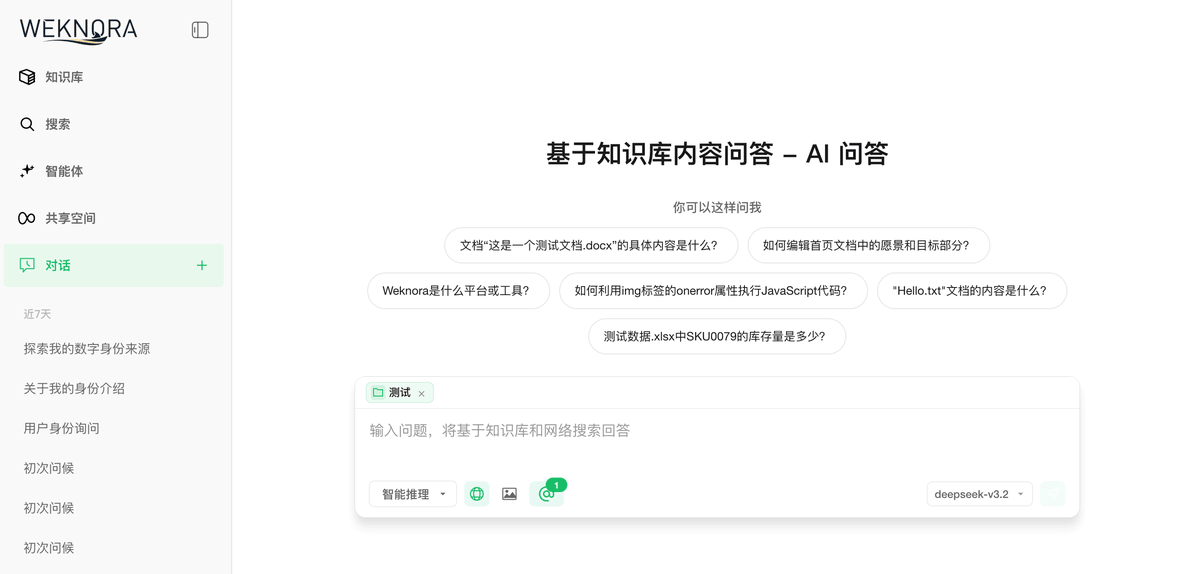
WeKnora is organized around three core capabilities: RAG-based Quick Q&A for everyday lookups, a ReAct Agent that autonomously orchestrates retrieval, MCP tools and web search to handle complex multi-step tasks, and a Wiki Mode in which agents distill raw documents into a self-maintaining, interlinked markdown knowledge base with an interactive knowledge graph. Each mode serves a different use case, and you can run all three simultaneously against the same knowledge base.
The ReAct agent (short for Reason + Act) is the most powerful of the three. It doesn't just retrieve chunks and stuff them into a prompt , it plans, calls tools, searches the web, and iterates until it has a complete answer. The whole pipeline is instrumented with Langfuse for ReAct loops, token tracking, tool calls, and pipeline tracing. That means you can actually debug what the agent did, step by step, without guessing.

The Wiki Mode Is the Real Surprise
Most RAG tools stop at retrieval. WeKnora's Wiki Mode goes further: it uses an agent to read your raw documents and generate a structured, cross-linked Markdown wiki from them automatically. The wiki isn't static , it updates as your documents change, and it comes with a visual knowledge graph showing how concepts relate to each other. Agents distill raw documents into a self-maintaining, interlinked markdown knowledge base with an interactive knowledge graph.
This is a meaningful shift from the standard RAG pattern. Instead of always querying raw source chunks, you end up with a curated, human-readable knowledge layer that the agent keeps fresh. Think of it as the difference between a filing cabinet and a living encyclopedia.

What's Under the Hood
WeKnora integrates multimodal preprocessing, semantic vector indexing, intelligent retrieval, and large model generation reasoning. Its multi-modal cognitive engine can accurately parse mixed text and image content in PDFs, Word documents, and images, extracting text, tables, and image semantic information using OCR with cross-modal modeling.
The retrieval layer is notably flexible. Rather than picking one strategy, WeKnora supports all three simultaneously and lets you tune the blend:
- BM25 sparse search , classic keyword matching, fast and reliable for exact terms
- Dense vector search , semantic similarity via embeddings, good for paraphrased queries
- GraphRAG , graph-based retrieval that follows entity relationships across documents, useful for multi-hop questions
- Parent-child chunking , retrieves fine-grained chunks but returns their broader context to the LLM
The modular RAG pipeline design supports free combination of retrieval strategies, large language models, and vector databases, seamlessly integrating with platforms like Ollama, flexibly switching mainstream models such as Qwen and DeepSeek.
An Unusually Wide Integration Surface
One of WeKnora's strongest practical arguments is how many things it already connects to out of the box. The LLM support alone covers more than 20 providers:
- LLMs: OpenAI, Azure OpenAI, Anthropic (Claude), DeepSeek, Qwen, Zhipu, Hunyuan, Gemini, MiniMax, NVIDIA, Ollama, and more
- Vector DBs: PostgreSQL (pgvector), Elasticsearch, Milvus, Weaviate, Qdrant, Apache Doris, Tencent VectorDB
- Data sources: Feishu, Notion, Yuque (with auto-sync)
- IM channels: WeCom, Feishu, Slack, Telegram, DingTalk, Mattermost, WeChat
- Document formats: PDF, Word, Markdown, HTML, images (with OCR), CSV, Excel, PPT, JSON
WeKnora serves as the core technology framework for the WeChat Dialog Open Platform, enabling zero-code deployment for intelligent Q&A services within the WeChat ecosystem. That's a meaningful signal , this isn't just a research demo; it's production infrastructure that Tencent itself runs at scale.
Enterprise-Grade From Day One
Most open-source RAG tools are single-user or single-tenant by default, leaving teams to bolt on access control themselves. WeKnora ships with a full multi-tenant RBAC system: a 4-tier role matrix (Owner / Admin / Contributor / Viewer), per-KB resource ownership, per-tenant audit log, invite-only workspaces, self-service tenant creation, and cross-tenant superuser access. Credentials are encrypted with AES-256-GCM at rest, and the document reader communicates over gRPC with TLS.
The v0.6.0 release, the current latest, also added a weknora CLI with mcp serve support, KB retrieval fan-out across multiple vector stores, and Go 1.26.0. The CLI follows a <noun> <verb> pattern familiar from tools like gh:
weknora auth login --host https://kb.example.com
weknora kb list
weknora doc upload notes.md
weknora chat "summarise the design doc"
Getting Started
The fastest path to a running instance is Docker Compose. The core stack spins up with three commands:
git clone https://github.com/Tencent/WeKnora.git
cd WeKnora
cp .env.example .env
docker compose up -d
Optional profiles let you add Neo4j for the knowledge graph, MinIO for object storage, or Langfuse for tracing , each as a single flag. The platform is fully self-hostable with a modular architecture, supporting local and private cloud deployment for complete data sovereignty. For teams that don't want to manage infrastructure, there's also a hosted WeKnora Cloud option with managed LLM parsing.
Where It Fits (and Where It Doesn't)
WeKnora is well-suited for teams that need more than a simple chatbot over documents. The sweet spots are:
- Internal knowledge bases that need to stay current as source documents change
- Multi-team environments where RBAC and tenant isolation actually matter
- Workflows where the agent needs to combine document retrieval with live web search or external tools via MCP
- Organizations already in the WeChat / WeCom ecosystem looking for native IM integration
The tradeoffs are worth naming too. The project focuses on solving real enterprise document processing pain points rather than being a minimalist library , which means the full stack is substantial. Teams wanting a lightweight Python library to drop into an existing pipeline will find WeKnora over-engineered for that use case. The Go backend also means contributing to the core requires Go familiarity, though the REST API and CLI make integration language-agnostic. With 254 open issues and active development, some rough edges are expected.
The broader context here matters: WeKnora enters a crowded field alongside Dify, Ragflow, and Anything LLM. What sets it apart is the combination of the auto-Wiki mode, the depth of its IM channel integrations (especially for Asian enterprise ecosystems), and the fact that it's battle-tested as the backbone of WeChat's Dialog Open Platform. The MIT license and active release cadence , 32 releases since launch , make it a credible long-term bet for teams building internal knowledge infrastructure.